Imagine walking through your garden, seeing lush green leaves and healthy fruit developing — all without spending a single dollar on synthetic fertilizers or worrying about chemical residues on your food. Safe Ways to Brew Compost and Weed Teas Now imagine that the secret to this vitality has been sitting in your compost pile or growing wild along the fence line the entire time.
Many gardeners and small-scale farmers are turning to compost tea and weed tea as powerful, free, organic alternatives to bottled fertilizers. These liquid extracts can deliver nutrients, stimulate soil biology, and even help plants resist stress and disease — but only when made correctly.
Unfortunately, search “how to make compost tea” or “weed tea recipe” and you’ll quickly find dozens of methods — some of which can actually harm your plants, introduce pathogens, or create foul-smelling anaerobic soups that damage soil life rather than feed it.
Safe ways to brew compost and weed teas are not about shortcuts or “let it sit forever” folk recipes. They are about understanding microbiology, oxygen dynamics, dilution ratios, and proper timing so that you feed your plants and soil biology instead of stressing or poisoning them.
In this in-depth guide you will find:
- The real differences between compost tea and weed tea
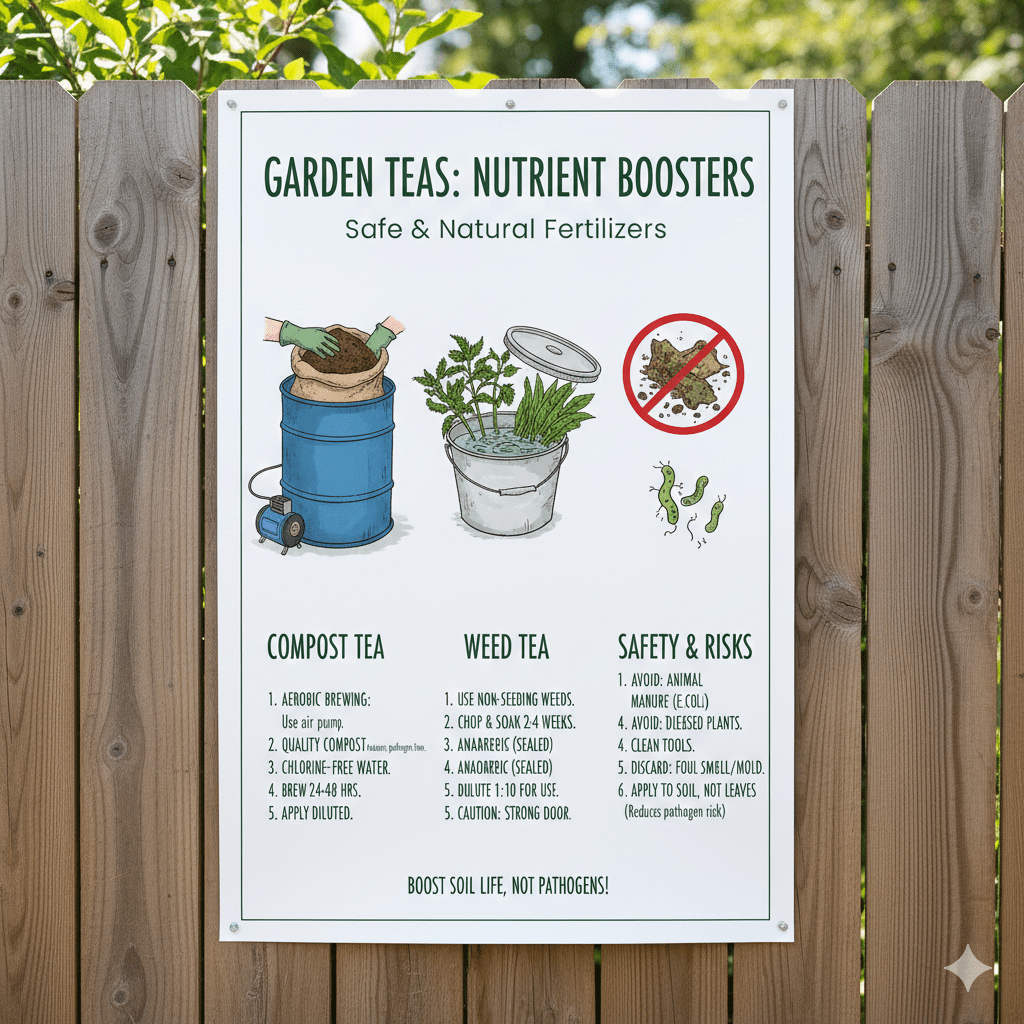
- The non-negotiable safety rules every gardener should follow
- Three proven, low-risk brewing methods ranked by safety and ease
- Step-by-step instructions with exact ratios, timing, and checkpoints
- How to recognize when a brew has gone wrong (and why you must throw it away)
- Realistic application guidelines that actually produce noticeable results
- Answers to the most common questions and misconceptions in 2025
Whether you are a backyard gardener growing tomatoes and herbs, a market gardener trying to reduce input costs, or a regenerative farmer focused on soil health, this article will give you reliable, science-informed methods to make liquid plant feeds you can trust.
Let’s start by clearing up exactly what these two preparations are — and why “safe” must come before “strong.”
Understanding Compost Tea vs. Weed Tea — What’s the Difference and Why Safety Matters
What Is Compost Tea?
Compost tea is a water extract of finished compost. Its primary value is not as a high-powered NPK fertilizer, but as:
- A liquid inoculant of beneficial bacteria, fungi, protozoa, and (in some cases) nematodes
- A mild source of soluble nutrients
- A delivery system for humic and fulvic acids that improve nutrient uptake
There are two main categories:
- Actively Aerated Compost Tea (AACT) — brewed with constant oxygen supply (air pump + airstones) for 18–36 hours
- Non-aerated compost extract / simple compost tea — steeped without forced aeration for a short period (usually 24–48 hours maximum)
What Is Weed Tea (Plant-Based Fermented Fertilizer)?
Weed tea (sometimes called plant tea or fermented plant extract) is made by fermenting fresh or wilted green plant material — usually nutrient-accumulating “weeds” — in water.
The main purpose is to extract and solubilize nutrients (especially potassium, magnesium, calcium, silica, and trace elements) that deep-rooted dynamic accumulator plants have pulled from the subsoil.
Unlike compost tea, weed tea is primarily nutrient-focused rather than microbe-focused, although fermentation does produce some beneficial microorganisms and organic acids.
Key Safety Concerns You Must Know Before Brewing
Poorly made teas can become dangerous or damaging in several ways:
- Human pathogen amplification If starting compost contains fresh manure or has not reached sustained thermophilic temperatures (≥55 °C / 131 °F), brewing can allow E. coli, Salmonella, or Listeria to multiply — especially in low-oxygen conditions.
- Anaerobic fermentation byproducts When oxygen runs out, anaerobic bacteria and yeasts produce alcohols, organic acids, ammonia, and hydrogen sulfide — compounds that can burn roots, inhibit beneficial microbes, or create phytotoxins.
- Nutrient burn from over-concentration Undiluted or poorly diluted teas can easily cause salt stress or nutrient imbalance.
- Foliar damage Applying strong tea in direct sunlight or using tea with high ammonia content can scorch leaves.
University extension services (Cornell, Oregon State, Washington State) and the USDA have repeatedly warned that improperly made compost teas can increase rather than decrease food safety risks on edible crops. That is why safety-first brewing is non-negotiable.
Essential Safety Rules — Non-Negotiable Best Practices
Before you brew anything, commit to these rules:
- Use only fully finished, mature compost that has completed hot composting (internal temperature stayed above 55 °C for several days) and then cured for at least 2–3 months.
- Never use fresh manure, chicken litter, or compost of unknown history.
- Always use dechlorinated water — let municipal tap water sit uncovered for 24 hours, use collected rainwater, or add a dechlorinator.
- Clean all buckets, pumps, and tools with hot soapy water between batches.
- Perform the smell test religiously: good tea smells earthy, like forest soil or mushrooms. Foul, rotten, or sewage-like = discard immediately.
- Dilute generously — most experts recommend 1:10 to 1:20 (tea:water) for soil applications and 1:30–1:50 for foliar sprays.
- Apply in the early morning or late afternoon/evening — never in the middle of a hot, sunny day on foliage.
- Do a test patch on a few plants or a small section of soil first, especially when using on edible crops or young seedlings.
- Use the tea within hours of finishing (especially AACT) — do not store for days.
Following these rules dramatically reduces risk and increases the chance of positive results.
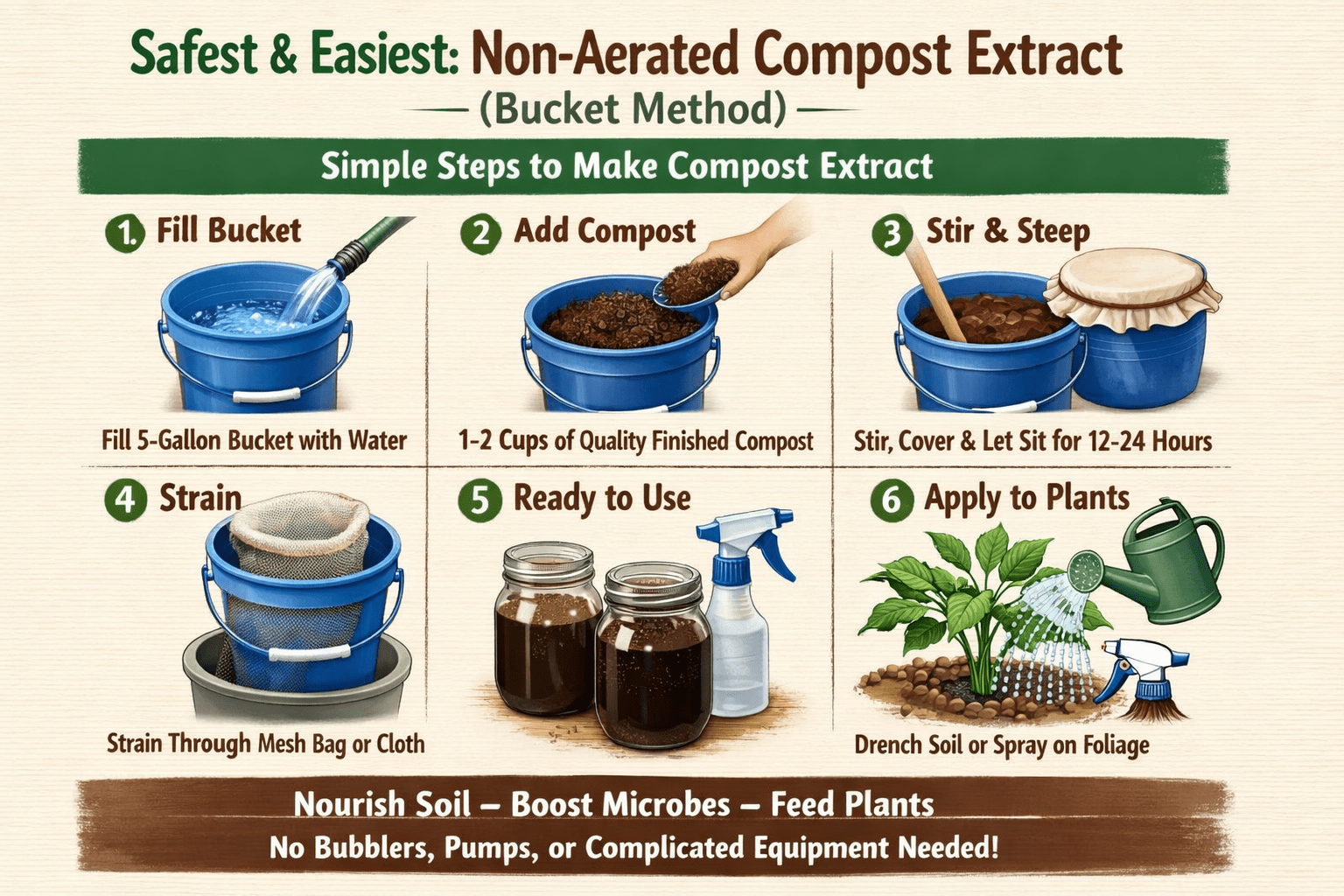
Method 1 — Safest & Easiest: Non-Aerated Compost Extract (Bucket Method)
This is the method most beginners should start with — and many experienced organic growers continue using it for its simplicity and safety profile.
Why choose this method?
- Minimal risk of pathogen amplification when using high-quality compost
- No electricity or air pumps required
- Very low chance of shifting anaerobic if time is controlled
- Produces a gentle microbial and nutrient extract
Materials needed
- 5–20 gallon food-grade bucket with lid
- Mature, finished compost (sifted if possible)
- Dechlorinated water
- Fine mesh bag, old pillowcase, or paint strainer bag
- Stirring stick
Step-by-step instructions safe ways to brew compost and weed teas
- Fill the bucket with dechlorinated water (leave 20–25% headspace).
- Place finished compost in the mesh bag — use a ratio of 1 part compost : 10–20 parts water by volume. Example: 1 gallon of compost in 10–20 gallons of water.
- Submerge the bag completely and secure the lid loosely (allow gas escape).
- Let steep in a shaded spot for 24–36 hours maximum — stir gently 1–2 times per day.
- After steeping, lift out the bag and let it drain back into the bucket.
- Dilute before use:
- Soil drench: 1:10–1:20
- Foliar: 1:30–1:50
- Use immediately or within 24 hours (keep in shade).
Best uses
- Watering in transplants
- General soil drench during active growth
- Reviving stressed plants
This method is intentionally conservative — it prioritizes safety and consistency over maximum microbial numbers.
Method 2 — Safest Weed Tea (Plant-Based Fermented Extract)
Weed tea is one of the oldest and most cost-effective ways to recycle nutrients from plants that would otherwise be considered “waste.” When made safely and used correctly, it becomes a surprisingly potent source of potassium, trace minerals, and organic acids that many fruiting and flowering crops respond to very well.
Why weed tea is different from compost tea While compost tea is mainly a microbial inoculant with modest soluble nutrients, weed tea is primarily a nutrient extraction tool. The fermentation process breaks down plant cell walls and releases locked-up minerals, especially potassium (K), calcium, magnesium, silica, and micronutrients that dynamic accumulator plants are famous for gathering.
Safe weeds to use (top nutrient accumulators)
- Comfrey (Symphytum officinale) — extremely high in potassium and allantoin
- Stinging nettle (Urtica dioica) — rich in nitrogen, iron, magnesium, silica
- Dandelion (Taraxacum officinale) — good all-rounder, high in potassium and calcium
- Borage (Borago officinalis) — high potassium + trace minerals
- Chickweed (Stellaria media) — mild, nutrient-dense, safe for beginners
- Lamb’s quarters (Chenopodium album) — high in many minerals
- Horsetail (Equisetum arvense) — exceptionally high silica (use sparingly)
Weeds and plants to avoid
- Anything that is toxic (e.g., jimsonweed, nightshades in large quantity, foxglove)
- Seedy weeds that could spread viable seeds through your garden
- Plants recently treated with herbicides or pesticides
- Very woody or tough materials that won’t break down well
Step-by-step safe weed tea recipe
Materials needed
- 5–20 gallon food-grade bucket with lid
- Fresh or slightly wilted weed material
- Dechlorinated water
- Sturdy stick or paddle for stirring
- Fine mesh strainer, old pillowcase, or burlap sack
Instructions
- Harvest weeds on a dry morning (avoid collecting after heavy rain when they’re waterlogged).
- Roughly chop the material to increase surface area (do not pulverize into a fine mush).
- Fill the bucket approximately 1/3 full with chopped weeds (roughly 1 part plant material to 5–10 parts water by volume).
- Example: 5–7 kg of fresh nettles + comfrey in a 60-liter barrel ≈ 40–50 liters of water.
- Pour in dechlorinated water until the bucket is nearly full (leave 10–15% headspace for foam and gas).
- Stir thoroughly to submerge all plant matter.
- Cover loosely with the lid (do not seal airtight — gases must escape).
- Place in a shaded spot (direct sun accelerates bad odors and anaerobic shift).
- Stir vigorously once or twice daily for the first week.
- Fermentation time: 7–14 days depending on temperature
- Warm weather (25–32°C): usually 7–10 days
- Cooler weather (<20°C): 12–18 days
- Readiness signs:
- Bubbles slow down or stop
- Strong initial “green manure” smell mellows to a less offensive earthy/fermented odor
- Liquid darkens to deep brown or tea-like color
- Strain through mesh or cloth, pressing solids to extract liquid.
- Dilute heavily before use:
- Soil drench: 1:10 to 1:20
- Foliar feed: 1:20 to 1:50
- Use within 1–2 days for best results.
Pro tip Many experienced growers add a small shovelful (≈5–10%) of finished mature compost to the bucket during the first few days. This introduces beneficial microbes early, helping to steer the fermentation toward a more balanced, less putrid outcome.
Best uses for weed tea
- Potassium boost during fruit set and flowering (tomatoes, peppers, squash, cucumbers, roses)
- General tonic for fruit trees and berry bushes
- Mid-to-late season foliar feed on vegetables
Method 3 — Advanced but Safe: Actively Aerated Compost Tea (AACT)
This is the method most often promoted by soil food web advocates and regenerative growers when the goal is maximum beneficial microbial diversity rather than just soluble nutrients.
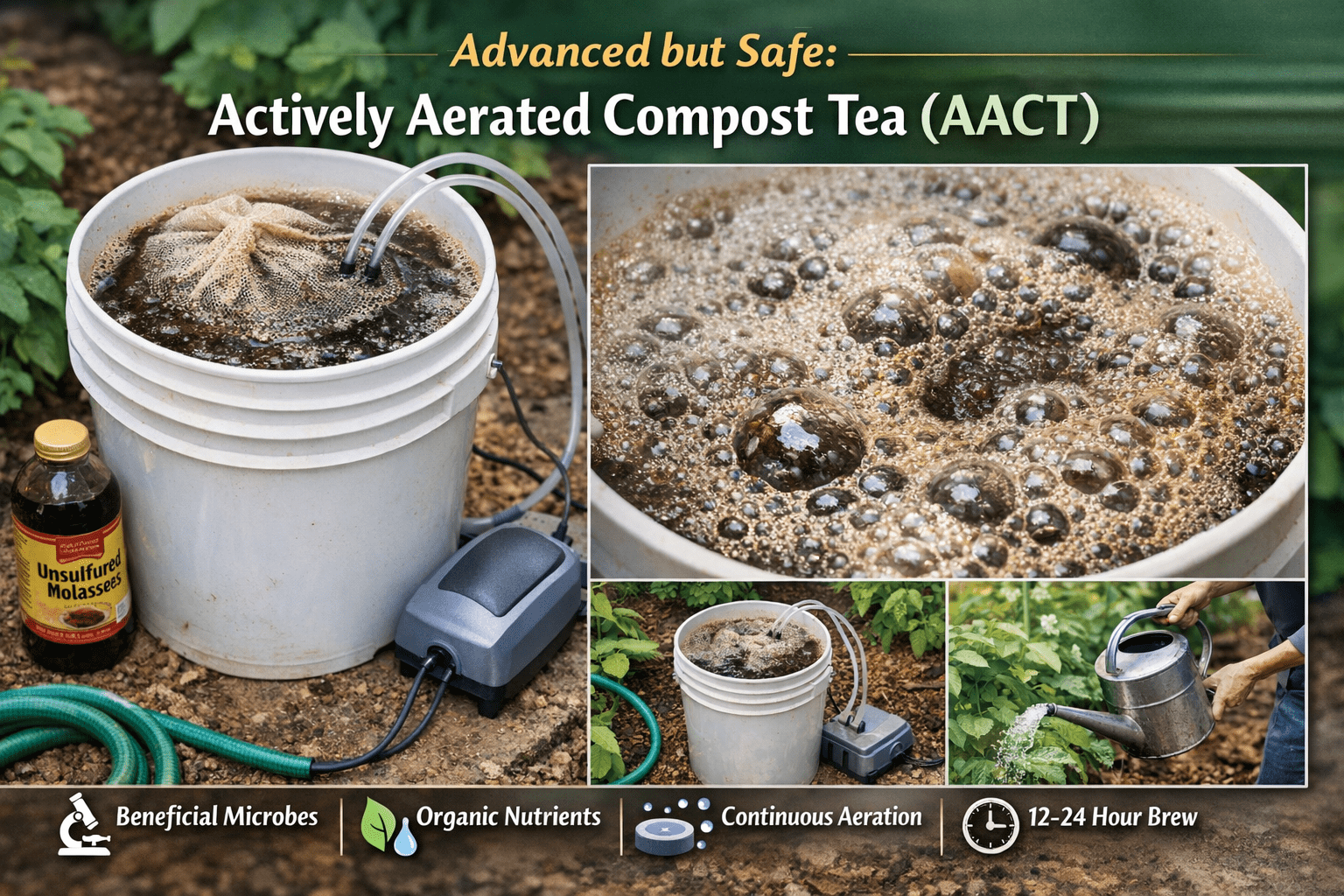
Important 2025 reality check While AACT can produce very high populations of beneficial bacteria and fungi when done correctly, it also carries the highest risk of going wrong if oxygen supply fails or poor compost is used. That is why we classify it as advanced — not beginner — and emphasize strict protocols.
Why some experts still prefer AACT (when done right)
- Can dramatically increase bacterial and fungal numbers in a short time Safe Ways to Brew Compost and Weed Teas
- May help suppress certain foliar diseases (powdery mildew, early blight) via competitive exclusion
- Delivers living microbes directly to leaf surfaces and root zones
Equipment needed
- 5–15 gallon food-grade bucket
- Powerful aquarium air pump (rated for at least 2× the bucket volume)
- 1–4 airstones (weighted or disc-style)
- Airline tubing and check valve (prevents backflow)
- Optional: dissolved oxygen meter (very helpful for learning)
- Fine mesh compost bag or paint strainer bag
- Dechlorinated water
Step-by-step safe AACT brewing process
- Fill bucket with dechlorinated water (60–80% full).
- Attach airstones to tubing, place in bucket, and start the pump before adding anything else.
- Add finished, high-quality compost to mesh bag. Safe ratio: 1:20 to 1:50 (compost to water by volume) Example: 1–2 liters of sifted compost in 50 liters of water.
- Optional microbial food (use very sparingly):
- Unsulfured molasses: 0.05–0.1% of total volume (≈5–10 ml per 50 L)
- Kelp extract or humic/fulvic acid: follow product label (usually very small amounts) Too much food = bacterial bloom → oxygen crash → anaerobic failure.
- Submerge the compost bag completely and secure.
- Aerate continuously for 18–36 hours maximum (most growers target 24–30 h).
- Monitor checkpoints:
- Light tan to beige foam after 12–24 hours = normal
- Smell remains earthy/slightly sweet = good
- Foul rotten smell or black foam = stop immediately and discard
- When finished, remove compost bag and let it drain.
- Use immediately — AACT begins to lose microbial activity rapidly after aeration stops. Best within 4–6 hours; maximum 12 hours if kept aerated and cool.
- Dilution rates
- Soil drench: 1:5 to 1:10
- Foliar application: 1:10 to 1:20 (add a pinch of liquid soap as spreader-sticker if desired)
Common Mistakes That Turn Teas Dangerous or Ineffective (and How to Avoid Them)
Even experienced gardeners occasionally make these errors. Learning to recognize and prevent them is one of the biggest safety and success boosters.Safe Ways to Brew Compost and Weed Teas
- Brewing way too long Symptom: Tea becomes black, smells like rotten eggs or sewage, produces thick black foam. Cause: Oxygen depletion → shift to anaerobic fermentation → production of phytotoxic compounds (alcohols, ammonia, hydrogen sulfide). Prevention:
- Non-aerated compost extract: never exceed 48 hours
- Weed tea: monitor daily and stop when bubbling slows dramatically (usually 7–14 days)
- AACT: strict 18–36 hour window, never longer
- Adding too much sugar/molasses/kelp in AACT Symptom: Explosive bacterial bloom followed by sudden oxygen crash, foul smell, collapse of foam into scum. Cause: Heterotrophic bacteria consume all available oxygen very quickly. Prevention: Use extremely small amounts of food sources — 0.05–0.1% molasses maximum. Many successful AACT brewers now use zero added food and rely solely on the compost’s own organic matter.
- Starting with low-quality or immature compost Symptom: Tea never smells good, plants show no benefit or get worse. Cause: Immature compost contains pathogens, phytotoxic compounds, or insufficient microbial diversity. Prevention: Only use compost that has completed full thermophilic phase + 2–3 months curing. Smell it first — it should smell like fresh forest soil.
- Ignoring the smell test Many people keep brewing or using tea “because the recipe said 14 days” even when it smells clearly bad. Rule: If it smells foul, throw it out — no exceptions. Your nose is one of the best safety tools you have.
- Applying undiluted or nearly undiluted tea Symptom: Leaf scorching, root tip burn, wilting despite watering. Cause: Osmotic stress or direct toxicity from concentrated organic acids/ammonia. Prevention: Always dilute at least 1:10 for soil, 1:20–1:50 for foliar.
- Spraying foliage in bright sunlight Symptom: Brown spots or burnt-looking patches on leaves within hours. Cause: Osmotic damage + rapid drying concentrates the tea on leaf surfaces. Prevention: Apply only early morning or late afternoon/evening.
- Storing brewed tea for days Especially deadly for AACT — microbial populations crash quickly without constant aeration. Prevention: Use within hours (AACT) or 1–2 days max (non-aerated extracts and weed teas).
How & When to Apply Compost and Weed Teas for Maximum Results
Getting the application right is just as important as brewing safely.
Soil drench vs. Foliar spray
- Soil drench Primary goal: deliver microbes and soluble nutrients to the root zone Dilution: 1:5 to 1:20 (stronger for poor/depleted soils, weaker for healthy soils) Method: Water directly at the base of plants or broadcast over beds Best timing: After transplanting, at early flowering, during fruit development, or when plants show stress
- Foliar spray Primary goal: deliver microbes to leaf surfaces (disease suppression) + some nutrient uptake through stomata Dilution: 1:10 to 1:50 (almost always weaker than soil applications) Add a few drops of natural surfactant (liquid castile soap or yucca extract) to help spread and stick Best timing: Early morning when stomata are open, humidity is higher, and sun is not intense
Best plants and growth stages
- Heavy feeders / fruiting crops — tomatoes, peppers, cucumbers, squash, melons, eggplant: respond strongly to both teas, especially potassium-rich weed tea during flowering and fruit set
- Leafy greens — lettuce, spinach, kale, chard: prefer gentler compost extracts
- Fruit trees & berries — excellent response to diluted weed teas (comfrey + nettle blends) 2–4 times during active growth
- Seedlings & transplants — very diluted compost extract only (1:20–1:30) to avoid burn
- Stressed or recovering plants — light applications of either tea can help recovery
Frequency recommendations
- Once every 7–14 days during active growth
- Reduce or stop during dormancy or very hot/dry periods
- Never more than once per week — plants can only absorb so much at once
Combining with other organic practices Teas work best as part of a bigger system:
- Apply after mulching or top-dressing with compost
- Use before and after cover crop termination
- Pair with biochar or rock dust applications for longer-term mineral supply
Real-World Results & What Science Says about Safe Ways to Brew Compost and Weed Teas
What the research shows
- Multiple university studies (Cornell, Ohio State, Washington State, Southern Cross University) have demonstrated that properly made aerobic compost teas can increase populations of beneficial bacteria and fungi in soil and on leaf surfaces.
- Some trials show reduced incidence of foliar diseases (e.g., powdery mildew on cucurbits, early blight on tomatoes) when AACT is applied preventatively.
- Safe Ways to Brew Compost and Weed Teas / fermented plant extracts consistently show potassium and micronutrient benefits, especially when made from comfrey, nettles, or dandelion.
- However — almost every credible study emphasizes high-quality starting material, proper aeration/dilution, and immediate use.
Realistic expectations These are not miracle products. They will not replace good soil building, proper watering, or balanced fertility management. The biggest and most consistent benefits appear in:
- Biologically depleted or conventionally farmed soils
- Gardens transitioning to organic methods
- High-value crops under stress (heat, drought, pest pressure)
Frequently Asked Questions (FAQs)
Is weed tea safe to use on vegetables and edible crops? Yes — when made with safe, non-toxic plants (comfrey, nettles, dandelion, borage, chickweed, etc.), properly fermented, and heavily diluted (1:10 to 1:20 minimum for soil, 1:20–1:50 for foliar), weed tea is widely used and considered safe on food crops by experienced organic growers. Always do a small test area first and avoid applying close to harvest if you are concerned about flavor or residue.
Can I use anaerobic weed tea, or does it have to be aerobic? Most traditional weed teas are naturally anaerobic (bucket with loose lid). When managed correctly (regular stirring, not exceeding reasonable fermentation time, discarding if it becomes truly putrid), the final diluted product is generally safe for plants. The main risks are odor and potential phytotoxicity if over-fermented. True aerobic brewing (with air pump) is rarely used for weed teas because the goal is nutrient extraction rather than maximum microbial multiplication.
How long does finished compost tea or weed tea last?
- Actively aerated compost tea (AACT): 4–6 hours maximum after aeration stops (ideally use immediately)
- Non-aerated compost extract: 24–48 hours if kept cool and shaded
- Weed tea: 2–7 days if stored in a sealed container in shade/cool place (quality slowly declines) Best practice: make only what you can use within a day or two.
Will compost tea or weed tea burn my plants? Yes — if applied undiluted or too strong. Concentrated teas can cause osmotic stress (salt-like burn) or ammonia toxicity. Always dilute generously and test on a few leaves or plants first.
Which weeds make the best potassium-rich tea? Ranking roughly by potassium content and grower experience:
- Comfrey (by far the highest)
- Stinging nettle
- Dandelion
- Borage
- Chickweed / lamb’s quarters (good but milder) Blending two or three types usually gives the most balanced result.
Is it safe to spray compost tea or weed tea on leaves (foliar application)? Yes, but only when:
- Diluted much more than soil applications (1:20 to 1:50)
- Applied during low-light periods (early morning or evening)
- Made from high-quality materials (no pathogens)
- Tested first on a small area Many growers report reduced fungal issues when using well-made AACT as a preventative foliar spray.
Do I need to add molasses or other foods to make good tea?
- For non-aerated compost extract and weed tea → no
- For AACT → optional and now often discouraged in small-scale home brewing. Many modern protocols use zero added food sources to avoid oxygen crashes and keep the brew more stable.
Can I make tea from manure compost? Only if the compost has been hot-composted properly (sustained ≥55°C / 131°F for several days) and then cured for 3–6 months. Even then, many food-safety-conscious growers avoid manure-based teas on edible crops out of caution. Plant-based compost or pure weed teas are significantly lower-risk choices.
Why does my weed tea smell so bad even when I stir it every day? Strong odors are normal during the first 4–10 days of anaerobic fermentation. The smell should gradually mellow from “rotting greens” to a more earthy/fermented scent. If it becomes sewage-like, blackens dramatically, or develops thick scum, discard it — the batch has gone too far anaerobic and may contain phytotoxic compounds.
Can kids or pets be around while brewing? Keep buckets out of reach. Weed tea and compost tea buckets can attract flies and smell unpleasant. The final diluted product is generally low-risk, but avoid letting children or animals drink or play in undiluted brews.
Final Thoughts — Safe Ways to Brew Compost and Weed Teas, Natural Way
Compost teas and weed teas are not magic potions — they are tools. When used thoughtfully, they help recycle nutrients, stimulate soil life, reduce dependence on purchased inputs, and support more resilient plants.
The single most important takeaway from this guide is this:
Safety and consistency beat aggressive brewing every time.
Start simple:
- Try the non-aerated compost extract method first — it’s the lowest-risk entry point.
- Once comfortable, experiment with a small bucket of comfrey + nettle weed tea.
- Only move to actively aerated compost tea if you’re prepared to invest in equipment and pay close attention to oxygen and smell checkpoints.
Make small batches. Observe your plants. Keep notes. Adjust slowly.
Over time, you’ll develop an intuition for what works best in your climate, soil type, and garden — and that practical knowledge is far more valuable than any single recipe.
You now have the safest, most realistic framework available for brewing these powerful plant feeds at home. Go brew something small this week, use it judiciously, and watch how your garden thanks you.
Happy gardening — and feel free to share your results, questions or photos in the comments below!