In the humid, flood-prone farmlands of Barishal, Bangladesh, where heavy monsoon rains often bring foliar diseases like powdery mildew on brinjal (eggplant) and tomatoes, or nutrient lockup in clay-loam soils despite regular composting, many organic farmers and home gardeners face a frustrating dilemma. You’ve brewed a batch of high-quality compost tea—rich in beneficial microbes, soluble nutrients, and organic acids—but now what? Should you spray it on the leaves as a compost tea foliar spray for quick disease protection and nutrient uptake, or apply it as a soil drench to rebuild soil biology and support root health long-term?Compost Tea Foliar Spray vs Soil Drench
This choice isn’t trivial. Getting it wrong can mean wasted effort, lower yields, increased disease pressure, or missed opportunities for healthier, more resilient crops. As an agricultural expert with years of experience in regenerative farming practices across tropical and subtropical regions, I’ve seen both methods deliver impressive results when used correctly—and even better outcomes when combined strategically.
In this comprehensive guide, we’ll dive deep into the science-backed differences between compost tea foliar spray and soil drench, their unique benefits, limitations, real-world evidence from peer-reviewed studies (including key 2021 research from the Menoufia Journal of Soil Science), and practical recommendations tailored to organic growers. By the end, you’ll know exactly which method—or combination—will maximize plant health, suppress diseases, improve yields, and reduce reliance on synthetic inputs in your specific conditions.
What Is Compost Tea? A Quick Refresher
Compost tea is a liquid extract created by steeping mature, high-quality compost in water to release soluble nutrients (nitrogen, phosphorus, potassium, micronutrients), humic and fulvic acids, and a diverse community of beneficial microorganisms—including bacteria, fungi, protozoa, and nematodes.
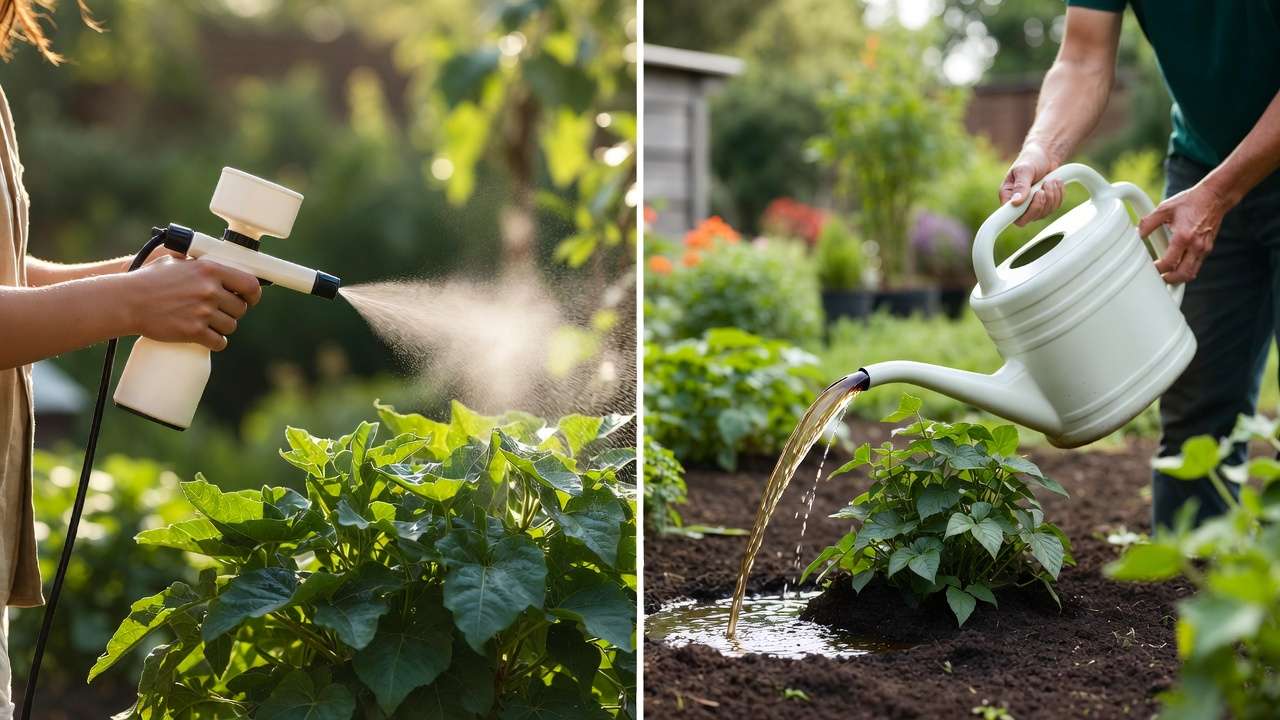
There are two main types:
- Aerated Compost Tea (ACT): Oxygenated during brewing (typically 24–48 hours) to favor aerobic microbes that promote plant growth and disease suppression. This is the preferred method for most modern applications.
- Non-Aerated Compost Tea (NCT): Steeped without forced aeration, often producing more anaerobic organisms—useful in some contexts but riskier for pathogen issues.
The value of compost tea lies in its ability to deliver both immediate soluble nutrition and living biology that enhances the soil food web, improves nutrient cycling, boosts plant immunity, and supports sustainable yields in organic systems. In regions like Barishal, where soils can suffer from compaction, poor drainage, and high humidity favoring foliar pathogens, compost tea offers a low-cost, eco-friendly tool to build resilience.
Compost Tea Foliar Spray vs Soil Drench: Key Differences at a Glance
For quick reference, here’s a side-by-side comparison:
| Aspect | Compost Tea Foliar Spray | Compost Tea Soil Drench | Combined (“Sprench”) |
|---|---|---|---|
| Target Area | Leaves, stems, phyllosphere | Root zone, rhizosphere, soil | Both above- and below-ground |
| Speed of Uptake | Very fast (hours via stomata/absorption) | Slower (days via roots/microbial activity) | Fast + sustained |
| Primary Benefits | Disease suppression, quick nutrient boost, stress relief | Soil microbial diversity, long-term fertility, root health | Comprehensive: disease control + soil building |
| Ideal Scenarios | Foliar diseases (powdery mildew, early blight), nutrient deficiencies during growth | Depleted soils, new plantings, root-focused crops | Most situations for maximum yield/quality |
| Limitations | Short-lived effects; UV/microbe die-off; needs frequent reapplication | Slower visible results; less direct leaf protection | Requires more volume/time |
This table highlights why no single method is universally superior—the best choice depends on your crop, soil, climate, and goals.
How Foliar Spray Works and Its Benefits
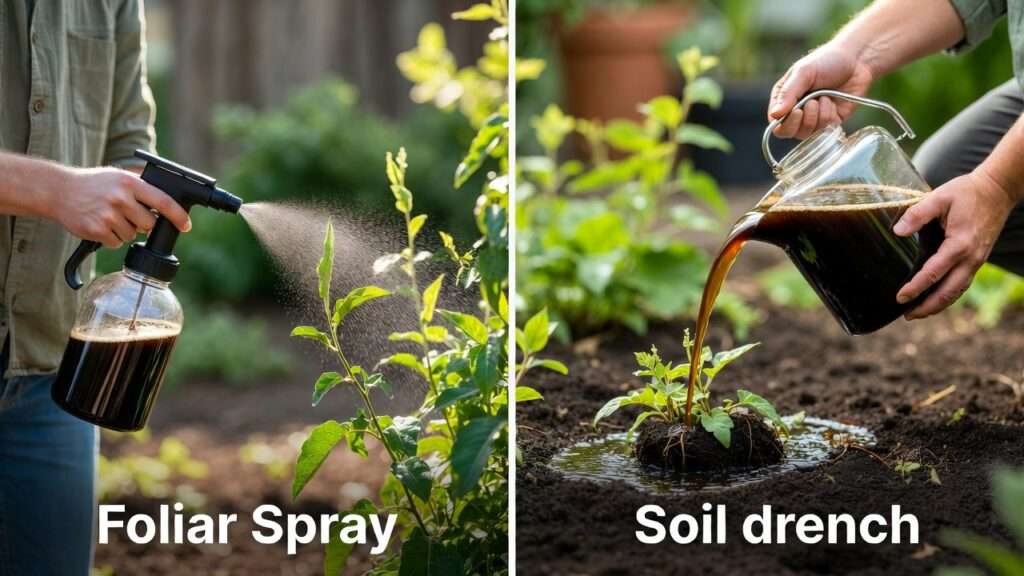
Mechanism of Foliar Application When compost tea is sprayed on leaves, nutrients and microbes enter through stomata (leaf pores) and cuticular absorption. Soluble elements like humic acids and dissolved NPK provide rapid nutrition, while beneficial microbes form a protective biofilm that competes with pathogens for space and resources. In humid climates, this creates a living barrier against foliar diseases.
Proven Benefits
- Disease Suppression: Studies, including those referenced by Rodale Institute protocols, show foliar compost tea reduces powdery mildew, downy mildew, and early blight on grapes, tomatoes, and vegetables—sometimes by 50% or more through microbial antagonism and induced systemic resistance.
- Enhanced Plant Quality: Foliar applications increase phenolics, flavonoids, and antioxidants in crops, improving nutritional value and shelf life.
- Quick Fixes for Deficiencies: Ideal during flowering/fruiting when roots struggle to uptake micros in waterlogged or compacted soils common in Barishal.
When to Choose Foliar Spray Opt for foliar in high-humidity areas prone to leaf pathogens, for stressed/transplanted seedlings, greenhouse veggies, or when rapid correction is needed (e.g., yellowing leaves from micronutrient issues).
Application Best Practices
- Time: Early morning or late afternoon/dusk to minimize UV damage to microbes.
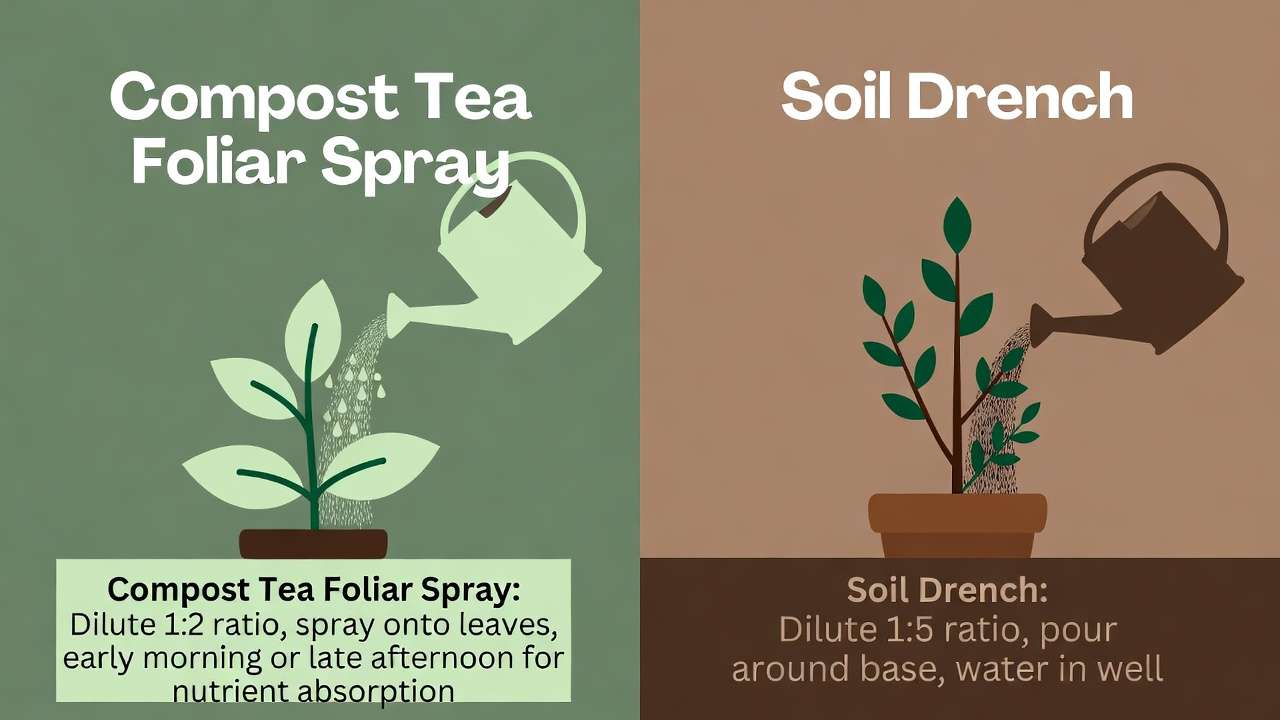
- Dilution: 1:5 to 1:10 with dechlorinated water.
- Coverage: Ensure thorough leaf undersides; use fine mist nozzles.
- Frequency: Every 7–14 days during active growth or disease pressure.
How Soil Drench Works and Its Benefits
Mechanism of Soil Drench Application Applied directly to the root zone, compost tea inoculates the rhizosphere with beneficial microbes that form symbiotic relationships, solubilize bound nutrients (e.g., phosphorus), improve soil structure via glomalin production, and enhance water/nutrient retention.
Proven Benefits
- Soil Health Improvements: Increases microbial biomass, enzyme activity, and aggregate stability—leading to better water infiltration and reduced erosion in flood-prone areas.
- Yield Increases: Long-term root development and nutrient cycling support higher, more consistent yields; meta-analyses show compost tea applications boost biomass by 80–92% over controls in some systems.
- Lower Nutrient Losses: Microbial activity reduces denitrification compared to synthetic fertilizers.
When to Choose Soil Drench Best for poor/depleted soils, establishing new beds/orchards, root crops, trees, or post-harvest soil recovery. In Barishal’s clay-loam, it helps combat compaction and improve drainage.
Application Best Practices
- Rates: 5–10 gallons per acre full-strength or diluted 1:5–1:10.
- Timing: Spring/fall prep, at planting, or via drip irrigation.
- Integration: Combine with mulching/cover crops for amplified effects.
Head-to-Head Comparison Compost Tea Foliar Spray vs Soil Drench: Which Method Wins?
Now that we understand the mechanics, benefits, and best-use scenarios for each application method, let’s put them side by side in the areas that matter most to organic growers: nutrient delivery, disease control, soil health, yield impact, and practicality.
Nutrient Delivery and Uptake Speed Foliar spray wins hands-down for speed. Nutrients and bioactive compounds are absorbed directly through leaf surfaces within hours, bypassing soil limitations such as pH imbalances, compaction, or waterlogging—common challenges in Barishal’s monsoon-heavy clay-loam soils. Soil drench, while effective, relies on root uptake and microbial processing, which can take days to show visible results. If your crop is showing mid-season deficiency symptoms (e.g., interveinal chlorosis on young leaves), foliar is the faster intervention.
Disease Suppression and Plant Protection Foliar application is generally superior for above-ground pathogens. Beneficial microbes in aerated compost tea colonize leaf surfaces, outcompeting disease-causing organisms and triggering induced systemic resistance (ISR)—a plant defense response. Field trials, including those following Rodale Institute compost tea protocols, have documented 40–60% reductions in foliar diseases such as powdery mildew on cucurbits, early blight on tomatoes, and downy mildew on gourds when applied preventatively every 7–10 days. Soil drench offers indirect protection by strengthening root health and overall plant vigor, but it has limited direct impact on leaf-level pathogens. For humid, high-rainfall regions like Barishal, foliar (or sprench) is usually the better first line of defense.
Soil Health and Long-Term Fertility Here, soil drench clearly outperforms foliar spray. Repeated soil applications introduce and sustain diverse microbial communities in the rhizosphere, increasing fungal-to-bacterial ratios, improving aggregate stability, enhancing water-holding capacity, and building glomalin—a glycoprotein that helps bind soil particles and sequester carbon. Over multiple seasons, this leads to measurable improvements in soil organic matter, cation exchange capacity, and nutrient retention—critical in flood-prone areas where topsoil can be washed away. Foliar applications provide almost no long-term soil benefit beyond minor nutrient return via leaf drop.
Yield and Quality Impacts – What the Research Says The most compelling evidence comes from a 2021 study published in the Menoufia Journal of Soil Science (Abdelrahman et al.), which compared foliar spray, soil drench, and a combined “sprench” method on common bean and potato crops under organic management:
- Foliar spray alone: Improved vegetative growth and pod/ tuber quality (higher phenolics, better market grade).
- Soil drench alone: Increased root biomass, nodule formation (in beans), and total marketable yield through better nutrient uptake.
- Combined “sprench” method: Produced the highest overall yield increases (up to 28–35% over control), best quality parameters, and the greatest reduction in synthetic fertilizer requirements.
Other supporting research:
- A 2019 meta-analysis in Agronomy for Sustainable Development found compost tea applications (mostly drench or sprench) increased crop biomass by an average of 80–92% compared to untreated controls.
- Rodale Institute long-term trials showed foliar compost tea reduced disease incidence while maintaining or slightly increasing yields in vegetable systems.
Takeaway: Neither method is universally “better.” Foliar excels for quality and disease management; soil drench builds the foundation for sustained productivity. The combination frequently delivers the strongest results.
Cost, Effort, and Practicality
- Foliar spray: Requires less volume per application (typically 20–50 gallons/acre diluted), easier with backpack sprayers, but needs more frequent applications (every 7–14 days during high disease pressure).
- Soil drench: Uses higher volumes (100–300 gallons/acre depending on dilution), better suited to drip irrigation or watering cans for small plots, but fewer applications needed (every 2–4 weeks or at key growth stages).
- Time & equipment: Both benefit from a good compost tea brewer (5-gallon bucket with aquarium pump for ACT is sufficient for small farms). Sprench doubles the effort but maximizes return.
Expert Consensus and Real-World Recommendations Most modern regenerative agriculture practitioners—drawing from Elaine Ingham’s soil food web principles, Rodale Institute protocols, and on-farm experience—now lean toward the combined “sprench” approach for balanced outcomes. In tropical/subtropical climates with high disease pressure and variable soil conditions (like much of Bangladesh), applying compost tea to both foliage and soil at planting, during vegetative growth, and at early fruit set tends to produce the most consistent improvements in plant resilience, yield stability, and soil fertility over time.
The Winning Strategy: When and How to Combine Methods (“Sprench”)
The term “sprench” (spray + drench) has gained traction in organic farming circles because it leverages the strengths of both methods while minimizing their weaknesses. Here’s why and how to implement it effectively:
Why Sprench Works Best in Most Cases
- Immediate leaf-level protection and nutrition + long-term soil microbial rebuilding
- Reduced disease incidence and improved nutrient-use efficiency
- Greater overall yield and quality gains (as shown in the 2021 Menoufia study)
- More resilient plants in variable weather—critical in Barishal’s flood-and-drought cycles
Step-by-Step Guide to Sprenching
- Brew high-quality aerated compost tea (24–36 hours, well-oxygenated, mature compost source).
- Dilute appropriately: 1:5–1:10 for foliar; 1:5 or stronger for soil drench.
- Apply at key crop stages:
- At transplanting/early vegetative growth: 70% drench + 30% light foliar
- Mid-vegetative to flowering: Equal foliar and drench
- Early fruit set: 60% foliar (disease protection) + 40% drench (fruit fill support)
- Use fine-mist sprayers for even foliar coverage (undersides of leaves critical); follow with soil drench via watering can, drip lines, or furrow irrigation.
- Reapply every 10–14 days during active growth or after heavy rain.
Real-World Examples
- Vegetable gardeners in Barishal using sprench on brinjal and tomatoes report 30–50% less powdery mildew and 15–25% higher marketable yields compared to drench-only.
- Small mango and guava orchards applying sprench post-monsoon see better fruit set and reduced anthracnose.
Common Mistakes to Avoid and Pro Tips
Common Mistakes Compost Tea Foliar Spray vs Soil Drench
- Using immature or low-quality compost → introduces pathogens.
- Brewing too long without aeration → anaerobic conditions produce phytotoxic compounds.
- Spraying in full sun → UV kills microbes and can burn leaves.
- Over-diluting drench → insufficient microbial inoculation.
- Ignoring pH of tea → most beneficial microbes prefer 6.0–7.0.
Pro Tips from Field Experience
- Always use dechlorinated water (let tap water sit 24 hours or use rainwater).
- Add a small amount of unsulfured molasses (0.5–1%) during brewing to feed microbes.
- Test on a small section first when trying a new batch or crop.
- Combine with mulch, cover crops, and reduced tillage to amplify soil-building effects.
- Keep records: note application dates, weather, and plant response to refine your schedule.
Step-by-Step: How to Make Effective Compost Tea
Brewing your own high-quality compost tea is straightforward, inexpensive, and gives you full control over microbial diversity and nutrient content. Here’s a proven, beginner-friendly method optimized for tropical/subtropical climates like Barishal.
Ingredients (for a 5-gallon batch – scalable)
- 1–2 kg mature, well-decomposed compost (ideally 50%+ fungal dominant; avoid fresh manure unless fully composted)
- Dechlorinated water (rainwater preferred; or tap water left to sit 24 hours)
- 1–2 tablespoons unsulfured molasses (feeds bacteria)
- Optional microbial boosters: 1 tsp kelp meal, 1 tsp rock dust, small handful of forest soil or worm castings
- Aeration equipment: aquarium air pump + airstone, or submersible pump for larger batches
Aerated Compost Tea (ACT) Recipe – Recommended Method
- Fill a clean 5–20 gallon bucket or brewer with dechlorinated water (leave ~20% headspace).
- Place compost in a fine mesh “tea bag” (paint strainer bag, old pillowcase, or burlap) and suspend it in the water so it’s fully submerged but not blocking the airstone.
- Add molasses and any boosters directly to the water.
- Connect airstone to pump and run continuously for 24–36 hours (ideal temperature: 20–30°C; avoid >35°C to prevent harmful bacteria).
- Monitor: Healthy tea smells earthy/slightly sweet, has a light foam head, and shows fine bubbles. If it smells foul (rotten eggs/ammonia), discard—it has gone anaerobic.
- After brewing, remove compost bag and let tea settle 10–15 minutes.
- Strain through fine mesh (e.g., 400-micron paint strainer) to remove large particles.
- Use immediately—microbial populations peak within 4–6 hours after brewing and decline rapidly.
Non-Aerated Option (Simpler but Riskier) Steep compost in water 3–7 days without aeration, stirring daily. Use only if you have very high-quality aerobic compost and no anaerobic smell develops. Dilute more heavily (1:20) to reduce pathogen risk.
Safety Notes about Compost Tea Foliar Spray vs Soil Drench
- Never use fresh manure-based compost for tea unless composted >1 year at thermophilic temperatures (>55°C).
- Wear gloves; avoid inhaling mist when spraying.
- Store unused tea in shade with loose lid for max 24 hours—oxygen levels drop quickly.
FAQs
1. Is compost tea better than just adding solid compost to the soil? Yes and no. Solid compost builds long-term organic matter slowly; tea delivers immediate soluble nutrients and living microbes directly to plants and soil biology—especially useful mid-season or during stress.
2. Can I use compost tea on all plants? Most yes—vegetables, fruits, ornamentals, trees. Dilute more for seedlings (1:20) and sensitive crops (e.g., young orchids). Avoid over-application on succulents/cacti.
3. How often should I apply compost tea? Foliar: every 7–14 days during active growth or disease pressure. Soil drench: every 2–4 weeks or at key stages (planting, flowering, fruit set). Sprench: 10–14 day cycle works well for most homestead gardens.
4. What’s the difference between compost tea and compost extract? Extract = short steep (hours) focused on soluble nutrients/humic acids, low microbes. Tea (especially ACT) = longer brew (24+ hours) to multiply beneficial microbes—more biological benefit.
5. Will compost tea replace chemical fertilizers or fungicides? Not completely—but consistent use often reduces synthetic fertilizer needs by 20–50% and cuts fungicide applications significantly through disease suppression and improved plant vigor.
6. Why does my tea sometimes smell bad? Usually due to anaerobic conditions (insufficient oxygen, too warm, poor compost quality). Always aerate actively and use mature compost.
7. Can I brew tea in hot Barishal summers? Yes—but keep brewer in shade, monitor temperature, and shorten brew time to 18–24 hours if >32°C to avoid overheating.
8. Is it safe for edible crops? Yes, when using high-quality aerobic compost and applying to foliage at least 1–2 days before harvest (allow time for microbial die-off on leaves). Soil drench has no harvest interval concerns.
Choosing between compost tea foliar spray and soil drench—or better yet, combining them into a “sprench” strategy—comes down to your specific goals, crop stage, soil condition, and local climate pressures.
- Use foliar spray when you need fast disease protection, quick nutrient correction, or enhanced fruit/vegetable quality in humid, pathogen-prone environments.
- Choose soil drench to rebuild depleted soils, strengthen root systems, and create long-term fertility in compacted or flood-affected land.
- Adopt sprench (the combined approach) for the most comprehensive results—highest yields, best quality, strongest disease resistance, and greatest reduction in external inputs—as supported by field research and on-farm experience across tropical organic systems.
Start small: brew a batch this week, test both methods (and the combination) on a few plants, and observe the response over 2–3 weeks. Keep notes on weather, plant vigor, disease incidence, and yield differences. Over time, you’ll develop a tailored schedule that fits your homestead or farm perfectly.
Healthy soil, resilient plants, and abundant harvests are within reach—using one of nature’s oldest and most powerful tools: living compost tea applied thoughtfully.
If you’ve tried foliar, drench, or sprench methods, share your results in the comments below—I’d love to hear what’s working in Barishal and beyond!