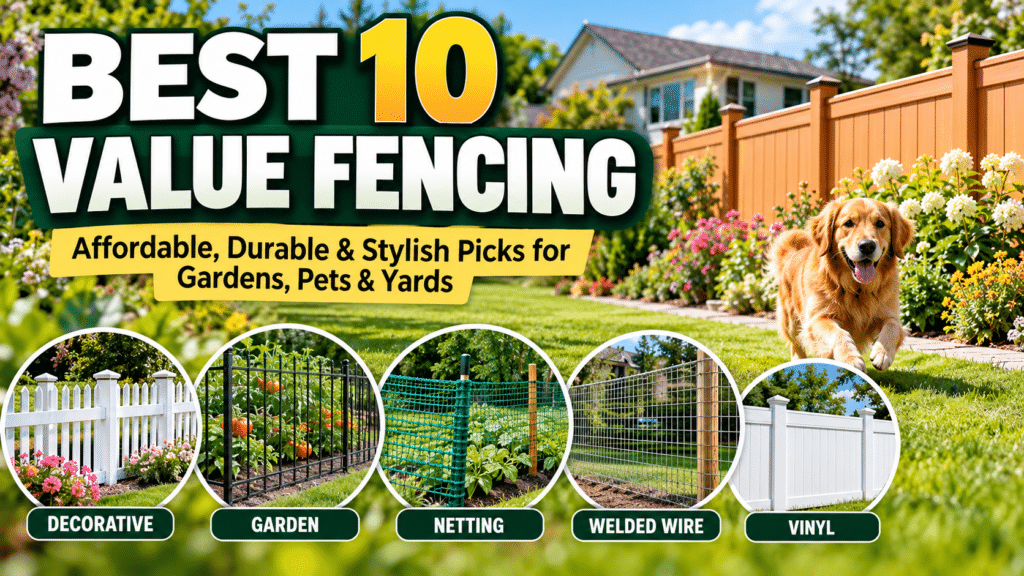
A fence can completely change how a yard, garden, or property looks and functions—but finding one that offers the right combination of price, durability, coverage, and easy installation can be surprisingly difficult. The best 10 value fencing options aren’t necessarily the cheapest products on the market. A low-cost fence that rusts, breaks, provides too little coverage, or requires expensive installation can end up costing much more over time.
That is why choosing fencing based on overall value, rather than the sticker price alone, matters. Whether you need a fence to protect a vegetable garden, keep pets safely contained, create a decorative border, improve privacy, or cover a large outdoor area, the right product depends on your specific needs, budget, and installation requirements.
In this guide, we compare 10 value-focused fencing options across different categories. We look at the factors that actually matter when making a purchase: price, material quality, durability, coverage, installation difficulty, maintenance, customer feedback, versatility, and long-term value.
You’ll find detailed reviews of each recommended fence, along with its key features, benefits, strengths, limitations, ideal use cases, and the type of buyer who should consider it. We also explain how to calculate fencing cost per linear foot, compare materials, avoid common buying mistakes, and determine whether a low-cost fence is genuinely a good value.
Whether you’re a homeowner planning a permanent installation, a gardener protecting plants from animals, a pet owner looking for a reliable boundary, or a DIY enthusiast working with a limited budget, this guide is designed to help you make a confident buying decision.
The goal is simple: spend your money on fencing that actually does the job.
Best Value Fencing at a Glance
Instead of forcing every specification into a wide comparison chart, the table below focuses on the three things most useful when you’re deciding what to investigate first: product, best use, and key value point.
| Fence | Best For | Why Consider It |
|---|---|---|
| OUSHENG 36-in Decorative Fence | Best overall garden barrier | Tall metal panels, rust-resistant coating and flexible layouts |
| KYATE 33-in Garden Fence | Pets & garden boundaries | 24-ft coverage from 10 panels and no-dig installation |
| Zippity Baskenridge Vinyl | Decorative gardens | Attractive vinyl picket appearance with no-dig installation |
| Feitore Deer Netting | Large garden areas | 7 × 100-ft coverage at a lightweight price |
| Thealyn Metal Fence | Sturdy garden barriers | Taller metal-panel design for stronger boundaries |
| ZeroPone Welded Wire Fence | Durable garden protection | Galvanized, PVC-coated steel construction |
| PotatoLife Plastic Mesh | Budget garden protection | Lightweight, reusable and UV-resistant mesh |
| INJOPEXI Multi-Panel Fence | Larger enclosed areas | Multiple panels and gate-style configurations |
| Sunnydaze Steel Panels | Decorative metal fencing | Solid steel construction and attractive appearance |
| Premium Vinyl/Metal Option | Long-term value | Higher upfront cost aimed at durability and appearance |
Important: Amazon prices, ratings, review counts, and availability fluctuate. Always verify the current listing before publishing an affiliate recommendation or making a purchase.
How We Evaluate the Best Value Fencing
The word value can be misleading. A $25 fence isn’t automatically a better deal than a $75 fence.
For example, suppose a $25 fence covers only 10 feet while a $75 fence covers 50 feet. The first fence costs $2.50 per linear foot, while the second costs only $1.50 per linear foot.
That’s why our evaluation goes beyond the purchase price.
Price-to-Coverage Ratio
One of the most useful measurements is:
Total product price ÷ total linear feet of coverage = approximate cost per linear foot
This doesn’t tell the entire story, but it provides a much better starting point for comparing packages.
Material Quality
We consider whether the fencing uses:
- Powder-coated metal
- Galvanized steel
- PVC-coated steel
- Vinyl
- HDPE or polypropylene mesh
- Other outdoor-rated materials
The best material depends heavily on the job. Lightweight plastic mesh can be excellent for protecting plants from birds or deer, while it would be a poor choice for containing a large dog.
Durability
Outdoor fencing has to deal with:
- Rain
- Humidity
- UV exposure
- Wind
- Soil moisture
- Accidental impacts
- Temperature changes
A product that looks inexpensive initially may have poor long-term value if it needs to be replaced frequently.
Installation
We also consider whether installation requires:
- Digging
- Concrete
- Fence posts
- Specialized tools
- A rubber mallet
- Screws
- Connectors
- Additional hardware
No-dig systems are particularly attractive for temporary projects, renters, gardens and homeowners who want a relatively simple DIY installation.
Customer Feedback
Customer reviews can reveal problems that aren’t obvious from a product description.
For example, buyers may praise a fence for its appearance but complain that the panels are difficult to connect. Others may love the installation but report that the stakes aren’t deep enough for hard or rocky soil.
A good buying decision therefore requires looking at both positive and negative feedback.
1. OUSHENG Decorative Garden Fence — Best Overall Value
If you want a fence that combines height, decorative appearance, portability and relatively simple installation, the OUSHENG 36-inch decorative garden fence is one of the strongest options to consider.
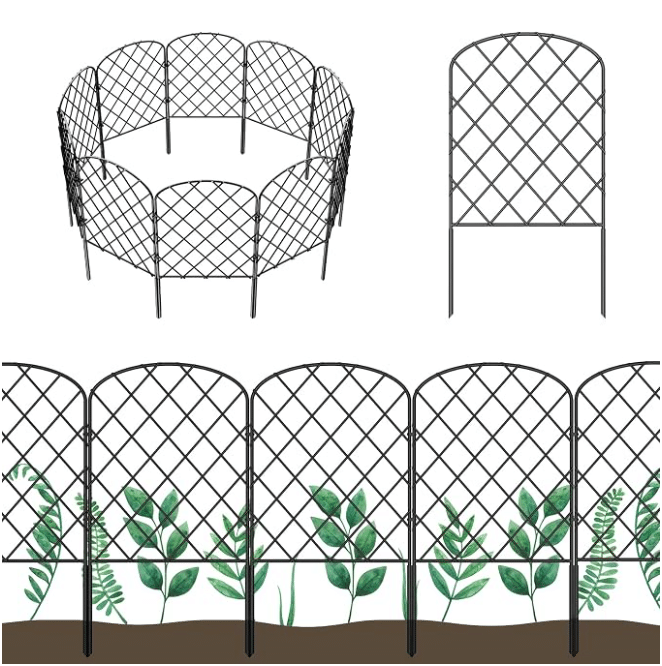
The product consists of 10 metal panels measuring approximately 36 inches high by 13 inches wide, creating roughly 10.8 feet of connected fencing. The panels use an interlocking design and can be arranged in different configurations, including straight lines, L-shapes and curved or enclosed layouts.
That flexibility is particularly useful for gardens because flower beds and vegetable plots aren’t always perfectly rectangular.
What Makes the OUSHENG Fence Different?
Many inexpensive garden fences are very short. They may look attractive around a flower bed, but their limited height makes them more of an edging product than a genuine barrier.
The OUSHENG model is approximately 36 inches tall, giving it considerably more visual presence.
The manufacturer describes the panels as using a rust-resistant coating and welded metal-wire construction. The panels can also be removed and stored when they’re no longer needed.
This makes the fence useful for homeowners who don’t want to build a permanent fence.
Key Features
- Approximately 36-inch height
- 10 interconnected panels
- Approximately 10.8 feet total length
- Metal construction
- Rust-resistant outdoor coating
- Arched decorative design
- Interlocking installation
- Multiple layout possibilities
- Removable and reusable
- Suitable for garden borders and animal barriers
Price
Typical price: $25.99
Because Amazon pricing changes based on promotions, seller, quantity and availability, the article should display the live Amazon price immediately before publication rather than using a static price that could become outdated.
Coverage and Value
Ten panels provide approximately 10.8 feet of connected fence.
That means you’ll want to calculate the number of packages required before ordering.
For example, a garden requiring approximately 40 feet of fencing would need substantially more than one package.
This is an important distinction: a product can look inexpensive on its own but become considerably more expensive when several packages are required.
Installation
The panels connect through an interlocking design, and the pointed feet are assembled before installation. The system allows the fence to be configured in different shapes rather than requiring a perfectly straight run.
That flexibility is one of its strongest advantages.
On reasonably soft soil, installation should be straightforward. Hard clay, rocky ground or compacted soil can make driving the stakes considerably more difficult.
Customer Feedback
Third-party review analysis reports generally positive feedback around the OUSHENG’s appearance and installation, with reviewers particularly appreciating the decorative design and relatively straightforward assembly.
However, buyers should understand the distinction between a garden barrier and a heavy-duty containment fence.
A 36-inch decorative metal fence may discourage small animals or define a garden boundary, but it should not automatically be treated as a secure enclosure for a determined large dog.
Pros
- 36-inch height provides more barrier than many decorative borders
- Attractive arched appearance
- Flexible configurations
- Metal construction
- Rust-resistant coating
- Reusable
- Suitable for gardens and landscaping
- Relatively DIY-friendly
Cons
- Only about 10.8 feet of total coverage per package
- Multiple packages can become expensive
- Not intended as a heavy-duty security fence
- May require extra effort in hard soil
- Height may still be insufficient for large or athletic dogs
Why It’s a Good Choice
The OUSHENG is compelling because it sits between two categories.
It’s more substantial than a tiny decorative garden border, but considerably simpler than building a permanent wood, vinyl or wrought-iron fence.
If your primary goal is protecting a garden, defining a landscaped area, or creating a visible barrier without a permanent construction project, it offers an attractive combination of function and appearance.
Ideal Use Case
The OUSHENG is best suited to:
- Vegetable gardens
- Flower beds
- Landscaping
- Small-animal deterrence
- Yard boundaries
- Temporary garden protection
- DIY outdoor projects
Best for: Homeowners who want a taller decorative metal garden barrier without committing to a permanent fence installation.
2. KYATE 33-Inch Garden Fence — Best for Pets and Garden Boundaries
The KYATE 33-inch garden fencing system takes a different approach from the OUSHENG.
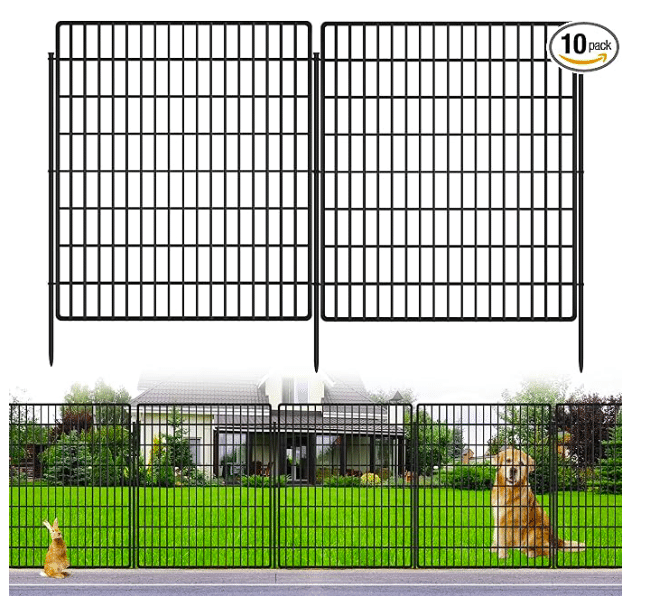
Instead of providing many narrow panels that create only a short total run, the KYATE 10-panel configuration can cover approximately 24 feet, with individual panels around 33 inches high and 29 inches wide. The panels use metal stakes and an interlocking connection system designed for no-dig installation.
That larger coverage area can make it more practical when you need to enclose a substantial garden without purchasing numerous small packs.
Key Features
- Approximately 33-inch height
- 10-panel configuration
- Approximately 24 feet of coverage
- Metal construction
- Approximately 8.3-inch in-ground stake section
- No-dig installation concept
- Interlocking panels
- Available in configurations intended for garden and pet boundaries
- Portable and reconfigurable
Price
Typical Price: $79.89
Why Coverage Matters
The most important advantage here is coverage efficiency.
If you’re fencing a small flower bed, 10 feet may be enough. But once your project grows to 20, 30 or 40 feet, buying multiple short fence packs can quickly become expensive.
The KYATE system’s approximately 24-foot configuration makes it more attractive for medium-sized areas.
Installation
The no-dig concept is one of the product’s major selling points.
Rather than excavating holes and setting conventional fence posts in concrete, the panels are connected and the stakes are driven into the ground. A rubber mallet can be useful during installation.
However, “no dig” does not mean “works equally well in every type of soil.”
Hard clay, gravelly ground and rocky soil can make installation difficult.
Pet Use
At 33 inches tall, this fence can work well as a boundary for some smaller or moderately sized dogs.
But buyers should be realistic.
A motivated large dog may jump over a 33-inch fence, push against it or potentially dig beneath it.
For pet containment, consider:
- Dog size
- Jumping ability
- Digging behavior
- Fence height
- Stake depth
- Ground conditions
Never assume a decorative garden fence is equivalent to a professionally engineered dog enclosure.
Customer Feedback and Practical Considerations
Current product-focused reviews and comparison sources highlight the KYATE’s portability, relatively quick setup and usefulness as a temporary or semi-permanent boundary.
Its strongest appeal is therefore convenience rather than maximum security.
Pros
- Good coverage for a panel-based garden fence
- Relatively tall for decorative fencing
- No-dig installation
- Reconfigurable
- Useful for garden and pet boundaries
- Easier to move than a permanent fence
Cons
- Not suitable for every large or athletic dog
- Hard soil can complicate installation
- Not a privacy fence
- Not designed for high-security applications
- Ground stability affects overall strength
Why It’s a Good Choice
Choose the KYATE when you want something more substantial than simple garden edging but easier to install than a permanent fence.
Its combination of panel size, height and coverage makes it particularly interesting for homeowners who need to create a temporary or semi-permanent boundary around a garden.
Ideal Use Case
Best suited for:
- Medium-sized gardens
- Small and medium pets
- Flower beds
- Temporary dog boundaries
- Yard sections
- Portable outdoor enclosures
Best for: Buyers who want a relatively tall, reusable metal boundary with more coverage than many small decorative fence kits.
3. Zippity Baskenridge No-Dig Vinyl Fence — Best Decorative Option
Not everyone wants their garden to look like it has been surrounded by utility fencing.
If appearance is a major priority, a white vinyl picket fence can create a much more traditional residential look.
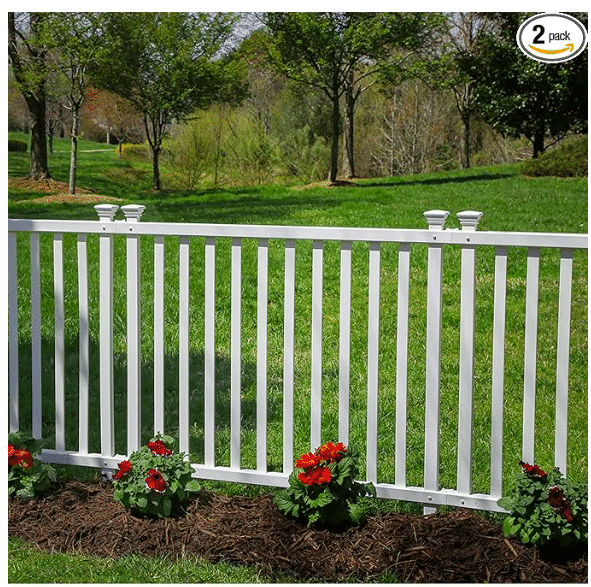
The Zippity Baskenridge is a 3-foot-high by 3.5-foot-wide no-dig vinyl fence panel kit, with a classic picket-style design. The manufacturer lists a two-panel kit at around $80 on its current website, although Amazon pricing can differ.
A separate retail listing shows the 2-panel product at $69.99, illustrating why shoppers should check the current seller and price before buying.
Key Features
- Approximately 3 feet tall
- Approximately 3.5 feet wide per panel
- White vinyl construction
- Classic picket appearance
- No-dig installation
- Weather-resistant design
- Suitable for gardens and landscaping
- Designed as a semi-permanent DIY fence
Price
Typical Price: $69.99
Appearance
This is where the Baskenridge has a significant advantage.
Instead of looking like a temporary barrier, its white picket design can make a garden or front-yard landscaping project look deliberately designed.
It can work particularly well around:
- Flower beds
- Front gardens
- Walkways
- Patio areas
- Small landscaped sections
Installation
The system uses pointed stakes rather than conventional concrete-set posts.
However, no-dig does not mean installation is completely effortless.
The manufacturer’s installation documentation specifically provides guidance for situations where the ground is too hard, including loosening the ground and using an appropriate drill attachment.
That’s an important consideration for buyers with hard or compacted soil.
Durability and Maintenance
Vinyl has a major advantage over painted metal in one respect: it doesn’t rust.
That makes it attractive for homeowners who want an outdoor fence with relatively low maintenance.
However, vinyl is not indestructible. It can be damaged by strong impacts, and lightweight decorative panels should not be treated like heavy-duty security fencing.
Customer Feedback
Recent garden-fence comparisons highlight the Baskenridge’s attractive appearance, easy installation and long manufacturer warranty as major advantages, while also noting limitations around sloped ground and stronger or more active dogs.
Pros
- Attractive traditional appearance
- No-dig installation
- Weather-resistant vinyl
- Low maintenance
- Useful around gardens and landscaping
- More visually polished than basic wire fencing
Cons
- More expensive than basic mesh fencing
- Limited suitability for large or highly active dogs
- Alignment can be more challenging on slopes
- Not intended as a high-security fence
- Additional panels increase overall project cost
Why It’s a Good Choice
If the main purpose of your fence is not simply to block animals but also to improve the appearance of your property, the Baskenridge deserves serious consideration.
You’re paying for more than physical coverage. You’re also paying for the aesthetic finish and reduced maintenance associated with vinyl.
Ideal Use Case
Best for:
- Decorative gardens
- Flower beds
- Front-yard landscaping
- Walkway borders
- Homeowners prioritizing appearance
- Small garden boundaries
Best for: Buyers who want their garden fence to look like part of the landscape rather than an improvised barrier.
4. Feitore Deer Fence Netting — Best for Large Garden Coverage
When the objective is covering a large area for as little money and weight as possible, metal panels aren’t always the smartest choice.
That’s where deer netting comes in.
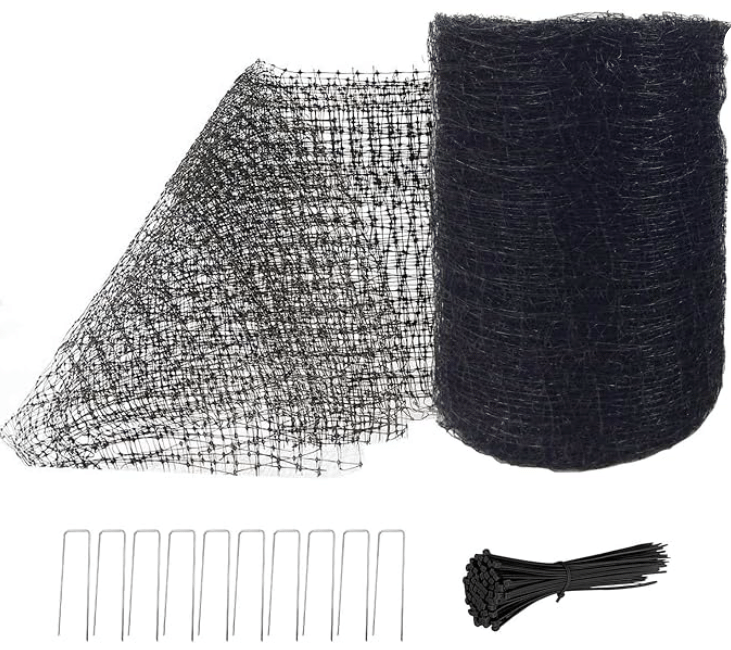
The Feitore Deer Fence Netting is listed at approximately 7 × 100 feet, giving you a large amount of coverage from a single lightweight roll. Current Amazon-market tracking identifies the product as one of the strongest-selling products in the garden-fence category, with thousands of estimated monthly sales and more than 10,000 reviews reported in the tracked listing data.
Key Features
- Approximately 7 feet high
- Approximately 100 feet long
- Lightweight netting
- Fine mesh
- Designed for garden and crop protection
- Reusable
- Suitable for birds and larger garden pests
- Much greater coverage than typical decorative panels
Price
Typical Price: $15.99
Why Netting Can Be Better Than Panels
Suppose you have a large vegetable garden measuring 20 × 30 feet.
The perimeter is:
20 + 30 + 20 + 30 = 100 feet
A 100-foot roll can therefore potentially cover the entire perimeter, depending on installation and how much overlap or additional material you need.
Trying to accomplish the same project using 10-foot decorative metal panels could require many packages.
This is where netting can offer dramatically better value.
Protection
The product is designed to create a physical barrier against animals and birds.
The important advantage is height.
At approximately 7 feet tall, it provides a much more substantial vertical barrier than 17- or 24-inch decorative garden edging.
However, netting works differently from rigid fencing.
It needs proper support and tension to remain effective.
Installation
You’ll generally need supporting posts, stakes, ties or another method of securing the netting.
That means the advertised product price isn’t necessarily the complete project cost.
Before purchasing, calculate the cost of:
- Netting
- Posts
- Stakes
- Zip ties
- Clips
- Gates or access points
Customer Feedback
The product’s large review base and strong estimated sales position suggest significant consumer interest. Current market tracking places it at the top of Amazon’s garden-fence category by estimated monthly sales.
However, sales popularity should not be confused with universal suitability.
Netting is excellent when coverage and animal protection are priorities. It is a poor choice when your primary objective is a beautiful decorative boundary.
Pros
- Extremely large coverage
- Lightweight
- High enough for many garden-protection applications
- Reusable
- Easy to cut and configure
- Generally more economical for large areas
- Useful against birds and garden animals
Cons
- Requires support structure
- Doesn’t provide privacy
- Less visually attractive than decorative fencing
- Can sag without proper installation
- Not equivalent to a rigid security fence
- Additional hardware may be necessary
Why It’s a Good Choice
For large gardens, coverage per dollar can matter more than decorative appearance.
A 100-foot roll can solve a problem that would require numerous small panel packages if you choose traditional garden fencing.
That’s why this type of product belongs in a best-value fencing roundup even though it looks completely different from a metal panel fence.
Ideal Use Case
Best for:
- Vegetable gardens
- Large planting areas
- Deer protection
- Bird protection
- Fruit trees
- Large rural or suburban gardens
- Temporary seasonal protection
Best for: Gardeners who need maximum coverage and animal protection without paying for heavy rigid panels.
Quick Takeaway So Far
The first four products demonstrate why there isn’t one universally “best” fence.
- OUSHENG is strongest when you want a taller decorative metal garden barrier.
- KYATE is better when you need more panel coverage and a portable boundary.
- Zippity Baskenridge is the aesthetic choice for homeowners who prioritize appearance.
- Feitore netting is the coverage champion for large gardens and animal protection.
The right choice ultimately depends on what you’re trying to accomplish—not simply which product has the lowest price.
What to Look for Before Buying
Before moving to the remaining recommendations, it’s worth understanding one important principle:
Don’t Compare Fence Prices Without Comparing Coverage
A $30 package may appear cheaper than an $80 package.
But if the first covers 10 feet and the second covers 40 feet, the comparison changes completely.
Always calculate:
Package price ÷ total usable linear feet = cost per linear foot
Then add the cost of installation hardware.
This simple calculation can prevent one of the most common fencing-buying mistakes: choosing a product because its package price looks inexpensive.
5. ZeroPone Welded Wire Fence — Best for Durable Garden Protection
If your priority is strength rather than decorative appearance, welded-wire fencing is one of the most practical options to consider.
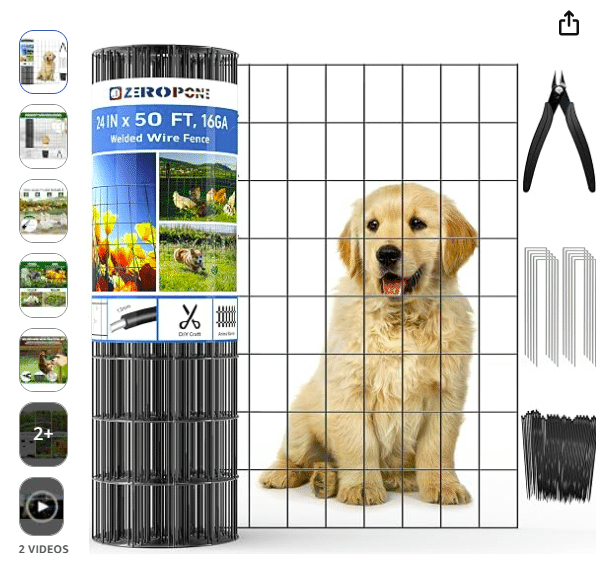
Unlike lightweight plastic mesh, welded wire creates a rigid structure that is much harder for animals to push through. It can also be cut and configured for different garden layouts, making it useful for vegetable gardens, animal enclosures, landscaping and general outdoor barriers.
The ZeroPone welded-wire fence is designed around galvanized or coated steel construction, giving it an advantage over untreated steel when it is exposed to outdoor moisture.
Why Welded Wire Makes Sense
There is a major difference between a fence that simply marks a boundary and one that physically prevents something from passing through it.
Welded-wire fencing is useful when you need a stronger barrier against:
- Rabbits
- Ground animals
- Chickens
- Small livestock
- Pets
- Garden pests
- Accidental foot traffic
The rigid welded intersections also make the fence easier to keep upright than loose netting.
Key Features
Depending on the specific ZeroPone variant, buyers should verify:
- Roll length
- Fence height
- Mesh dimensions
- Wire gauge
- Galvanized or PVC-coated finish
- Included stakes or accessories
- Whether the product is sold as a single roll or multiple sections
These specifications can vary between Amazon variations, so don’t assume that every ZeroPone listing has identical dimensions.
Price
Current Amazon price: $41.99
This is particularly important with fencing because a single brand may offer several combinations of height, mesh size and roll length.
Instead of comparing the package price alone, calculate:
Price ÷ total linear feet = approximate material cost per foot
Durability
Galvanized steel is generally a stronger long-term material than ordinary untreated wire.
A protective coating can help slow corrosion, but no outdoor steel fence should be assumed to be completely immune to rust.
The lifespan depends on:
- Coating quality
- Soil contact
- Rainfall
- Humidity
- Salt exposure
- Scratches
- Installation conditions
If the wire is cut during installation, exposed cut ends can become more vulnerable to corrosion. Using appropriate protective measures around cut sections can help.
Installation
Welded wire typically requires more installation work than a small decorative no-dig panel.
You may need:
- T-posts
- U-posts
- Wooden posts
- Wire ties
- Fence clips
- Pliers
- A post driver
For a permanent installation, strong posts are often more important than the wire itself.
A high-quality wire fence attached to weak or widely spaced posts can still fail.
Customer Review Considerations
When analyzing Amazon reviews for welded-wire fencing, pay particular attention to comments about:
- Actual wire thickness
- Mesh size
- Whether the roll matches the advertised dimensions
- Ease of cutting
- Rust after prolonged outdoor use
- Packaging damage
- Whether the material is rigid enough for the intended application
These details are often more useful than simply looking at the average star rating.
Pros
- Stronger than lightweight plastic mesh
- Versatile
- Suitable for garden protection
- Useful for animal barriers
- Can cover relatively large areas
- Rigid structure
- Can be adapted to different installations
Cons
- Requires posts and attachment hardware
- Installation takes longer
- Cutting wire can be difficult
- Exposed steel can eventually corrode
- Less decorative than vinyl or ornamental metal
Why It’s a Good Choice
Choose welded wire when function comes before appearance.
If your biggest concern is keeping animals away from vegetables rather than creating an attractive landscape border, a rigid wire fence can provide substantially better practical value than decorative panels.
Ideal Use Case
Best for:
- Vegetable gardens
- Chicken runs
- Small animal enclosures
- Garden pest control
- Rural properties
- DIY agricultural projects
Best for: Buyers who want a durable, versatile fence and are willing to spend more time on installation.
6. PotatoLife Plastic Mesh Fence — Best Budget Garden Protection
Plastic mesh occupies the opposite end of the fencing spectrum.
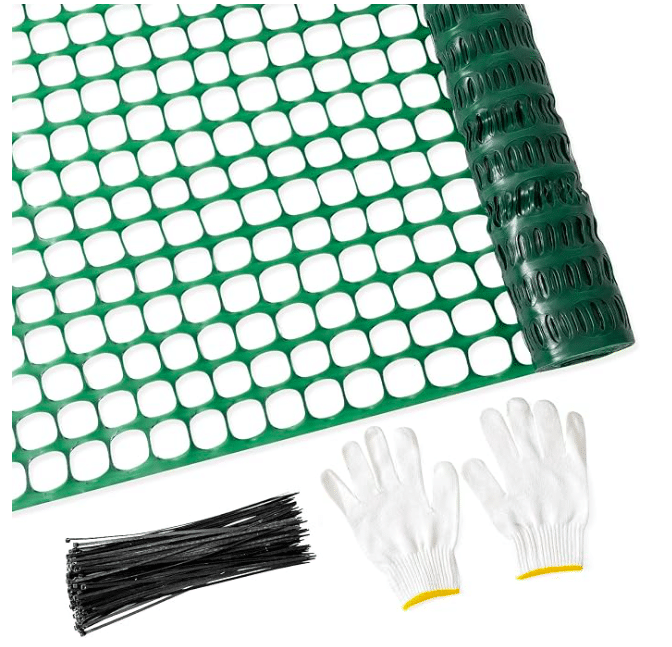
Instead of heavy steel panels or welded wire, products such as the PotatoLife garden mesh focus on low weight, flexibility, easy cutting and inexpensive large-area coverage.
This makes plastic mesh particularly useful when you need a temporary or seasonal barrier rather than a permanent architectural fence.
What Makes Plastic Mesh Useful?
A good garden mesh can solve a surprisingly wide range of problems.
For example, you may want to:
- Keep rabbits away from seedlings
- Protect newly planted vegetables
- Create a temporary garden enclosure
- Separate sections of a yard
- Build a lightweight animal barrier
- Protect plants during a growing season
Plastic mesh can often be installed with simple stakes, zip ties or garden posts.
Key Features
Depending on the exact PotatoLife variant, check:
- Roll dimensions
- Mesh opening
- Material
- UV resistance
- Height
- Color
- Reusability
- Included accessories
Because mesh products are sold in numerous sizes, the exact Amazon variation matters considerably.
Price
Current Amazon price: $38.87
The biggest value advantage of plastic mesh is normally its coverage-to-weight ratio.
A large roll can cover a significant area without the shipping weight or installation difficulty associated with metal fencing.
Durability
Plastic mesh is not as impact-resistant as welded steel.
That’s important.
If a determined dog repeatedly pushes against the fence, plastic mesh may stretch, tear or pull away from its supports.
But for lighter applications, its flexibility can actually be an advantage.
It can bend around:
- Trees
- Garden beds
- Curved landscaping
- Uneven boundaries
- Temporary structures
Installation
This is where plastic mesh is particularly attractive for DIY gardeners.
You can typically install it using:
- Garden stakes or posts
- Mesh stretched along the boundary
- Zip ties, clips or wire
- Additional support where necessary
No concrete is normally required for temporary applications.
Pros
- Lightweight
- Easy to transport
- Easy to cut
- Flexible
- Good coverage
- Generally inexpensive
- Useful for temporary projects
- Easy to remove and store
Cons
- Less durable than metal
- Can tear
- Vulnerable to strong animals
- Requires supporting stakes
- Limited privacy
- Not appropriate for security fencing
Why It’s a Good Choice
If you need fencing for a garden but don’t want to spend heavily on a permanent structure, plastic mesh can provide excellent short-term value.
It is particularly attractive for gardeners whose needs change seasonally.
For example, you may need a barrier around seedlings in spring but no fence around that area once plants become established.
Ideal Use Case
Best for:
- Vegetable gardens
- Seedlings
- Temporary enclosures
- Rabbit protection
- Lightweight animal barriers
- Seasonal gardening
Best for: Budget-conscious gardeners who need lots of coverage without the cost and weight of metal.
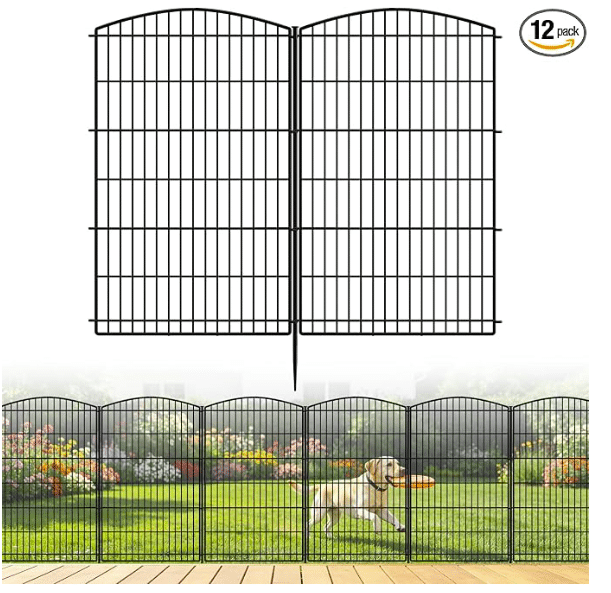
7. INJOPEXI Multi-Panel Garden Fence — Best for Larger Enclosed Areas
If you want a panel-style fence but need more flexibility than a small decorative kit provides, an INJOPEXI multi-panel configuration can be worth considering.
These systems are designed around multiple metal panels that can be connected to create different shapes.
That makes them useful when your project isn’t simply a straight line.
Why Multi-Panel Systems Are Useful
Imagine you need to surround a:
- Vegetable garden
- Compost area
- Small animal enclosure
- Flower bed
- Tree
- Backyard feature
A rigid straight fence can become difficult to configure.
Individual panels allow you to create:
- Rectangles
- Squares
- L-shapes
- Curves
- Partially enclosed areas
Key Features
Verify the exact Amazon variation for:
- Panel height
- Panel width
- Number of panels
- Total coverage
- Gate availability
- Coating
- Stake length
- Panel thickness
The exact configuration is important because multi-panel fencing often has several package sizes.
Price
Current Amazon price:
A useful way to compare this product against competitors is to calculate:
Total package price ÷ total assembled fence length
Don’t forget to account for any separate gate or connector costs.
Installation
Multi-panel fencing is generally easier than constructing a conventional permanent fence.
The main process is:
- Plan the boundary.
- Position the panels.
- Connect adjacent sections.
- Mark the stake locations.
- Drive stakes into the ground.
- Check alignment.
- Reinforce weak points if necessary.
A rubber mallet can be helpful.
Strength
Panel systems generally provide more rigidity than loose netting.
However, their strength depends on:
- Panel construction
- Stake depth
- Soil
- Number of connection points
- Wind exposure
- Animal pressure
A lightweight decorative panel should not be treated as a security fence.
Pros
- Flexible layout
- Easy to expand
- Reusable
- Suitable for garden enclosures
- Better rigidity than mesh
- DIY-friendly
- Can create enclosed spaces
Cons
- Package sizes vary
- Multiple packages may be needed
- Installation depends on soil conditions
- Not suitable for high-security applications
- Some configurations may require additional hardware
Why It’s a Good Choice
The biggest advantage is modularity.
Instead of committing to one fixed-size structure, you can start with a smaller area and add additional panels later.
That’s useful for gardeners whose projects grow over time.
Ideal Use Case
Best for:
- Medium and large gardens
- Temporary enclosures
- Landscape boundaries
- Small animal areas
- DIY yard projects
Best for: Buyers who want a modular fence that can be expanded or rearranged.
8. Sunnydaze Steel Garden Fence Panels — Best Decorative Metal Option
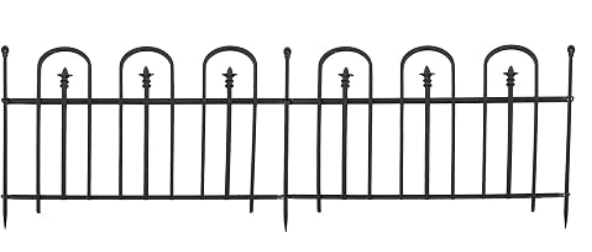
For buyers who want something sturdier and more substantial than plastic but don’t want the utilitarian appearance of wire mesh, decorative steel fencing can be a strong compromise.
Sunnydaze steel garden panels are aimed more at landscaping and decorative outdoor use than agricultural fencing.
That distinction matters.
The objective isn’t necessarily to build an impenetrable barrier. Instead, these panels can provide structure and visual separation while complementing the surrounding landscape.
Key Features
Depending on the selected model:
- Steel construction
- Decorative design
- Outdoor finish
- Individual panels
- Garden-border applications
- Expandable layout
- Suitable for flower beds and landscaping
Appearance
This category is where decorative steel has an advantage over welded wire.
A decorative fence can become part of the garden’s design.
It can frame:
- Roses
- Shrubs
- Pathways
- Flower beds
- Front-yard landscaping
- Patio areas
Rather than hiding the fence, you can intentionally use it as a visual feature.
Price
Current Amazon price: $121.80.
Decorative metal fencing can have a higher price per linear foot than basic wire.
However, comparing it solely by cost per foot misses its aesthetic value.
If replacing an inexpensive fence because you dislike how it looks after installation, the cheaper product wasn’t necessarily the better value.
Durability
Steel is generally more rigid than lightweight plastic.
The key question is the quality of the protective finish.
Outdoor steel can eventually rust when its protective coating is damaged.
Therefore, buyers should inspect:
- Coating quality
- Weld quality
- Stake construction
- Customer comments about rust
- Packaging damage
Pros
- Attractive appearance
- Stronger than lightweight plastic
- Useful for landscaping
- Reusable
- Can create visual boundaries
- More substantial appearance than mesh
Cons
- Usually costs more than basic mesh
- Can eventually rust
- Not intended as security fencing
- Decorative panels may be relatively short
- Multiple panels may be required
Why It’s a Good Choice
Decorative steel is ideal when you want function and visual appeal at the same time.
It can make a garden look finished rather than temporary.
Ideal Use Case
Best for:
- Flower beds
- Front yards
- Walkways
- Landscaping
- Decorative garden borders
- Patio areas
Best for: Homeowners who care about how the finished garden looks as much as the physical boundary.
9. Best Premium Vinyl/Metal Option — Best Long-Term Value
Sometimes the best value isn’t the product with the lowest price.
If you’re planning to keep a fence installed for years, paying more initially can make sense when the product provides better:
- Materials
- Appearance
- Weather resistance
- Warranty
- Maintenance
- Structural stability
This is where premium vinyl or higher-quality metal fencing enters the picture.
When Premium Fencing Makes Sense
Consider spending more when:
- The fence is permanent.
- It is highly visible.
- You don’t want regular maintenance.
- You expect years of use.
- You are improving property appearance.
- Replacing the fence later would be expensive.
Vinyl vs. Metal
Vinyl
Advantages:
- Doesn’t rust
- Low maintenance
- Clean appearance
- Easy to wash
- Suitable for residential landscaping
Disadvantages:
- Can crack or break under impact
- Usually costs more than basic wire
- Some systems are less suitable for uneven terrain
Metal
Advantages:
- Rigid
- Strong
- Wide variety of designs
- Excellent for decorative applications
Disadvantages:
- May rust if coating is damaged
- Heavier
- Can require more installation effort
Price
Premium products can cost significantly more than simple garden mesh.
But the relevant question is:
How much will the fence cost over its useful life?
For example, a $50 temporary fence replaced every two years may ultimately cost more than a $150 product that lasts many years.
This is why lifetime value should be part of your purchasing decision.
Pros
- Better long-term durability
- Higher-quality appearance
- Lower maintenance in many cases
- Better suited to permanent projects
- Can increase perceived property quality
Cons
- Higher upfront cost
- Installation can be more involved
- Replacement components may cost more
- Overkill for temporary garden projects
Why It’s a Good Choice
Premium fencing makes sense when you don’t want to repeatedly rebuild your boundary.
It is particularly useful for homeowners who view fencing as a long-term property improvement rather than a temporary gardening accessory.
Ideal Use Case
Best for:
- Permanent landscaping
- Residential properties
- Front yards
- Long-term garden boundaries
- Homeowners prioritizing appearance and durability
Best for: Buyers willing to spend more initially to reduce maintenance and replacement costs later.
10. Best Value Fencing for Large Projects — Choose by Coverage, Not Brand
For large properties, there is no universal “best” fence.
A 100-foot vegetable garden, a half-acre boundary and a small flower bed have completely different requirements.
When your project becomes large, coverage economics become increasingly important.
The Cost-per-Foot Rule
Suppose:
Fence A: $40 for 20 feet
Fence B: $90 for 80 feet
Fence A appears cheaper.
But:
- Fence A = $2.00/ft
- Fence B = $1.125/ft
Fence B is actually cheaper per foot.
Now add installation costs and durability.
The difference can become even larger.
What to Consider for Large Areas
Material Cost
Calculate the total amount of material required.
Posts
Large installations usually require substantially more support.
Gates
Don’t forget entry points.
Corners
Corners may require additional reinforcement.
Terrain
Sloping or rocky terrain can significantly increase installation difficulty.
Maintenance
A large fence can become expensive to maintain even if the original material was inexpensive.
Best Materials for Large Areas
Wire Mesh
Excellent for:
- Gardens
- Animal areas
- Agricultural applications
Plastic Netting
Excellent for:
- Seasonal protection
- Deer control
- Bird protection
- Lightweight barriers
Wood
Excellent for:
- Privacy
- Traditional appearance
- Permanent boundaries
But maintenance can be significant.
Vinyl
Excellent for:
- Residential landscaping
- Low maintenance
- Long-term appearance
Metal Panels
Excellent for:
- Decorative applications
- Smaller enclosed areas
- Stronger garden boundaries
Why Large-Project Buyers Should Think Differently
When purchasing 10 feet of fencing, a difference of $1 per foot may not matter much.
When purchasing 500 feet, it represents $500.
For large projects, even a small difference in cost per linear foot can dramatically change the final budget.
Detailed Comparison: Which Fence Gives You the Most for Your Money?
Now that we’ve covered the major categories, it’s easier to compare them based on the factors that matter most.
Price Comparison
Best for Lowest Upfront Cost
Plastic mesh and lightweight netting
These products generally provide substantial coverage without the weight or material cost of rigid panels.
Best Mid-Range Value
Metal garden panels and welded wire
These offer a stronger physical barrier while remaining relatively accessible for DIY projects.
Best Long-Term Investment
Quality vinyl or premium metal
These products make the most sense when the fence is intended to remain installed for years.
Coverage Comparison
Coverage is one of the most overlooked fencing specifications.
A product may advertise:
“10 panels!”
That sounds impressive.
But what matters is how much finished fence those panels actually create.
Always look for:
- Total linear feet
- Panel width
- Panel height
- Overlap
- Gate openings
- Required spacing
Example
If a panel is 2 feet wide and you need 40 feet of fencing:
40 ÷ 2 = 20 panels
You may need more than 20 if some sections overlap or if you need a gate.
Material Comparison
| Material | Durability | Maintenance | Best Use |
|---|---|---|---|
| Metal | High | Low–Medium | Garden barriers & landscaping |
| Welded Wire | High | Low | Gardens & animal protection |
| Vinyl | Medium–High | Low | Decorative residential fencing |
| Plastic Mesh | Medium | Low | Temporary garden protection |
| Netting | Medium | Low | Deer/bird protection |
| Wood | Medium | High | Privacy & permanent fencing |
There is no material that wins every category.
The best choice depends on what you’re asking the fence to do.
How to Choose the Best Value Fencing for Your Needs
1. Decide What You’re Trying to Protect
Start with the problem rather than the product.
Are you trying to protect:
- Vegetables?
- Flowers?
- Pets?
- Children?
- Property?
- Livestock?
- Privacy?
- Landscaping?
A fence designed to stop rabbits doesn’t necessarily make a suitable dog fence.
2. Measure Your Area
Measure the perimeter before buying anything.
For a rectangular garden:
Perimeter = 2 × (length + width)
For example:
A 20 × 30-foot garden has:
2 × (20 + 30) = 100 feet
You therefore need approximately 100 feet of fencing before accounting for gates, overlaps and installation adjustments.
3. Choose the Right Material
Choose:
Wire if function and durability matter.
Plastic mesh if low cost and flexibility matter.
Netting if you need extensive animal protection.
Vinyl if appearance and low maintenance matter.
Decorative metal if you want strength plus visual appeal.
4. Consider Your Soil
Soil can completely change the installation experience.
Soft Soil
Most no-dig products are easier to install.
Hard Clay
You may need to loosen the soil before driving stakes.
Rocky Soil
No-dig systems may become frustrating.
Sandy Soil
Longer or deeper stakes may be necessary to improve stability.
5. Think About Weather
Consider your local environment.
Rain
Can accelerate corrosion.
UV
Can eventually degrade some plastic materials.
Wind
Large lightweight fences can behave like sails.
Snow
Snow accumulation can place additional loads on fencing.
Coastal Air
Salt can accelerate corrosion of metal.
Cheap vs. Best Value Fencing: What’s the Difference?
Why the Cheapest Fence Can Cost More
A cheap fence can become expensive when you have to replace it repeatedly.
Potential hidden costs include:
- Replacement panels
- Rust treatment
- New stakes
- Repair hardware
- Installation labor
- Removal of damaged fencing
That’s why purchase price and total cost of ownership are not the same thing.
When Cheap Fencing Makes Sense
Cheap fencing can be perfectly reasonable for:
- Seasonal gardens
- Temporary animal barriers
- Rental properties
- Short-term landscaping
- Temporary construction
- Seedling protection
There’s no reason to buy a premium permanent fence for a project that will only exist for three months.
When You Should Spend More
Spend more when:
- You need a permanent fence.
- The fence must withstand animals.
- The area experiences strong wind.
- Appearance matters.
- Replacement would be difficult.
- Maintenance is expensive.
Common Fencing Mistakes to Avoid
1. Buying Based Only on Price
The cheapest package isn’t necessarily the cheapest solution.
2. Ignoring Fence Height
A 24-inch fence and a 48-inch fence serve very different purposes.
3. Forgetting Installation Hardware
The fence may not include:
- Posts
- Stakes
- Clips
- Gates
- Ties
- Concrete
Always check what’s included.
4. Underestimating Coverage
Calculate your perimeter before ordering.
5. Choosing the Wrong Mesh Size
A large mesh opening may allow smaller animals to pass through.
6. Using Decorative Fencing for Pet Containment
A decorative garden fence isn’t automatically a safe dog fence.
7. Ignoring Rust Protection
For steel fencing, protective coatings matter.
8. Failing to Account for Slopes
A fence designed for flat ground may require creative installation on uneven terrain.
9. Not Calculating Cost Per Foot
Always compare the actual amount of fencing you’re receiving.
10. Ignoring Negative Reviews
Don’t read only the five-star reviews.
Look for recurring complaints.
If dozens of buyers report the same problem, pay attention.
Best Value Fencing by Use Case
| Your Need | Best Category | Why |
|---|---|---|
| Best overall garden barrier | Decorative metal panel | Good balance of appearance and function |
| Lowest budget | Plastic mesh | High coverage for relatively little money |
| Large garden | Netting or welded wire | Efficient coverage |
| Pet boundary | Taller rigid panels | Better physical barrier |
| Decorative landscaping | Vinyl or ornamental metal | Better appearance |
| Animal protection | Welded wire/netting | Designed around physical exclusion |
| Temporary project | Plastic mesh | Easy to install and remove |
| Permanent project | Quality vinyl/metal | Better long-term value |
| DIY installation | No-dig panels | Less excavation |
| Large property | Wire fencing | Efficient cost per foot |
Frequently Asked Questions
What is the best value fencing for the money?
There isn’t one answer for every property. For small decorative garden projects, metal or vinyl panels can offer excellent value. For large areas, welded wire or netting usually provides more coverage per dollar.
The best value is the fence that meets your requirements without paying for features you don’t need.
What is the cheapest type of fencing?
Plastic mesh and lightweight netting are generally among the least expensive options for large-area coverage.
However, the cheapest material isn’t necessarily the best choice for pets, security or permanent installations.
What is the most durable affordable fence?
Welded galvanized or coated steel is generally a strong value when durability is more important than appearance.
The supporting posts and installation method are just as important as the wire itself.
Is metal fencing better than vinyl?
Not universally.
Metal generally offers greater rigidity, while vinyl offers excellent resistance to rust and relatively low maintenance.
Choose based on your environment and intended use.
What is the cheapest fence per linear foot?
Large rolls of netting or mesh can offer very low material cost per linear foot.
However, remember to include posts, stakes and installation accessories when calculating the true project cost.
What type of fence is easiest to install?
No-dig panel systems are usually among the easiest options for small DIY projects.
They are particularly convenient when the soil is reasonably soft.
Is no-dig fencing strong enough for dogs?
It depends on the dog and the fence.
A no-dig decorative fence may work for a calm small dog but may be inadequate for a large, strong or determined dog.
Always consider jumping, pushing and digging behavior.
How long does inexpensive fencing last?
There is no universal lifespan.
Outdoor exposure, material quality, installation, maintenance and climate all affect longevity.
Plastic mesh may be ideal for seasonal use, while quality vinyl or coated metal can be better for long-term applications.
What fence requires the least maintenance?
Vinyl is generally one of the lowest-maintenance residential fencing materials.
It doesn’t rust and typically doesn’t require regular painting.
How much does 100 feet of fencing cost?
The answer depends heavily on the material.
A basic mesh system can cost substantially less than decorative vinyl or permanent metal fencing.
Always calculate the complete installed cost rather than using the product price alone.
What is the best fencing for a vegetable garden?
For small gardens, decorative metal panels can provide an attractive barrier.
For larger gardens or serious animal protection, welded wire or netting may provide better value and coverage.
What is the best fencing for small dogs?
A sufficiently tall rigid fence with secure ground attachment is generally preferable.
Don’t select a fence solely because the manufacturer calls it “pet-friendly.” Consider the actual height, panel spacing and your dog’s ability to jump or dig.
Can I install fencing myself?
Many garden fencing products are designed for DIY installation.
No-dig panels and lightweight mesh are generally easier than permanent wood, vinyl or heavy metal fencing.
Does fencing require concrete?
Not always.
Some temporary and no-dig systems are designed to use stakes directly in the ground.
Permanent fences often benefit from more substantial post installation, depending on the design and local conditions.
How do I calculate how much fencing I need?
Measure the perimeter of the area you want to enclose.
For a rectangle:
2 × (length + width)
Then add additional material for gates, corners, overlaps and installation requirements.
Final Verdict: Which Best Value Fence Should You Buy?
The best fence isn’t necessarily the one with the highest rating, the lowest price or the most attractive photograph.
It’s the one that solves your particular problem at a reasonable total cost.
Choose Decorative Metal If…
You want a garden boundary that looks attractive while providing a meaningful physical barrier.
Choose No-Dig Panels If…
You want relatively simple DIY installation and the ability to rearrange the fence.
Choose Plastic Mesh If…
You need inexpensive, lightweight and temporary protection.
Choose Netting If…
Your main priority is covering a large area against deer, birds or other garden pests.
Choose Welded Wire If…
You need stronger, more rigid protection and don’t mind spending more time installing the fence.
Choose Vinyl If…
Appearance, low maintenance and long-term residential use are your priorities.
Choose Premium Fencing If…
You’re installing a permanent fence and want to minimize future replacement and maintenance.
The Bottom Line
The smartest way to shop for fencing is to stop asking:
“Which fence is cheapest?”
and start asking:
“Which fence gives me the most useful performance for the total money I’ll spend?”
A $30 fence may be a fantastic deal for a seasonal vegetable garden. A $150 fence may be the better investment for a permanent landscaped boundary. And for a large garden, a roll of netting may provide dramatically more usable coverage than a collection of decorative panels.
Before buying, compare coverage, material, height, installation requirements, durability and customer feedback alongside the price.
Most importantly, check the exact Amazon variation you’re purchasing. Fence products frequently have multiple sizes and configurations, and the price, dimensions, included hardware, availability and customer-review totals can differ between variants.
For a small decorative garden: start with metal or vinyl panels.
For maximum coverage: consider netting.
For stronger animal protection: consider welded wire.
For temporary projects: lightweight plastic mesh can be difficult to beat.
For a permanent property improvement: spend more on quality materials and installation rather than repeatedly replacing inexpensive fencing.
Ultimately, the best value fencing is the option that gives you the right combination of coverage, durability, appearance and convenience—without paying for features your project doesn’t actually need.
Before You Buy: Final Amazon Checklist
Before clicking Buy Now, confirm these eight things:
- Exact fence height
- Total linear-foot coverage
- Mesh or panel dimensions
- Number of panels/rolls included
- Whether stakes/posts are included
- Current price for the exact variation
- Recent customer reviews
- Return policy and current availability
And remember: Amazon prices and availability can change. A product that was the best deal yesterday may not be the best deal today.
That’s why the final buying decision should always be based on the current listing, not an old screenshot or outdated price.