A professional automotive paint job can easily cost anywhere from $3,000 to over $10,000. For many car enthusiasts, tackling the job in their own garage seems like the perfect way to save money—until the reality of the final finish sets in. For too many, the DIY dream turns into a nightmare of orange peel texture, severe paint runs, uneven metallic flake distribution, and expensive automotive paint wasted on the garage floor.
The problem isn’t always a lack of skill; more often than not, it’s a lack of proper equipment. Attempting to spray high-solids clear coats or delicate pearl base coats with cheap, uncalibrated spray guns (or worse, aerosol cans) is a recipe for a devastating finish.
The solution is simple: you don’t need a million-dollar professional paint booth to get glass-like results; you need the right tool in your hand. Investing in a high-quality, precision-machined auto paint spray gun transforms a DIY disaster into a showroom-quality masterpiece. Whether you are a weekend driveway warrior laying down primer or a seasoned body shop veteran looking for a new clear-coat gun, here is our definitive guide to the best 10 auto paint spray gun options on the market.
II. Expert Buying Guide: How to Choose the Right Auto Paint Spray Gun
Before you buy, it is critical to understand that not all spray guns are created equal. The type of paint you are spraying and the size of your air compressor dictate exactly what kind of gun you need.
-
HVLP vs. LVLP vs. Conventional:
-
HVLP (High Volume Low Pressure): This is the modern industry standard. HVLP guns use a high volume of air at a low pressure to push the paint, resulting in minimal overspray and high transfer efficiency (more paint on the car, less in the air). However, they require a substantial air compressor to keep up.
-
LVLP (Low Volume Low Pressure): The savior for home garages. LVLP guns operate efficiently on smaller, lower-CFM air compressors (like standard 20-gallon or pancake compressors) while still providing excellent atomization.
-
-
Air Compressor Requirements (CFM & PSI): The most common mistake beginners make is buying a gun their compressor cannot support. Always check the CFM (Cubic Feet per Minute) rating of the gun. If a gun requires 13 CFM and your compressor only outputs 5 CFM, the pressure will drop mid-panel, causing the paint to spit and splatter.
-
Nozzle (Fluid Tip) Sizes Explained:
-
1.2mm – 1.3mm: Ideal for thin, watery materials like base coats, thin clear coats, and sealers.
-
1.4mm: The versatile “sweet spot.” If you can only buy one gun for single-stage paints, base coats, and clear coats, a 1.4mm tip is generally the best all-rounder.
-
1.7mm – 2.0mm+: Mandatory for spraying thick, heavy-build primers, polyester primers, and bed liners.
-
-
Material and Build Quality: Automotive paints (especially solvent-based urethanes) are highly corrosive. Ensure the gun you choose has stainless steel fluid passages and needles, paired with precision-machined brass air caps, to withstand heavy solvent cleaning.
III. At a Glance: Top Auto Paint Spray Guns
Note: For optimal mobile reading, this comparison table highlights the three most critical purchasing factors.
| Spray Gun Model | Technology / Tip Size | Best For |
| DeVilbiss FinishLine 4 (FLG-670) | HVLP / 1.3, 1.4, 1.8mm | Best Overall Pro-Sumer |
| Iwata LPH400-144LV | LVLP / 1.4mm | Best Premium Clear Coat |
| 3M Performance Spray Gun (26832) | HVLP / Replaceable Heads | Fastest Cleanup & High Production |
| Neiko 31215A Gravity Feed | HVLP / 1.7mm | Best Budget Primer Gun |
| Fuji Spray 2203G Semi-PRO 2 | Turbine HVLP / 1.3mm | Garages Without Large Compressors |
| TCP Global 3-Gun Set | HVLP / 1.0, 1.4, 1.8mm | Best Starter Kit for Beginners |
| Master Pro 44 Series | HVLP / 1.3mm | Best Mid-Range Value |
| Astro Pneumatic Tool 4008 | Conventional / 1.8mm | Heavy 2K Primers & Glues |
| SPRAYIT SP-33000K Kit | LVLP / 1.3, 1.5, 1.7mm | Best for Small Air Compressors |
| DeVilbiss StartingLine Kit | HVLP / 1.0, 1.3, 1.5mm | Brand-Name Entry Level |
IV. Detailed Product Comparison and Reviews
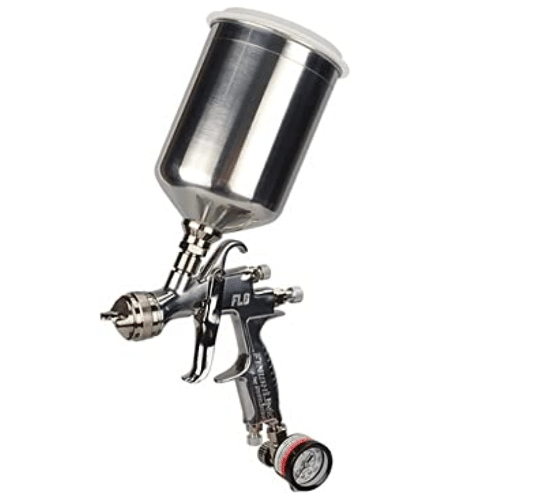
1. DeVilbiss FinishLine 4 (FLG-670) Solvent Based HVLP Gravity Feed
Product Description:
The DeVilbiss FinishLine 4 (FLG-670) bridges the gap between affordable hobbyist guns and $700 commercial paint weapons. As a pro-sumer heavyweight, it utilizes DeVilbiss’s renowned atomization technology, ensuring paint goes on wet and lays down flat. Crucially, this kit comes with three distinct fluid tips (1.3mm, 1.4mm, and 1.8mm), effectively giving you three specialized spray guns in one body to handle everything from heavy primer to delicate clear coat.
-
Price: Mid-Range/Premium (~$289 – $334)
-
Key Features and Benefits:
-
Features anodized internal passages and high-grade stainless steel needles and fluid nozzles for extreme durability and easy solvent cleaning.
-
Includes 1.3mm, 1.4mm, and 1.8mm fluid nozzles.
-
Comes with a 900cc aluminum gravity-feed cup.
-
Requires an air compressor capable of delivering 13 CFM at 23 PSI.
-
-
Pros and Cons:
-
Pros: Incredible value with three tips included; lays down clear coat like glass; ultra-smooth trigger pull prevents hand fatigue.
-
Cons: Requires a very robust, high-volume air compressor (minimum 60-gallon tank recommended) to meet the 13 CFM demand.
-
-
Amazon Customer Ratings and Reviews: 4.7/5 stars. Users consistently praise how forgiving the gun is for intermediate painters, noting that it drastically reduces the amount of wet-sanding and buffing required after clear coating.
-
Why It’s a Good Choice: It offers professional-grade atomization without stepping into the intimidating commercial price bracket. It is the definition of a “buy it for life” DIY tool.
-
Ideal Use Case: Serious DIYers, restorers, and semi-professionals spraying solvent-based primers, base coats, and clear coats who already own a large air compressor.
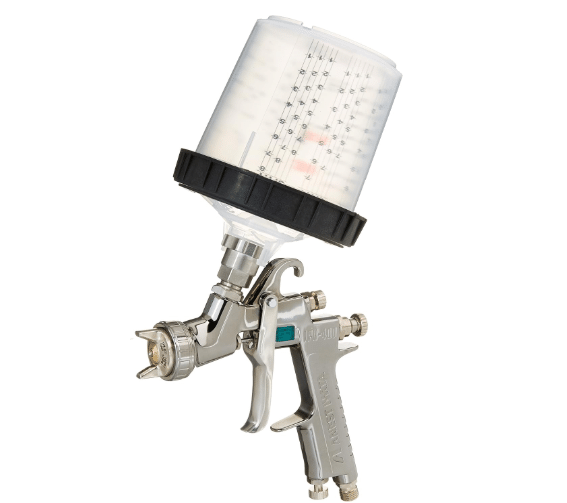
2. Iwata LPH400-144LV Gravity Feed Heavy Duty Spray Gun
Product Description:
Ask any veteran body shop painter what they use for clear coats and difficult metallic base coats, and the Iwata LPH400 is almost always the answer. This is the absolute pinnacle of Japanese precision engineering. It is famed for its patented “Tulip” spray pattern—an incredibly uniform, soft spray that flawlessly atomizes paint, ensuring metallic flakes lay perfectly flat without mottling or striping.
-
Price: Premium (~$663 – $719 for the gun alone)
-
Key Features and Benefits:
-
LVLP technology operates at incredibly low pressures (requires only 16 PSI at the inlet and ~10 PSI at the cap).
-
Features a 1.4mm nozzle with Split Nozzle Pre-Atomization Technology.
-
Extremely lightweight and ergonomic body (weighs roughly 1 lb).
-
Incredible transfer efficiency reduces paint waste.
-
-
Pros and Cons:
-
Pros: Unmatched atomization precision; uses significantly less air than standard HVLP guns (making it friendlier to smaller compressors); drastically reduces overspray.
-
Cons: Very expensive upfront cost; typically sold without a mixing cup (cup must be purchased separately or used with a disposable cup system).
-
-
Amazon Customer Ratings and Reviews: 4.8/5 stars. Professional painters frequently state this gun pays for itself in a few months simply through the amount of expensive paint it saves via high transfer efficiency.
-
Why It’s a Good Choice: When you are spraying $300-a-gallon pearl or metallic base coats, a cheap gun will ruin the job with uneven striping. The Iwata LPH400 guarantees a flawless, even application every single time.
-
Ideal Use Case: Professional auto body painters and perfectionist restorers laying down high-end metallic base coats and premium clear coats.
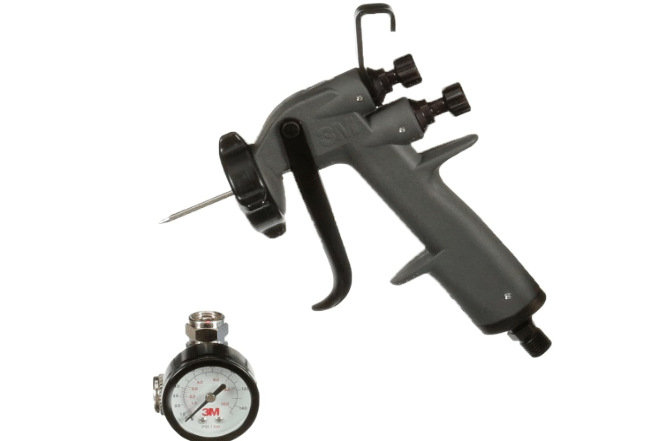
3. 3M Performance Spray Gun System (26832)
Product Description:
The 3M Performance Spray Gun System is a revolutionary shift in automotive painting. Instead of a traditional heavy metal body with fixed internal passages that require meticulous solvent soaking and brushing to clean, this gun utilizes a lightweight, impact-resistant composite body paired with quick-change, disposable atomizing heads. You simply snap on a new nozzle, spray, and toss it when you’re done.
-
Price: Premium (~$347 – $482)
-
Key Features and Benefits:
-
Ultra-lightweight impact-resistant composite body reduces painter fatigue.
-
Utilizes quick-change replaceable nozzles ranging from 1.2mm up to 2.0mm.
-
Integrates flawlessly with the highly regarded 3M PPS 2.0 disposable cup system.
-
Capable of spraying both pressure-fed and gravity-fed coatings.
-
-
Pros and Cons:
-
Pros: Slashes cleanup time from 15 minutes down to 1 minute; you essentially get a “brand new” spray gun every time you snap on a fresh nozzle; incredibly lightweight.
-
Cons: Requires the ongoing, recurring expense of buying replacement nozzles and PPS cup liners.
-
-
Amazon Customer Ratings and Reviews: 4.6/5 stars. Professional body men and busy DIYers rave about how much time and costly lacquer thinner this system saves them every week.
-
Why It’s a Good Choice: It completely eliminates the risk of cross-contamination (e.g., spraying clear coat through a gun that previously had microscopic specs of primer trapped inside it).
-
Ideal Use Case: High-production auto body shops or busy DIYers who despise the tedious teardown and cleanup process of traditional spray guns.
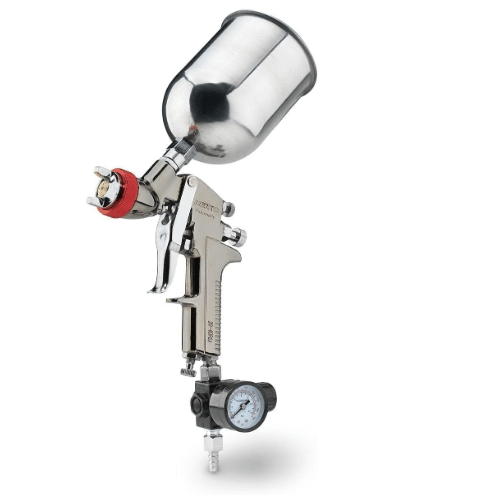
4. Neiko 31215A HVLP Gravity Feed Air Spray Gun
Product Description:
A flawless paint job relies entirely on the foundation underneath it. The Neiko 31215A is the undisputed king of budget spray guns, engineered specifically to lay down that foundation. Equipped with a large 1.7mm nozzle, it is perfectly suited for pushing thick, heavy automotive materials that would otherwise clog a standard clear-coat gun.
-
Price: Budget (~$40 – $42)
-
Key Features and Benefits:
-
Rust-resistant stainless steel 1.7mm nozzle and solid brass cap.
-
Includes a 600cc aluminum cup with a tethered lid.
-
Comes packaged with a handy inline air gauge/regulator.
-
Classic HVLP gravity-feed design.
-
-
Pros and Cons:
-
Pros: Extremely affordable; highly durable aluminum cup; perfect nozzle size for high-build primers.
-
Cons: The atomization is not refined enough for high-end clear coats; it consumes a significant amount of air (requires ~14.5 CFM), making it tough on small compressors.
-
-
Amazon Customer Ratings and Reviews: 4.5/5 stars. Countless reviewers note that they bought this solely to spray 2K urethane primer or truck bed liner, and it performed the heavy-duty task flawlessly.
-
Why It’s a Good Choice: You should never spray thick primer and delicate clear coat through the same gun. At this price point, the Neiko serves as the perfect dedicated “primer gun,” keeping your expensive guns pristine for the final finish.
-
Ideal Use Case: Beginners, budget restorers, and anyone needing a dedicated gun for spraying heavy primers, sealers, and bed liners.
5. Fuji Spray 2203G Semi-PRO 2 Gravity HVLP Turbine System
Product Description:
What happens if you want professional automotive paint results, but you don’t have the space or budget for a massive 60-gallon, 220V air compressor? You buy the Fuji Spray Semi-PRO 2. This is a complete, self-contained turbine painting system. The powerful electric turbine generates its own clean, dry air, feeding it directly to the specialized non-bleed spray gun.

-
Price: Premium (~$566)
-
Key Features and Benefits:
-
Powered by a dedicated 2-stage, 1400-watt turbine motor.
-
Professional non-bleed M-Model spray gun with an ergonomic, heat-insulated handle.
-
Comes with a 1.3mm stainless steel air cap installed and a 400cc gravity cup.
-
Includes a 25-foot flexible hose with an air control valve to dial in bounce-back and overspray.
-
-
Pros and Cons:
-
Pros: Completely bypasses the need for an air compressor; ensures 100% dry, oil-free air (eliminating fish-eyes in the paint); highly portable.
-
Cons: The turbine unit is loud (similar to a shop vacuum); the air traveling through the hose can get warm during extended spraying sessions, potentially speeding up the flash time of the paint.
-
-
Amazon Customer Ratings and Reviews: 4.7/5 stars. DIY car builders love the independence this system provides, noting the finish quality easily rivals traditional compressor-fed pneumatic guns.
-
Why It’s a Good Choice: It solves the biggest logistical nightmare of home garage painting. You get a steady, high-volume air supply without worrying about moisture traps, CFM ratings, or upgrading your garage electrical panel.
-
Ideal Use Case: Home garage DIYers who do not own a massive air compressor but demand professional-level atomization for base and clear coats.
6. TCP Global Complete Professional 3-Gun HVLP Spray Gun Set
Product Description:
If you are starting an automotive restoration from scratch and currently own zero painting equipment, the TCP Global 3-Gun kit is the ultimate starter package. Instead of forcing you to swap fluid tips on a single gun, this kit provides three entirely separate spray guns, each dedicated to a specific phase of the painting process.

-
Price: Budget/Mid-Range (~$150)
-
Key Features and Benefits:
-
Gun 1: 1.8mm fluid tip for thick primers and spray putties.
-
Gun 2: 1.4mm fluid tip for single-stage paints, base coats, and clear coats.
-
Gun 3: 1.0mm fluid tip mini detail gun for door jambs, motorcycle parts, and touch-ups.
-
Includes an inline air pressure regulator and a maintenance/cleaning kit.
-
-
Pros and Cons:
-
Pros: Unbeatable value for three dedicated tools; absolutely eliminates cross-contamination between primer and clear coat.
-
Cons: Entry-level build quality means you should tighten all seals and fittings out of the box; not suitable for commercial daily use.
-
-
Amazon Customer Ratings and Reviews: 4.4/5 stars. Reviewers highly recommend taking the guns apart and cleaning them thoroughly with thinner before the first use, after which they spray surprisingly well for the price.
-
Why It’s a Good Choice: It instantly equips you with an entire automotive painting arsenal for less than the cost of a single mid-range spray gun.
-
Ideal Use Case: First-time painters tackling full car restorations on a tight budget who need to spray every layer from bare metal up to clear coat.
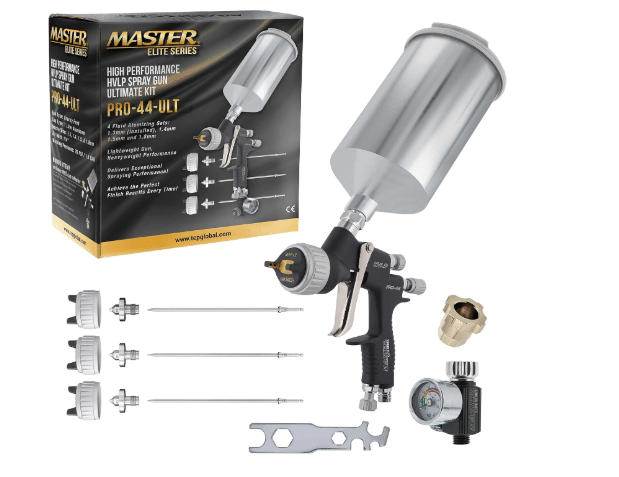
7. Master Pro 44 Series High-Performance HVLP Spray Gun
Product Description:
The Master Pro 44 Series is a highly respected mid-tier option that mimics the ergonomics, weight, and performance of high-end European spray guns without the punishing price tag. Featuring a masterfully machined 1.3mm fluid tip, it is designed to atomize modern clear coats into a fine mist for a glass-smooth finish.
-
Price: Mid-Range (~$150)
-
Key Features and Benefits:
-
Advanced atomization technology ensures high transfer efficiency.
-
Precision-machined 1.3mm stainless steel needle and nozzle.
-
Compatible with both modern waterborne base coats and traditional solvent-based urethanes.
-
Includes a high-flow air regulator gauge and a 1-liter aluminum cup.
-
-
Pros and Cons:
-
Pros: Sprays clear coat exceptionally well; very comfortable in the hand for large, all-over paint jobs; easy to tear down and rebuild.
-
Cons: Slightly heavier than premium composite or titanium-forged guns.
-
-
Amazon Customer Ratings and Reviews: 4.6/5 stars. Intermediate painters frequently cite the Pro 44 as the best “next step up” from their cheap starter guns, noting a massive reduction in orange peel.
-
Why It’s a Good Choice: It effectively bridges the gap between $40 throwaway guns and $600 pro guns. It delivers 90% of the performance of the elite brands for a fraction of the cost.
-
Ideal Use Case: Intermediate painters looking to upgrade their finish quality—specifically their clear coat—without breaking the bank.
8. Astro Pneumatic Tool 4008 Spray Gun with 1.8mm Nozzle
Product Description:
Automotive bodywork isn’t always delicate. When you are aggressively pushing thick materials like high-build 2K primers, heavy sealers, or even automotive contact cements and glues, you need a rugged, no-nonsense tool. The Astro Pneumatic 4008 is a traditional siphon/pressure hybrid styled gun that acts as the ultimate heavy-duty workhorse.

-
Price: Budget (~$40 – $50)
-
Key Features and Benefits:
-
Massive 1.8mm nozzle for thick, high-viscosity materials.
-
1-quart dripless aluminum cup assembly (often set up as a siphon feed).
-
Fully adjustable, extremely wide fan pattern.
-
Two-piece construction makes it incredibly easy to rebuild or soak in solvent.
-
-
Pros and Cons:
-
Pros: Unstoppable when spraying thick fluids; highly durable “old school” metal construction; very cheap to rebuild.
-
Cons: It is a conventional (non-HVLP) style gun in many configurations, meaning it produces massive amounts of overspray and wastes material compared to modern HVLP designs.
-
-
Amazon Customer Ratings and Reviews: 4.5/5 stars. Old-school auto body veterans love this gun for its simplicity and ruggedness, often using it exclusively for sprayable body filler and heavy polyester primers.
-
Why It’s a Good Choice: It handles the heavy, messy, abrasive work of automotive body prep so you don’t ruin the delicate micro-machining of your dedicated clear-coat gun.
-
Ideal Use Case: Auto body specialists and DIYers who are in the aggressive block-sanding and priming phase of a build.
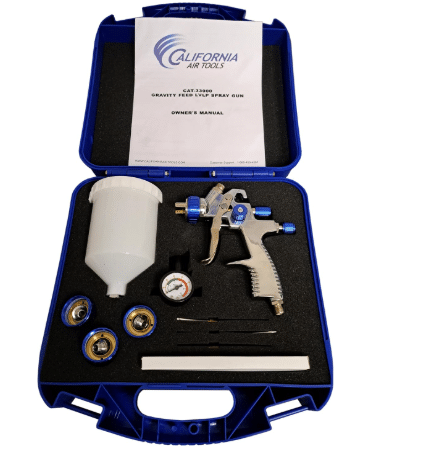
9. SPRAYIT SP-33000K LVLP Gravity Feed Spray Gun Kit
Product Description:
Air starvation is the number one reason DIY paint jobs fail. If you try to run an HVLP gun on a standard 20-gallon compressor, the pressure will drop halfway down the car door, causing the gun to spit giant droplets of paint. The SPRAYIT SP-33000K solves this by utilizing LVLP (Low Volume Low Pressure) technology, allowing you to paint continuously without waiting for your small compressor to catch up.
-
Price: Budget (~$50 – $70)
-
Key Features and Benefits:
-
Ultra-low air consumption: Requires only 3.9 CFM at 30 PSI.
-
Kit includes 1.3mm, 1.5mm, and 1.7mm fluid tips to cover all stages of painting.
-
Lightweight, one-piece aluminum gun body.
-
Incredibly high transfer efficiency (less paint floating in the air).
-
-
Pros and Cons:
-
Pros: Defeats the hurdle of small air compressors; minimal overspray keeps your garage much cleaner; great value with three tips included.
-
Cons: Because it uses a low volume of air, the fan pattern is slightly smaller and it paints slower than a high-flow HVLP gun.
-
-
Amazon Customer Ratings and Reviews: 4.4/5 stars. Buyers with 20- to 30-gallon compressors consider this kit a lifesaver, allowing them to paint entire cars panel-by-panel without the compressor dying.
-
Why It’s a Good Choice: It is the ultimate equalizer for the home garage. LVLP keeps the pressure steady, ensuring a smooth, consistent finish even with underpowered air equipment.
-
Ideal Use Case: Garage DIYers attempting panel repairs, motorcycle tanks, or full paint jobs while restricted by smaller 110V air compressors.
10. DeVilbiss StartingLine HVLP Gravity Spray Gun Kit
Product Description:
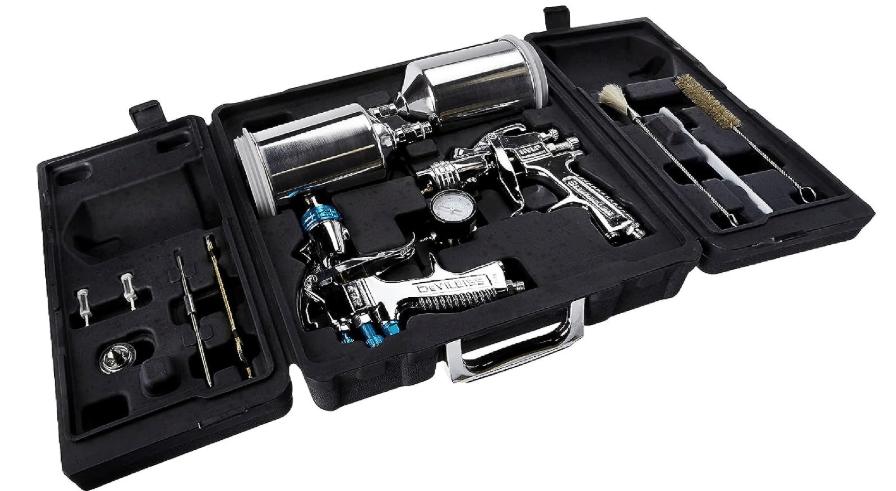
The StartingLine kit is the entry-level offering from industry-giant DeVilbiss. It is designed to provide reliable, brand-name atomization in a comprehensive, consumer-friendly package. By offering a full-size gun for the main body panels and a mini-gun for the tight spots, it covers all the bases for a weekend restoration.
-
Price: Mid-Range (~$160 – $190)
-
Key Features and Benefits:
-
Full-size HVLP spray gun with a 1.3mm tip installed (ideal for base/clear) and a spare 1.5mm tip (for single stage/sealers).
-
Mini HVLP detail gun with a 1.0mm tip for door jambs, engine bays, and small parts.
-
Includes a cleaning brush kit, wrench, and a durable blow-molded storage case.
-
-
Pros and Cons:
-
Pros: Gets you into the DeVilbiss ecosystem at a fraction of the cost; very consistent spray patterns; the inclusion of the mini-gun is highly valuable for intricate automotive work.
-
Cons: Unlike the high-end DeVilbiss guns (which are made in the USA or UK), the StartingLine series is outsourced to Taiwan/China to keep costs down, featuring slightly lower-tier internal components.
-
-
Amazon Customer Ratings and Reviews: 4.6/5 stars. Hobbyists appreciate the smooth trigger action and note that it lays down a far superior clear coat compared to the $40 budget guns.
-
Why It’s a Good Choice: You get the trusted engineering geometry of a DeVilbiss air cap and a highly consistent fan pattern without having to finance a commercial tool.
-
Ideal Use Case: Automotive hobbyists and weekend warriors who want the peace of mind of a reputable brand, but don’t quite need the daily durability of the professional FinishLine series.
V. Final Verdict
Achieving a flawless, mirror-like automotive finish in your own garage is entirely possible—but it requires respecting the chemistry of the paint and the physics of your equipment. A cheap, uncalibrated spray gun will handicap even the most talented painter, while a precision-machined gun will elevate an amateur’s work to professional levels.
Always remember to match your spray gun’s CFM requirements to the output of your air compressor, and follow the golden rule of auto body: never spray your delicate clear coat through the same gun you used to spray heavy primer.
Frequently Asked Questions (FAQ)
What is the difference between HVLP, LVLP, and Conventional spray guns?
-
HVLP (High Volume Low Pressure): This is the modern industry standard. HVLP guns use a high volume of air at a low pressure to atomize the paint. This results in excellent transfer efficiency (often 65% or more), meaning more paint lands on the car and less is wasted as overspray in the air. However, they require a substantial air compressor to maintain that high volume.
-
LVLP (Low Volume Low Pressure): These guns operate efficiently on smaller, lower-CFM air compressors while still providing excellent atomization. They are the most compressor-friendly option, making them ideal for home garages. They produce the least amount of overspray but generally have a narrower fan pattern and paint slightly slower than HVLP guns.
-
Conventional (High Pressure): These older-style guns operate at much higher air pressures (often 40-60+ PSI). While they deliver extremely fine atomization, they have poor transfer efficiency (often around 30%), meaning they create massive amounts of overspray and waste a lot of expensive paint.
What size fluid tip (nozzle) do I need?
The correct tip size depends entirely on the viscosity (thickness) of the material you are spraying. Using the wrong tip will result in poor atomization or a clogged gun.
-
1.0mm – 1.2mm: Ideal for very thin materials like sealers, light clear coats, or detail work on small parts.
-
1.3mm – 1.4mm: The “sweet spot” for most automotive base coats (especially metallics and pearls) and standard clear coats. If you can only buy one gun for base and clear, a 1.4mm is generally the best all-rounder.
-
1.5mm – 1.6mm: Best for thicker single-stage paints (where color and gloss are mixed) and enamels.
-
1.7mm – 2.0mm+: Mandatory for spraying thick, heavy-build primers, polyester primers, and heavy glues or bed liners. Never spray primer and clear coat through the same gun.
What does CFM mean, and why is it more important than PSI?
CFM (Cubic Feet per Minute) measures the volume of air your compressor can deliver. PSI (Pounds per Square Inch) measures the pressure.
Many beginners buy a spray gun that requires 13 CFM, but their small pancake compressor only produces 4 CFM. Even if the compressor can reach the required 30 PSI, it cannot maintain the volume of air needed. As you pull the trigger, the pressure will immediately drop mid-panel, causing the gun to sputter and spit large drops of paint onto the car.
Always check your compressor’s CFM rating at 40 or 90 PSI (depending on how it is rated) and ensure it exceeds your spray gun’s CFM requirement by at least 20% to prevent the compressor from running continuously.
Why is my paint finish coming out like “orange peel”?
Orange peel (a bumpy texture resembling the skin of an orange) is one of the most common painting defects. It is usually caused by poor atomization. Common culprits include:
-
Air pressure too low: Increase the PSI at the regulator to break the paint into finer droplets.
-
Paint is too thick (high viscosity): Ensure you have mixed the paint with the correct ratio of reducer/thinner according to the manufacturer’s technical data sheet (TDS).
-
Gun distance: Holding the gun too close or moving too fast.
-
Tip size too large: Using a 1.8mm tip for a thin clear coat will lay down too much fluid at once.
-
CFM Drop: Your compressor cannot keep up, causing a drop in pressure while spraying.
Why is my spray gun spitting or sputtering?
If your gun is spitting blobs of paint rather than a fine mist, check the following:
-
Loose fluid nozzle: If the nozzle isn’t screwed on tightly, air can bypass it and cause sputtering.
-
Clogged vent hole: The small vent hole on the lid of gravity-feed cups must be clear. If it clogs, it creates a vacuum that starves the gun of fluid.
-
Worn packing or seals: Air may be leaking into the fluid passage.
-
Insufficient CFM: As mentioned above, a lack of air volume from the compressor will cause sputtering.
Where should I set my air pressure—at the compressor or the gun?
You should set the main pressure at the wall regulator or compressor to be slightly higher than what you need. Then, attach a small, high-quality diaphragm regulator directly to the air inlet at the base of the spray gun.
Crucial Tip: Always set your final pressure at the gun regulator with the trigger pulled halfway (air flowing, but no fluid). This gives you the “dynamic” working pressure. If you set the pressure while the gun is closed, it will drop significantly the moment you pull the trigger due to line friction.
How do I clean my spray gun properly?
Automotive paints (especially catalyzed urethanes) will permanently destroy a spray gun if allowed to harden inside the passages.
-
Empty excess paint.
-
Fill the cup with the appropriate solvent (lacquer thinner for solvent paints, water/gun wash for waterborne paints).
-
Spray the solvent through the gun until it sprays completely clear.
-
Disconnect the air, remove the air cap, fluid nozzle, and needle.
-
Use a dedicated spray gun cleaning brush kit (never use metal wire brushes that can scratch the precision brass/stainless parts) to clean all removed parts and the internal fluid passages.
-
Reassemble and spray a tiny amount of clean solvent through to ensure it is perfectly clear