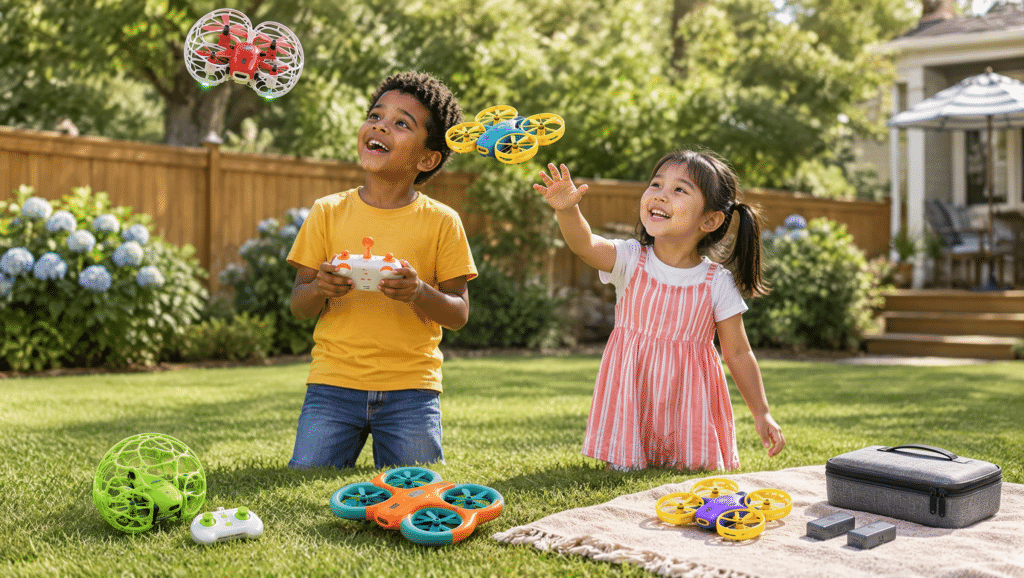
You’ve seen it happen: a parent orders a cheap “kids drone” that looks perfect in the photos, only to watch it crash into a wall within the first 10 minutes, snap a propeller, and end up in the trash—or worse, spin dangerously close to a child’s face. Finding the best 10 kids drone options shouldn’t feel this risky or frustrating.
Parents want something better than another screen. They want outdoor play that builds coordination, curiosity, and real STEM skills. Yet most toys sold as kids drones are fragile, hard for beginners to control, lack proper propeller guards, run out of battery in minutes, or jump straight to advanced features that overwhelm younger pilots. Add the flood of hundreds of Amazon listings, conflicting age recommendations, and worries about FAA rules or injuries, and the buying decision becomes overwhelming.
This guide cuts through the noise. We’ve analyzed current Amazon ratings, sales data, and expert roundups to identify the best 10 kids drone models that actually deliver on safety, durability, and fun. You’ll find clear priorities—full propeller guards, altitude hold, crash survivability, multiple batteries, and true age matching—plus side-by-side comparisons and honest “who should buy” guidance for every recommendation. Whether you’re shopping for a 6-year-old’s first flight or a teen ready for aerial photos, these picks help you choose confidently and avoid buyer’s remorse.
Quick Verdict: Our Top Picks at a Glance
- Best Overall (Ages 6–12): HASAKEE Q9s — Full-perimeter guards, two batteries, altitude hold, and excellent crash survival.
- Best Budget / First Drone: Holy Stone HS210 — Three batteries, rock-solid hover, and proven durability at a low price.
- Best for Youngest Kids (5–8): Force1 Scoot — Hand-operated, no remote required, and enclosed for maximum safety.
- Best Camera Option for Older Kids & Teens: DJI Neo — Palm takeoff, 4K video, full guards, and under 250 g.
- Best Value with Camera: DEERC D20 — 1080p FPV, altitude hold, and beginner-friendly features.
- Best Obstacle Avoidance: SYMA X100 — Automatic obstacle sensing plus full guards for safer indoor flying.
These six stand out most strongly from current Amazon data and expert testing. The full list of 10 appears below with deeper details.
How We Chose the Best 10 Kids Drones
We prioritized what parents actually care about when buying a drone for a child:
- Safety first — Full propeller guards (or fully enclosed designs), one-key takeoff/landing, and altitude hold so the drone doesn’t drift into walls or faces.
- Crash survivability — Lightweight frames and protective shells that can take repeated hard landings without breaking.
- Ease of learning — Headless mode, multiple speed settings, and intuitive controls that let kids succeed on the first try.
- Flight time — Multiple batteries included so play sessions last longer than 7–8 minutes.
- Age matching — Clear recommendations for 5–8, 8–12, and 12+ so you don’t overbuy or underbuy.
- Weight under 250 g — No FAA registration required for recreational use in the United States.
- Real-world data — High Amazon ratings (typically 4.2+), strong recent sales volume, and consistent praise in independent 2026 reviews for durability and value.
We avoided drones with exposed props, single short-life batteries, or features that only advanced teens can use. The result is a practical, parent-focused list rather than a pure “coolest specs” ranking.
Comparison Table (Mobile-Friendly)
| Product | Best For | Price |
|---|---|---|
| HASAKEE Q9s | Most kids ages 6–12 | ~$39.98 |
| Holy Stone HS210 | Budget beginners | ~$39.99 |
| Force1 Scoot | Youngest kids (5–8) | ~$18.99 |
| SYMA X100 | Indoor safety & obstacle avoidance | ~$44.99 |
| DEERC D20 | First camera drone | ~$49.99 |
| DJI Neo | Older kids & teens (camera) | ~$299.00 |
| Holy Stone HS190 | Portable foldable fun | ~$32.99 |
| Pallton / similar 1080p | Gesture selfies & value camera | ~$39.99 |
| SNAPTAIN H823H | Ultra-budget first flyer | ~$145.99 |
| Potensic ATOM SE | Step-up GPS camera (older kids) | ~$249.99 |
Prices fluctuate; always check the current Amazon listing. All recommended models weigh under 250 g.
In-Depth Reviews of the Best 10 Kids Drones
1. HASAKEE Q9s – Best Overall Kids Drone
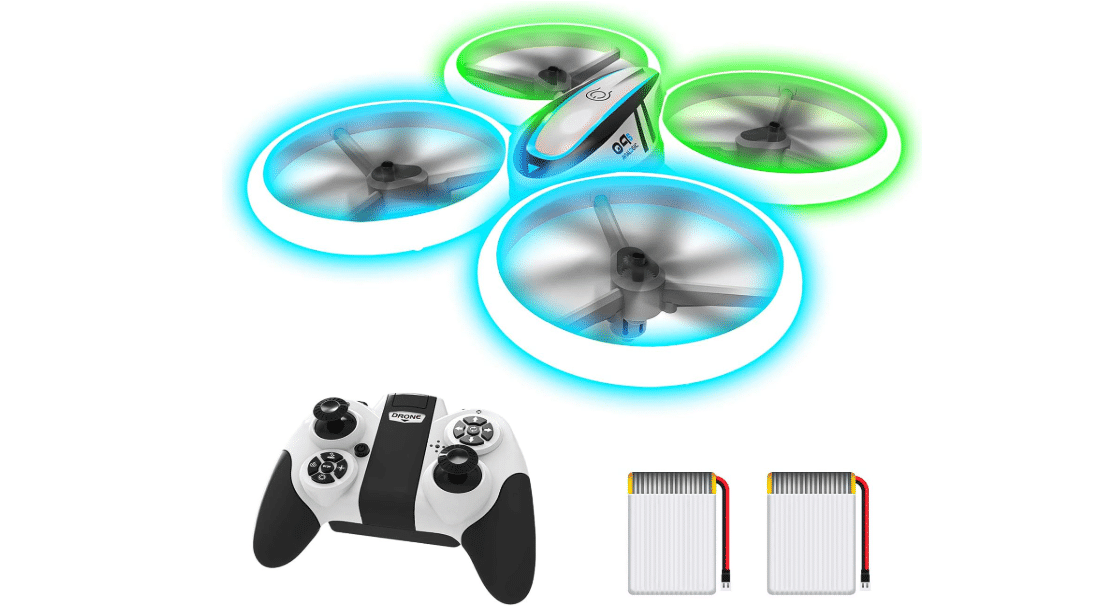
The HASAKEE Q9s consistently ranks as one of the strongest all-around choices for children ages 6 and up. It features full-perimeter propeller guards that completely surround the blades, dramatically reducing the chance of injury or damage during the inevitable early crashes. Altitude hold keeps the drone steady in the air so kids can focus on steering instead of constantly fighting to stay level. One-button takeoff and landing remove the biggest beginner frustration, while headless mode means the drone responds relative to the pilot rather than its own orientation.
It comes with two 500 mAh batteries, giving roughly 16–20 minutes of total flight time depending on conditions. Bright blue and green LED lights make it easy to track outdoors or in low light and add a fun visual element kids love. The remote is simple and responsive, with multiple speed settings that let younger pilots start slow and progress as they gain confidence.
Price: $39.98
Key Features & Benefits: Full propeller protection, altitude hold, one-key takeoff/landing, headless mode, dual batteries, LED light modes, 360° flips.
Pros: Excellent crash resistance, long enough play sessions, very beginner-friendly, strong Amazon sales and ratings.
Cons: No camera (pure flying fun), limited outdoor wind resistance like most mini drones.
Amazon Ratings: Around 4.3 stars from 6,000+ reviews. Parents frequently praise how well it survives wall and floor impacts and how quickly kids learn to fly it.
Why It’s a Good Choice: It balances safety, durability, and fun better than almost any other sub-$50 option.
Ideal Use Case / Who Should Buy: Perfect for most children ages 6–12 who need a reliable first or second drone for backyard or indoor flying. Ideal if you want maximum protection without spending camera-drone money.
2. Holy Stone HS210 – Best Budget / Highest-Volume Beginner Pick
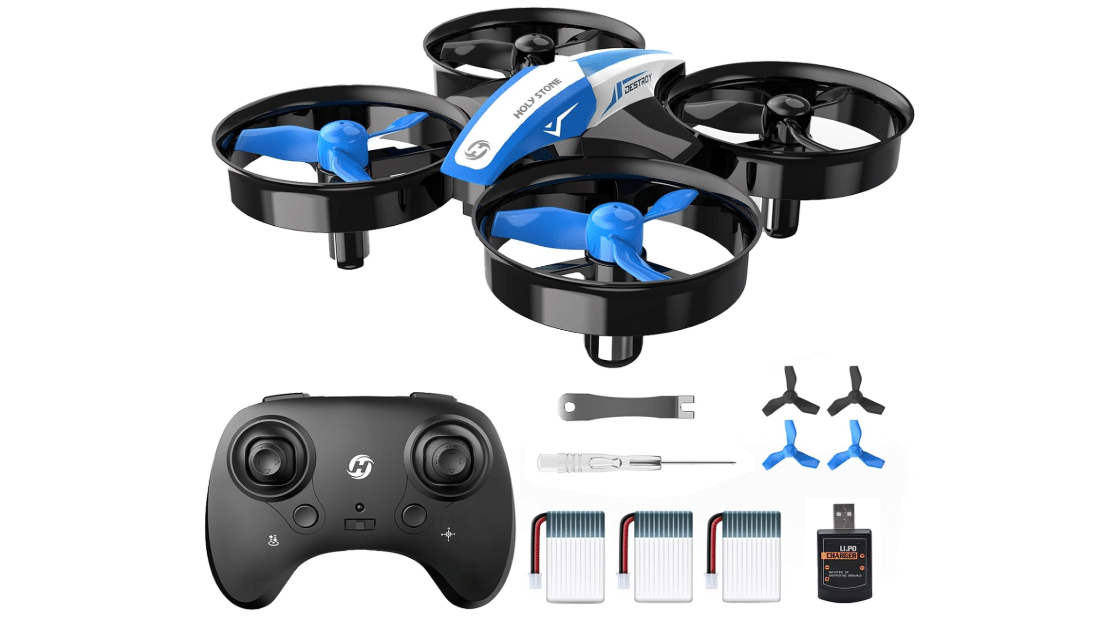
The Holy Stone HS210 has earned its reputation through sheer volume of positive real-world use. This tiny nano drone includes three batteries right in the box, delivering up to 21 minutes of total flight time—far more than most competitors at this price. Full propeller guards, altitude hold, and headless mode make it one of the easiest drones for true beginners to control. Three speed modes let kids start ultra-slow and gradually increase challenge.
At only about 50 grams, it is light enough that crashes rarely cause serious damage. The remote is straightforward, and the drone is quiet enough for indoor use without disturbing the whole house. Holy Stone’s reputation for spare parts availability is another quiet advantage—replacement props and batteries are easy to find if needed.
Price: $39.99
Key Features & Benefits: Three batteries, altitude hold, propeller guards, headless mode, 3D flips, one-key takeoff/landing, three speed settings.
Pros: Outstanding battery value, proven durability, simple learning curve, quiet operation.
Cons: No camera, shorter range than larger models, can drift slightly in stronger indoor air currents.
Amazon Ratings: Approximately 4.2 stars from more than 15,000 reviews. Reviewers repeatedly call it “the perfect first drone” and note how long the three batteries keep kids flying.
Why It’s a Good Choice: Maximum flight time and beginner features at a price that doesn’t hurt if it eventually takes a hard hit.
Ideal Use Case / Who Should Buy: Best for ages 6–10 who are completely new to drones or for families who want a low-risk, high-fun entry point. Excellent indoor trainer.
3. Force1 Scoot – Best Hand-Operated Drone for Youngest Kids
For children who are not yet ready for joysticks, the Force1 Scoot (and its Duo pack variants) removes the remote entirely. Kids simply hold their hand underneath or near the drone and use motion to control direction and height. A full protective webbed shell completely encloses the propellers, making it one of the safest options available for ages 5–8. Built-in obstacle sensors help it bounce or stop rather than crash hard into walls or furniture.
LED lights add visual appeal, and the soft shell survives the kind of rough play that destroys traditional mini drones. Flight time is shorter (typically 6–8 minutes per charge), but the fun factor and zero-learning-curve design make it ideal for the youngest pilots. Many parents buy the two-pack so siblings or friends can fly together.

Price: $18.99
Key Features & Benefits: Fully enclosed design, hand/gesture control, 360° obstacle sensors, LED lights, soft protective shell.
Pros: No remote needed, maximum safety, highly engaging for young children, durable shell.
Cons: Limited flight time, less precise control than stick-based drones, not suitable for older kids who want more challenge.
Amazon Ratings: Strong 4.3-star range with consistent praise for safety and how quickly young children engage with it.
Why It’s a Good Choice: It solves the “my child is too young for a remote” problem better than any traditional quadcopter.
Ideal Use Case / Who Should Buy: Ages 5–8 or any child who struggles with dual-stick controls. Perfect indoor toy for rainy days or small spaces.
4. SYMA X100 – Best Obstacle Avoidance & Indoor Safety
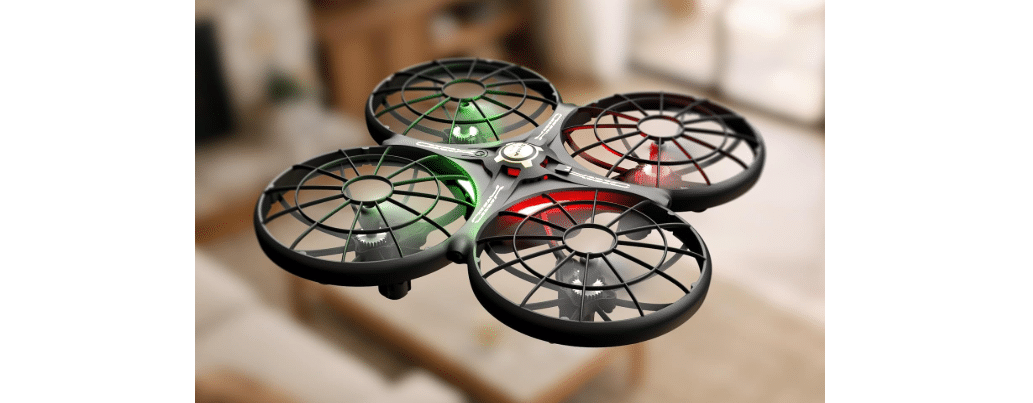
The SYMA X100 stands out by adding automatic obstacle avoidance to a fully guarded mini drone. Infrared or optical sensors help it detect and avoid walls, furniture, and people—reducing the number of hard crashes that end play sessions early. Full propeller guards, altitude hold, one-key takeoff, and two batteries combine to create a very forgiving indoor flyer.
Flight time reaches about 20 minutes total with the included batteries. The design prioritizes safety and ease, making it especially strong for younger or more cautious pilots who fly mostly indoors. Multiple flight modes and 360° flips keep it entertaining as skills improve.
Price: $44.99
Key Features & Benefits: Obstacle avoidance sensors, full guards, altitude hold, dual batteries, one-key functions, indoor-optimized.
Pros: Fewer crashes thanks to avoidance tech, excellent indoor performance, solid battery package.
Cons: Obstacle sensors are not perfect in all lighting, no high-quality camera on most versions.
Amazon Ratings: Around 4.4 stars with strong feedback on the avoidance feature and overall durability.
Why It’s a Good Choice: It actively helps prevent the most common beginner mistakes.
Ideal Use Case / Who Should Buy: Families who fly primarily indoors or want the safest possible learning experience for ages 7–12.
5. DEERC D20 – Best Value Camera Drone for Beginners
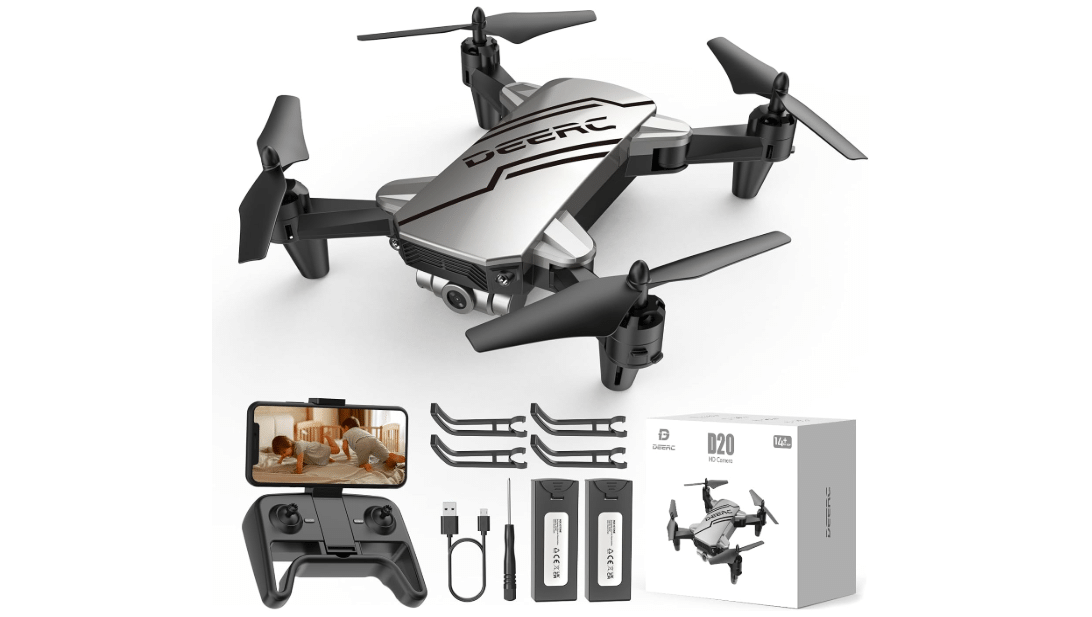
The DEERC D20 (and closely related D20S variants) is one of the most popular entry-level camera drones on Amazon for kids and beginners. It packs a 1080p or 720p FPV camera that streams live video to a smartphone, giving children their first taste of seeing the world from above. Altitude hold, one-key takeoff and landing, headless mode, and three speed settings make it far more stable and forgiving than older toy drones. Two batteries are typically included, providing around 16–20 minutes of total flight time.
The foldable design and lightweight frame (well under 100 g) make it easy to store and transport. Gesture controls and voice commands on some versions add extra fun, while propeller guards help protect both the drone and nearby people during the learning phase. Wind resistance is limited, so it performs best indoors or on calm outdoor days.
Price: $49.99
Key Features & Benefits: 1080p/720p FPV camera, altitude hold, headless mode, one-key start, multiple speed modes, dual batteries, foldable design, gesture/voice options on many units.
Pros: Real camera experience at a low price, beginner-friendly flight modes, good battery package, strong sales volume.
Cons: Camera quality is basic (not cinematic), can drift in even mild wind, build quality is plastic-toy level.
Amazon Ratings: Approximately 4.0 stars from nearly 20,000 reviews. Many parents note that kids love the live video feed and that the altitude hold makes learning much easier.
Why It’s a Good Choice: It bridges pure toy drones and more serious camera models without a big price jump.
Ideal Use Case / Who Should Buy: Ages 8–12 who want to try aerial photos and video for the first time. Great “step-up” after a no-camera nano drone.
6. DJI Neo – Best Premium Option for Older Kids & Teens
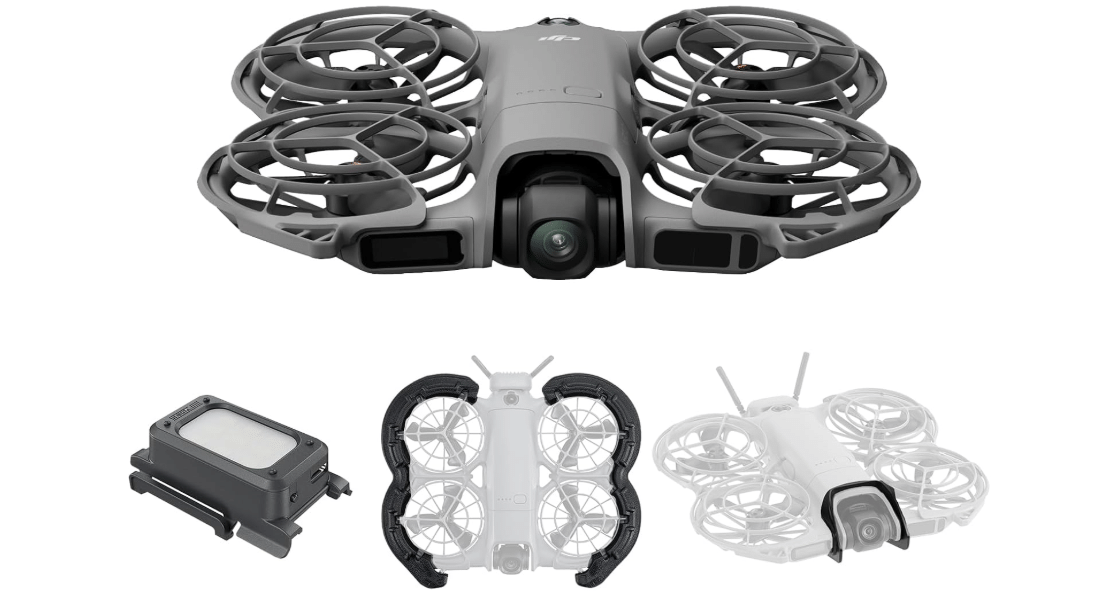
The DJI Neo (and newer Neo 2 variants) is the clear standout when a family is ready to move beyond basic toys. Weighing only 135 g (well under the 250 g threshold), it requires no FAA registration for recreational use. Full propeller guards, palm takeoff and landing, and intelligent flight modes (follow, circle, etc.) make it surprisingly approachable for supervised older children and teens. The camera delivers genuine 4K video and 12 MP photos with stabilization that far exceeds any sub-$100 toy drone.
Rated flight time is about 18 minutes per battery, and combo packages with extra batteries and a charging hub extend sessions significantly. The drone can be controlled via the DJI app on a phone or with optional remote controllers. Obstacle sensing on newer versions further improves safety. While it is more expensive, the build quality, camera performance, and software ecosystem justify the cost for families who want lasting value.
Price: $299.00
Key Features & Benefits: 4K camera, full propeller guards, palm takeoff/landing, intelligent flight modes, under 250 g, app control, optional motion or stick controllers, excellent stabilization.
Pros: Real aerial video quality, strong safety features for its class, future-proof software, highly portable.
Cons: Higher price, shorter single-battery flight time than some larger models, best with adult supervision at first.
Amazon & Retailer Ratings: Consistently 4.5+ stars. Reviewers praise the ease of getting cinematic shots and the confidence the guards provide.
Why It’s a Good Choice: It is the first “real” camera drone that still feels kid-appropriate thanks to the guards and simple launch methods.
Ideal Use Case / Who Should Buy: Ages 12+ (or mature 10–11 with supervision) who want to create videos of sports, family trips, or creative projects. Ideal when the family is ready to invest in a drone that can grow with the pilot.
7. Holy Stone HS190 – Best Portable Foldable Mini Drone
The Holy Stone HS190 folds neatly and even stores parts of the remote in some configurations, making it one of the most pocketable options. Altitude hold, headless mode, one-key takeoff/landing, and 3D flips deliver the core beginner features parents expect. Full propeller protection and a very light weight (around 35 g) help it survive the learning process. Flight time is shorter per battery, but the compact size and low price make it an excellent travel or secondary drone.
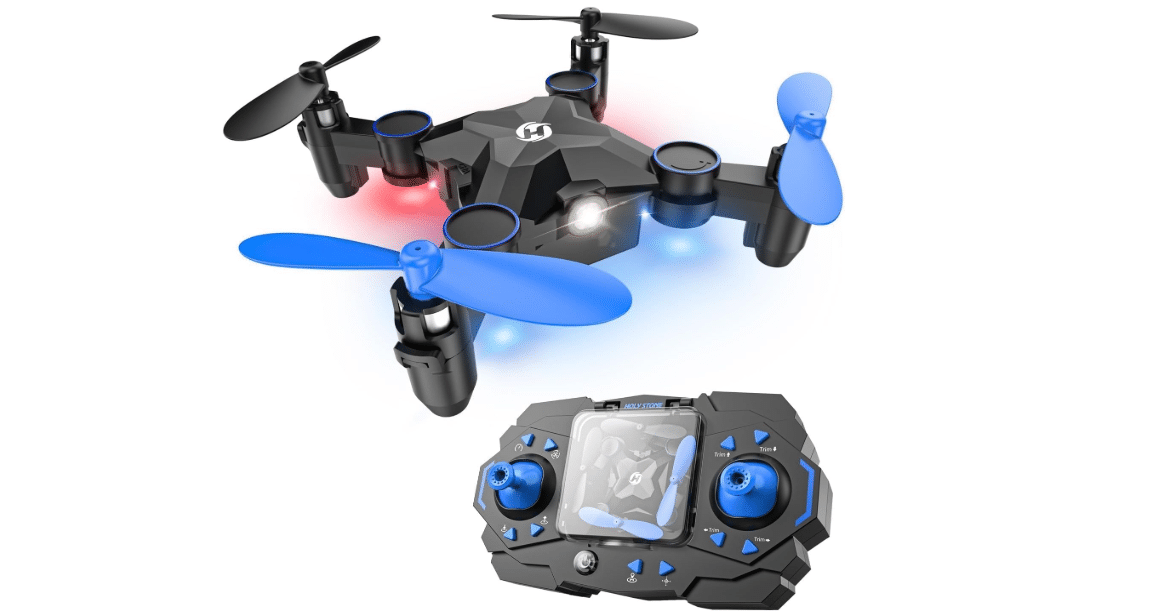
Price: $32.99
Key Features & Benefits: Foldable design, altitude hold, headless mode, propeller guards, 3D flips, one-key functions.
Pros: Extremely portable, inexpensive, easy for beginners, decent durability for the size.
Cons: No camera on most versions, limited flight time, short range.
Amazon Ratings: Around 4.2 stars from 10,000+ reviews. Frequently recommended as a “take-anywhere” first drone.
Why It’s a Good Choice: Convenience and simplicity at a very low cost.
Ideal Use Case / Who Should Buy: Families who travel, want a backup drone, or prefer something that disappears into a bag when not in use. Ages 6–10.
8. Pallton / Similar 1080p Foldable Camera Drones – Best Gesture-Selfie Value
Models in this popular Amazon category (Pallton X80 and close competitors) combine a 1080p camera, foldable arms, altitude hold, gesture selfie modes, and usually two batteries. They sit in the sweet spot between pure toys and more expensive camera drones. One-key takeoff, headless mode, and propeller guards keep them accessible for beginners, while the camera and gesture controls give kids an engaging “wow” factor.
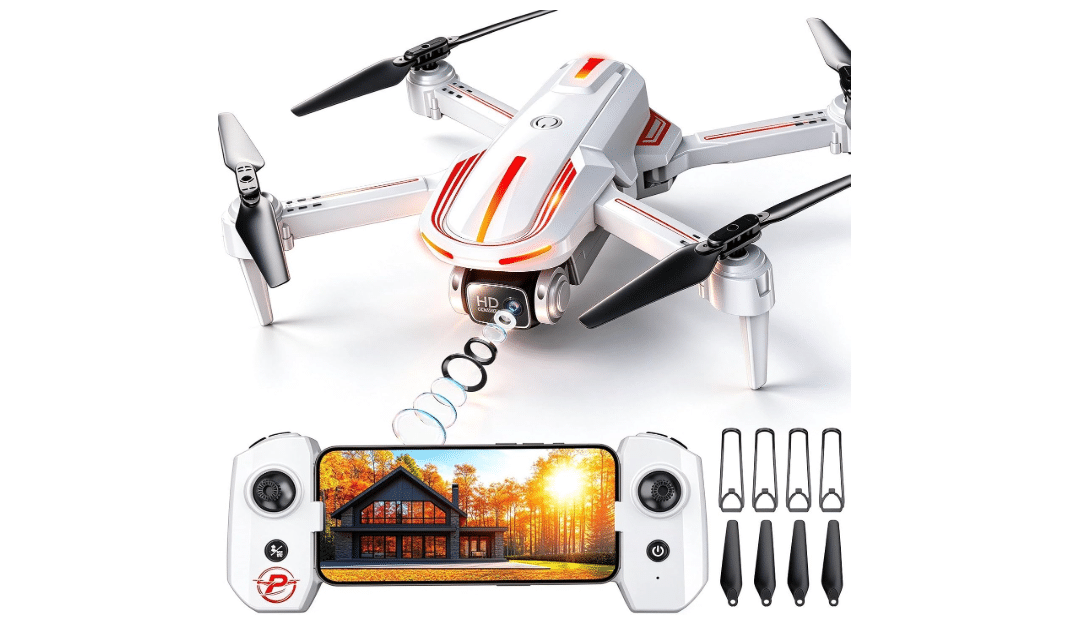
Price: $39.99
Key Features & Benefits: 1080p FPV camera, gesture control, altitude hold, foldable design, dual batteries, carrying case often included.
Pros: Fun camera features, good value, beginner modes, portable.
Cons: Image quality is average, wind performance is limited, build is still toy-grade.
Amazon Ratings: Frequently 4.4–4.6 stars with praise for the selfie modes and ease of use.
Why It’s a Good Choice: Delivers camera fun without jumping to premium pricing.
Ideal Use Case / Who Should Buy: Ages 8–13 who want photos and short videos of themselves or their surroundings. Strong birthday or holiday gift option.
9. SNAPTAIN H823H (or Equivalent Ultra-Budget Nano) – Best Ultra-Affordable First Flyer
At the lowest price tier, the SNAPTAIN H823H and similar nano drones offer 3D flips, headless mode, and basic altitude stability in a tiny, fully guarded package. They are not as refined as the Holy Stone or HASAKEE models, but they give children an inexpensive way to experience flight and learn basic stick control. Multiple batteries are sometimes included or easily added.
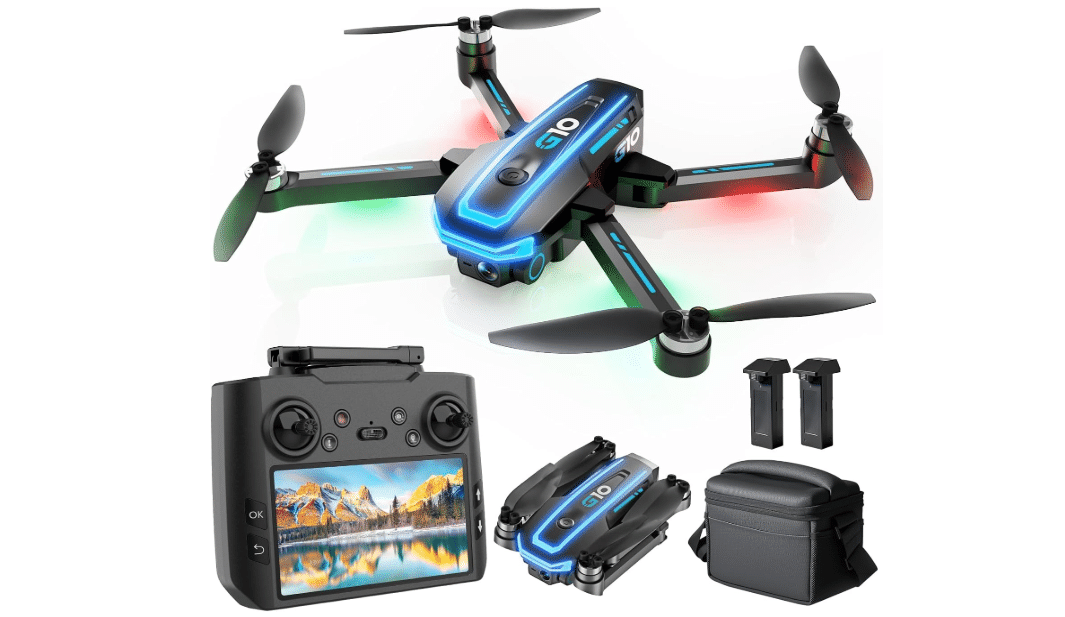
Price: $145.99
Key Features & Benefits: Propeller guards, headless mode, 3D flips, very lightweight, simple controls.
Pros: Lowest cost of entry, small and light, fun tricks.
Cons: Shorter flight times, more basic stability, higher chance of needing replacement parts sooner.
Amazon Ratings: Generally 4.1+ stars; buyers treat them as disposable fun rather than long-term tools.
Why It’s a Good Choice: Risk-free way to test whether a child enjoys flying before spending more.
Ideal Use Case / Who Should Buy: Ages 6–9 for pure introductory play or as a stocking stuffer. Not ideal as a long-term primary drone.
10. Potensic ATOM SE (or Similar Entry GPS Camera Drone) – Best Step-Up for Serious Young Pilots
For older kids and teens ready for GPS features, the Potensic ATOM SE (and comparable under-249 g models) offers 4K video with electronic image stabilization, longer flight times (often 30+ minutes with multiple batteries), return-to-home, and brushless motors. It remains under the 250 g limit while delivering noticeably better outdoor performance and camera quality than toy-level drones. Adult supervision is still recommended during the learning phase.
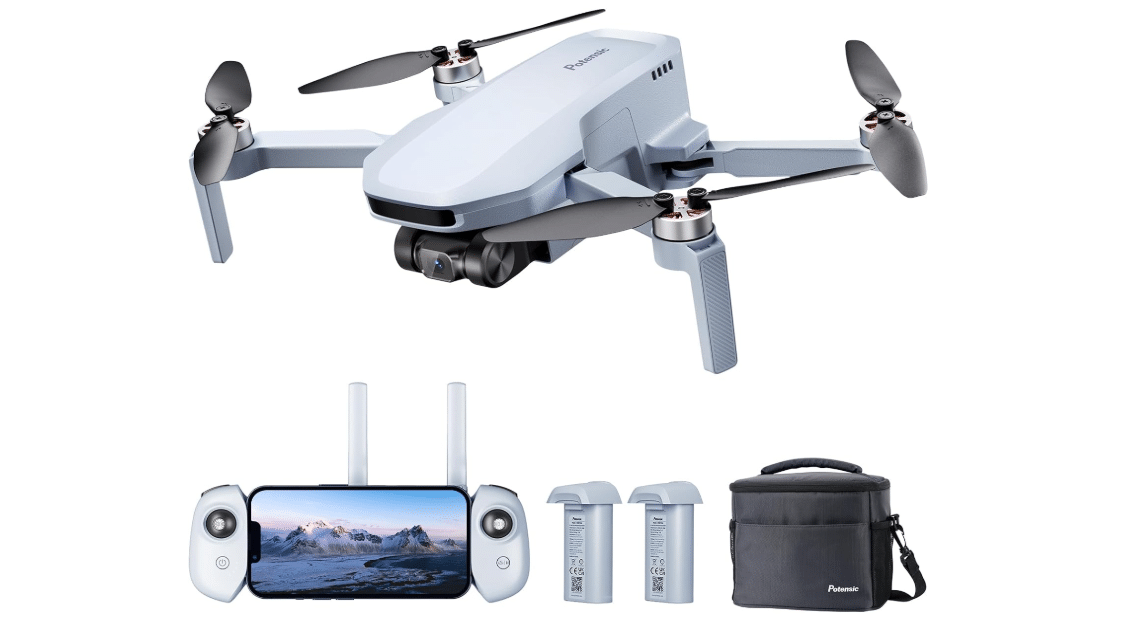
Price: $249.99
Key Features & Benefits: 4K EIS camera, GPS, return-to-home, longer flight time, under 249 g, foldable.
Pros: Real outdoor capability, better camera and motors, intelligent features.
Cons: Higher price, more complex than pure beginner toys, requires more responsible flying.
Amazon & Review Ratings: Strong positive feedback for value versus DJI alternatives.
Why It’s a Good Choice: Bridges the gap between kids’ toys and adult beginner drones.
Ideal Use Case / Who Should Buy: Mature ages 12–16 who have already mastered a basic mini drone and want GPS reliability and better video for outdoor adventures.
How to Choose the Right Kids Drone
Match the drone to the child’s age and personality first:
- Ages 5–8 → Hand-operated (Force1 Scoot) or simplest nano with full guards.
- Ages 8–12 → Altitude-hold mini with dual/triple batteries and full guards (HASAKEE Q9s or Holy Stone HS210). Add a basic camera model only if the child specifically wants video.
- Ages 12+ → DJI Neo or entry GPS camera drone once basic stick skills are solid.
Ask three questions: Will most flying be indoors? Is a camera a must-have? What is the realistic budget including spare batteries and props? Always buy extra batteries at the same time—short flight times are the number-one complaint with kids drones.
Safety, Legal & Parent Tips
- Full propeller guards or enclosed shells are non-negotiable for young children.
- Supervise all flights, especially the first several sessions.
- In the United States, recreational drones under 250 g do not require registration, but every pilot (including kids) should complete the free FAA TRUST test before outdoor flying.
- Fly in open areas away from people, cars, and airports.
- Charge batteries on a non-flammable surface and never leave them unattended.
- Keep spare propellers on hand; they are inexpensive and inevitable.
Frequently Asked Questions
What age can kids start flying drones?
Most children can begin around age 5–6 with hand-operated models. Stick-controlled drones work well from about age 7–8 with supervision.
Do kids need FAA registration?
Not for recreational drones under 250 g. The free TRUST certificate is still required for outdoor flights.
Indoor or outdoor?
Start indoors or in a sheltered backyard. Most mini drones struggle in wind.
How important are multiple batteries?
Very. Single-battery drones lead to short, frustrating sessions. Two or three batteries transform the experience.
Are camera drones worth it for kids?
Yes for ages 8+ who show interest in photos/video. Start with a simple 720p/1080p model before investing in 4K.
What if it crashes on day one?
Choose models with full guards and good review feedback on durability. Have spare props ready.
Final Recommendations & Conclusion
For most families, the HASAKEE Q9s or Holy Stone HS210 delivers the best combination of safety, flight time, and value. Youngest pilots should start with the Force1 Scoot. Older kids and teens who want real video will be happiest with the DJI Neo. The remaining models fill specific niches—portability, pure budget, or step-up GPS performance.
The best 10 kids drone list above is designed so you can match a product to your child’s age, skill level, and interests with confidence. Prioritize full propeller protection, multiple batteries, and altitude hold, and you will avoid the common disappointments that turn an exciting gift into a one-day toy. Check current Amazon prices and recent reviews before purchasing, add spare batteries and props, and enjoy the outdoor adventures that follow.