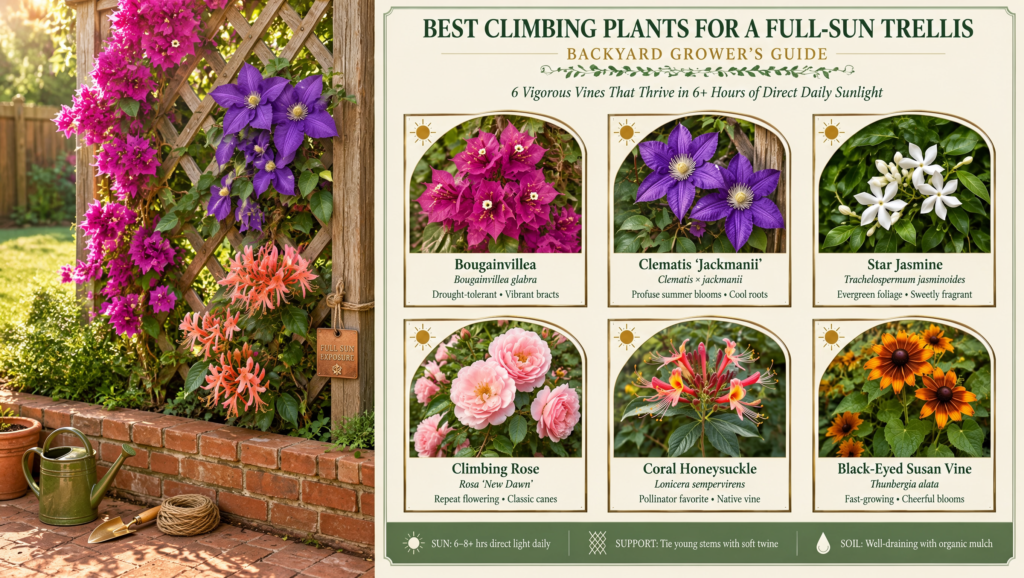
A sunny fence, balcony, patio wall, or garden border can feel frustratingly empty—especially when it receives six or more hours of direct sunlight every day. The challenge is not finding plants that can survive full sun; it is choosing climbers that will thrive in that exposure, cover the trellis attractively, bloom reliably, and remain manageable over time.
This guide highlights 10 excellent climbing plants for a trellis in full sun, along with practical trellis recommendations, buying advice, and care tips. Whether you want fragrant flowers, fast seasonal color, evergreen privacy, pollinator-friendly blooms, or edible harvests, you will find a suitable option below.
Affiliate disclosure: This article may contain affiliate links. If you purchase through these links, we may earn a commission at no additional cost to you. Prices, ratings, availability, and review counts can change.
What “Full Sun” Really Means
“Full sun” generally means a plant receives at least six hours of direct sunlight daily. In many gardens, a south- or west-facing position delivers the strongest light, but it can also create heat, wind exposure, and faster soil drying.
A plant may tolerate full sun without thriving in it. For example, some climbers prefer morning sun and afternoon shade in very hot climates, while others—such as black-eyed Susan vine, morning glory, and many climbing roses—perform best with abundant direct light.
Before buying, check:
-
Your garden receives at least 6 hours of direct sun.
-
The wall, fence, or patio does not reflect excessive heat onto the plant.
-
The soil drains well and does not stay waterlogged.
-
You can water consistently during establishment and hot weather.
-
The trellis is installed before planting.
-
The plant’s mature size fits the available support.
Most climbing plants need support to cling to or twine around, such as a trellis, wires, or canes. Sunny walls also create opportunities for many flowering climbers and wall shrubs that enjoy warm, sheltered conditions.rhs.org+1
How to Choose the Right Climbing Plant
The best climbing plant depends on more than sunlight. Consider your goal, available space, climate, and how much maintenance you want to do.
| Decision factor | Best choice! | Important consideration |
|---|---|---|
| Fast seasonal color | Black-eyed Susan vine, morning glory | Usually grown as annuals |
| Long-term privacy | Star jasmine, climbing rose, trumpet vine | Requires sturdy support and pruning |
| Fragrance | Star jasmine, climbing rose | Some need warmth or regular care |
| Pollinator garden | Passionflower, trumpet vine | Can be vigorous; give them room |
| Edible harvest | Beans, peas, cucumbers, grapes | Needs frequent watering and harvesting |
| Small patio or balcony | Black-eyed Susan vine, compact clematis | Containers dry out quickly in full sun |
| Low-maintenance foliage | Confederate jasmine, ivy | Some can become vigorous over time |
Match the Plant to the Support
Not every “climbing plant” climbs the same way. Some twine around supports, some use tendrils, and others need to be tied in.
| Climbing method | Examples | Best support |
|---|---|---|
| Twining stems | Morning glory, golden hop | Canes, strings, mesh, narrow trellis |
| Tendrils | Passionflower, cucumber, pea | Grid, netting, wire trellis |
| Needs tying in | Climbing rose, clematis, star jasmine | Horizontal wires, lattice, wall trellis |
| Self-clinging | Ivy, climbing hydrangea | Wall, fence, or sturdy support |
Clematis, climbing roses, and star jasmine generally need training and tying in during their early growth. Passionflowers climb using tendrils, making them well suited to trellises and wires.rhs.org+2
Best 10 Climbing Plants for Trellis Full Sun
1. Clematis — Best Flowering Climber
Clematis is one of the most rewarding climbing plants for a decorative trellis. With its large, showy blooms and wide range of colors, it can transform a plain fence, obelisk, or patio wall into a focal point.
Many clematis varieties perform well in full sun, although their roots prefer cooler, shaded soil. A simple solution is to plant the clematis so its base is shaded by low-growing plants, mulch, or a nearby container while the vines climb into the sun.
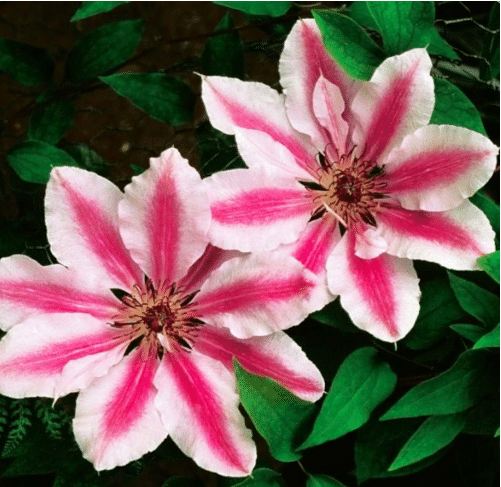
Why it is a good choice for full sun: Clematis produces abundant flowers when its upper growth receives plenty of light. It is especially attractive on a freestanding obelisk, wall trellis, or decorative metal support.
Ideal use case: Choose clematis if you want a polished, flower-focused garden display and are willing to provide a sturdy trellis, occasional pruning, and consistent watering.
Best trellis pairing: A 6-foot metal obelisk, wall-mounted lattice, or sturdy decorative trellis.
Quick-grow facts:
-
Sunlight: Full sun, with cool roots preferred
-
Mature size: Varies widely by variety; commonly 6–12 feet
-
Bloom season: Spring, summer, or repeat-flowering depending on variety
-
Support method: Needs tying in
-
Maintenance: Moderate
Pros
-
Exceptional flower display
-
Many colors and bloom periods available
-
Works well on decorative trellises
-
Suitable for fences, walls, and containers with proper care
Cons
-
Roots prefer cool, shaded conditions
-
Requires training and occasional pruning
-
Some varieties are more delicate than vigorous vines
Amazon buyer note: Look for live clematis plants with strong recent ratings, clear variety labeling, and reviews that mention healthy roots, successful establishment, and flowering performance.
2. Climbing Rose — Best for Classic Garden Beauty
A climbing rose is the ultimate choice for gardeners who want romantic color, repeat blooms, and fragrance. Unlike true vines, climbing roses do not grip a trellis on their own; their long canes must be tied and trained horizontally or diagonally across the support.
Climbing roses generally perform best in full sun, fertile soil, and good air circulation. They are excellent for fences, arches, pergolas, and wide trellis panels, but they need more maintenance than many fast-growing annual vines.
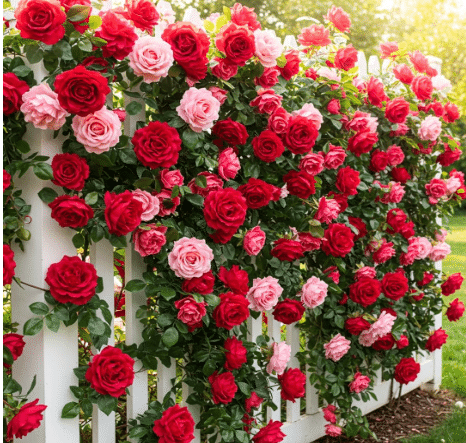
Why it is a good choice for full sun: Roses typically flower most heavily when they receive ample direct sunlight. A sunny wall or fence can help ripen the wood and encourage repeat blooming in suitable varieties.
Ideal use case: Choose a climbing rose if you want a long-lived, high-impact flowering plant and do not mind pruning, feeding, and training the canes.
Best trellis pairing: A wide horizontal-wire trellis, sturdy fence-mounted panel, arch, or pergola.
Quick-grow facts:
-
Sunlight: Full sun
-
Mature size: Often 6–12 feet or more, depending on variety
-
Bloom season: Late spring through fall for repeat bloomers
-
Support method: Must be tied in
-
Maintenance: Moderate to high
Pros
-
Large, beautiful flowers
-
Many varieties offer fragrance
-
Repeat-flowering types bloom across the season
-
Excellent for arches, fences, and pergolas
Cons
-
Requires regular training and pruning
-
Some varieties are susceptible to black spot or powdery mildew
-
Thorns can make maintenance uncomfortable
Amazon buyer note: Choose disease-resistant varieties and prioritize listings with clear plant size, root condition, and hardiness-zone information. Climbing roses can reach about 3 meters in height, depending on the cultivar.rhs.org
3. Star Jasmine — Best Fragrant Evergreen Climber
Star jasmine (Trachelospermum jasminoides) is an outstanding evergreen climber for warm, sunny fences and walls. It produces glossy green foliage and clusters of small, star-shaped white flowers with a sweet fragrance.
This plant is particularly useful when you want year-round coverage rather than a seasonal annual vine. It grows well against a warm, sheltered sunny wall and can be trained along wires, a trellis, or a fence panel.
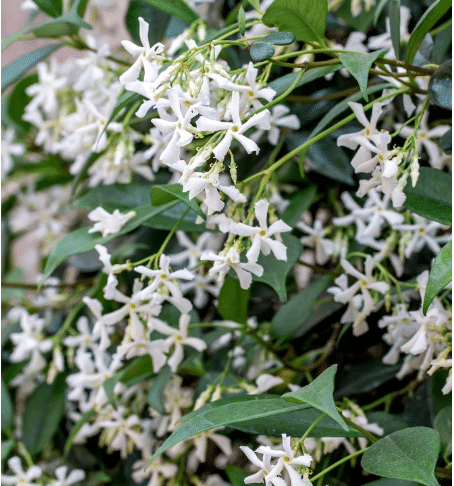
Why it is a good choice for full sun: Star jasmine enjoys warm, bright conditions and develops dense foliage when given adequate sun and shelter. It is especially effective where you want both privacy and fragrance.
Ideal use case: Choose star jasmine if you want an evergreen climber for a fence, wall, or pergola and live in a climate where it is hardy.
Best trellis pairing: Wall-mounted trellis, fence panel, horizontal wires, or pergola support.
Quick-grow facts:
-
Sunlight: Full sun to part shade
-
Mature size: Often 10–20 feet with support
-
Bloom season: Late spring to early summer
-
Support method: Needs initial training
-
Maintenance: Low to moderate
Pros
-
Evergreen foliage provides year-round interest
-
Highly fragrant white flowers
-
Excellent for fences, walls, and pergolas
-
Relatively low maintenance once established
Cons
-
Can be slow to establish in cooler climates
-
Needs protection from harsh frost in colder regions
-
May require regular tying during early growth
Amazon buyer note: Star jasmine is commonly sold as a live plant, often in 1-gallon pots or multipacks. Check whether the listing specifies your USDA hardiness zone and whether the plant is established or freshly rooted.
4. Black-Eyed Susan Vine — Best Fast Annual Color
Black-eyed Susan vine (Thunbergia alata) is one of the easiest ways to add fast, cheerful color to a sunny trellis. Its trumpet-shaped flowers—often orange, yellow, or white with a dark center—appear throughout summer and attract pollinators.
This is an annual or tender perennial in many climates, so it will not provide permanent coverage. However, it grows quickly from seed or young plants and is ideal for filling a trellis within a single growing season.
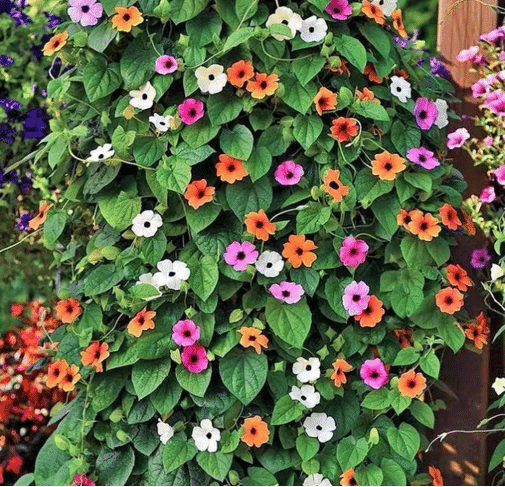
Why it is a good choice for full sun: Black-eyed Susan vine thrives in full sun, fertile well-drained soil, and warm temperatures. It climbs readily by twining around slender supports.rhs.org
Ideal use case: Choose this plant if you want quick, inexpensive color on a balcony trellis, small obelisk, fence section, or temporary garden screen.
Best trellis pairing: Small metal trellis, string trellis, balcony railing trellis, obelisk, or mesh panel.
Quick-grow facts:
-
Sunlight: Full sun
-
Mature size: About 5–8 feet
-
Bloom season: Summer until frost
-
Support method: Twining stems
-
Maintenance: Low
Pros
-
Fast-growing and easy to start
-
Produces abundant colorful flowers
-
Excellent for containers and small spaces
-
Attracts pollinators
Cons
-
Usually needs replanting each year
-
Can be sensitive to frost
-
Needs regular watering in hot, sunny containers
Amazon buyer note: Seed packets are usually the most affordable option, while live starter plants provide a head start. Look for listings with high germination feedback, clear sowing instructions, and recent positive reviews.
5. Morning Glory — Best Budget Fast-Coverage Vine
Morning glory (Ipomoea) is a classic fast-growing annual vine for sunny fences, garden borders, and temporary privacy screens. Its funnel-shaped flowers open in the morning and close by afternoon, creating a changing display throughout the day.
Morning glory is especially useful when you need quick coverage but do not want to invest in a permanent woody climber. It twines naturally around strings, mesh, canes, and trellises.
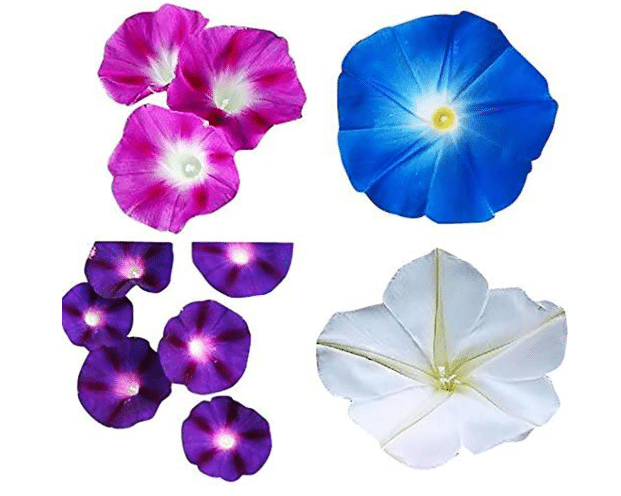
Why it is a good choice for full sun: Morning glory performs best in a sunny position with fertile, well-drained soil. It can grow rapidly once established and cover a fence or trellis quickly.rhs.org
Ideal use case: Choose morning glory if you want maximum coverage for minimal cost and are comfortable with an annual plant.
Best trellis pairing: String trellis, mesh panel, fence trellis, A-frame support, or bamboo teepee.
Quick-grow facts:
-
Sunlight: Full sun
-
Mature size: Often 6–10 feet or more
-
Bloom season: Summer until frost
-
Support method: Twining stems
-
Maintenance: Low
Pros
-
Very inexpensive, especially from seed
-
Fast coverage for fences and screens
-
Easy to grow in warm, sunny conditions
-
Attractive trumpet-shaped blooms
Cons
-
Flowers close by afternoon
-
Can self-seed aggressively in some regions
-
Not suitable for a permanent, formal trellis display
Amazon buyer note: Choose a reputable seed seller with recent reviews mentioning germination rate, bloom color accuracy, and packaging quality. Avoid planting invasive or unrestricted varieties where local guidance advises against them.
6. Passionflower — Best Exotic Pollinator Plant
Passionflower (Passiflora) brings an unmistakable tropical look to a sunny garden. Its intricate flowers, often purple, blue, white, or red depending on the species, are highly attractive to pollinators and make a dramatic statement on a trellis.
Passionflower climbs using tendrils, so it needs a support with small gaps or wires it can grip. It is vigorous in warm climates, so it is best for gardeners with ample space and a sturdy structure.
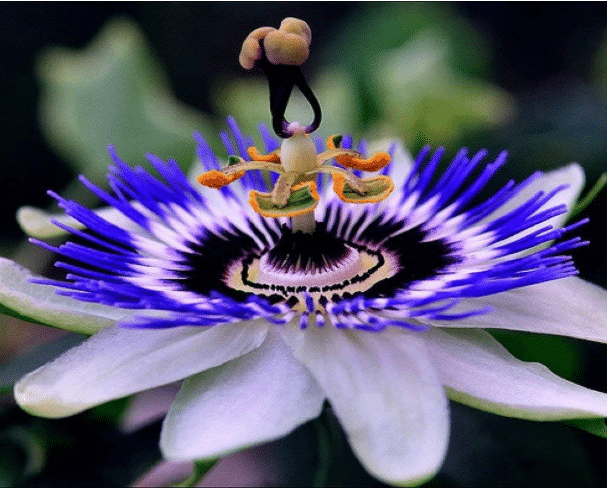
Why it is a good choice for full sun: Passionflower generally performs best in a warm, sunny position with well-drained soil. Its tendrils allow it to climb efficiently on trellises and wires.
Ideal use case: Choose passionflower if you want an exotic-looking, pollinator-friendly climber and have a large fence, pergola, or strong freestanding support.
Best trellis pairing: Heavy-duty metal trellis, wire trellis, fence panel, or pergola.
Quick-grow facts:
-
Sunlight: Full sun
-
Mature size: Often 10–20 feet or more in warm climates
-
Bloom season: Summer to early fall
-
Support method: Tendrils
-
Maintenance: Moderate to high
Pros
-
Unique, dramatic flowers
-
Excellent for pollinators
-
Fast-growing in warm conditions
-
Works well on larger structures
Cons
-
Can become very vigorous
-
Some species are not hardy in cold climates
-
May need regular pruning to prevent overcrowding
Amazon buyer note: Verify the exact species and hardiness before purchasing. Passiflora caerulea is often more cold-tolerant than tropical varieties, but local climate still matters.
7. Trumpet Vine — Best for Large Walls and Pollinators
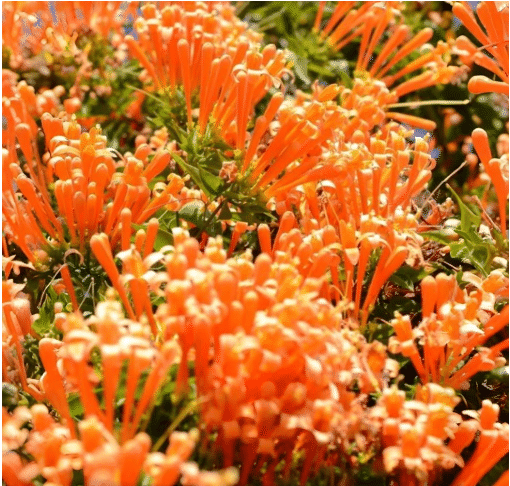
Trumpet vine (Campsis radicans), also called trumpet creeper, is a bold, vigorous climber with orange, red, or yellow trumpet-shaped flowers. It is highly attractive to hummingbirds and pollinators and can cover a large wall, fence, or pergola with lush foliage and bright blooms.
This is not a plant for a small decorative trellis. Trumpet vine needs strong support and regular pruning, especially in warmer climates where it can spread aggressively.
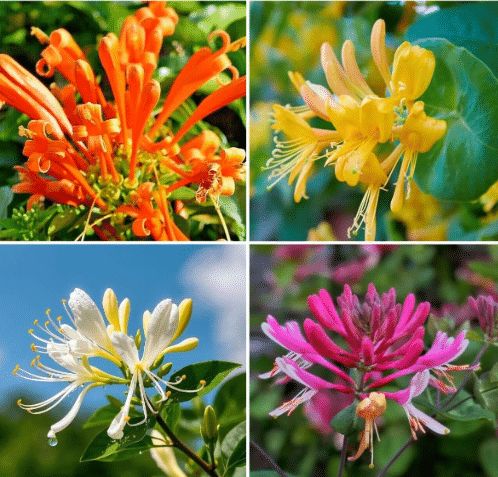
Why it is a good choice for full sun: Trumpet vine thrives in full sun and warm conditions. It is particularly effective on large, sunny walls and fences where a tough, high-impact climber is needed.
Ideal use case: Choose trumpet vine if you have a large sunny fence or wall, want to attract hummingbirds, and are prepared to manage its growth.
Best trellis pairing: Heavy-duty metal trellis, sturdy fence-mounted panel, large pergola, or masonry wall with appropriate support.
Quick-grow facts:
-
Sunlight: Full sun
-
Mature size: Often 20–40 feet
-
Bloom season: Summer
-
Support method: Aerial rootlets and clinging growth
-
Maintenance: High
Pros
-
Spectacular trumpet-shaped flowers
-
Attracts hummingbirds and pollinators
-
Very vigorous and durable
-
Excellent for large sunny walls
Cons
-
Can become invasive or difficult to control
-
Requires strong, permanent support
-
Not suitable for small gardens or delicate trellises
Amazon buyer note: Buy only from sellers that clearly identify the species and provide hardiness information. Read recent reviews carefully for reports on vigor, root development, and unwanted spread.
8. Confederate Jasmine — Best Low-Effort Evergreen Coverage
Confederate jasmine is another name commonly used for star jasmine (Trachelospermum jasminoides). It is a reliable evergreen climber for fences, trellises, and warm garden walls, offering dense foliage, fragrant white flowers, and long-term coverage.
It is a particularly good choice if you want a plant that looks attractive throughout the year rather than only during its flowering season. Once established, it generally requires less attention than annual vines or climbing roses.
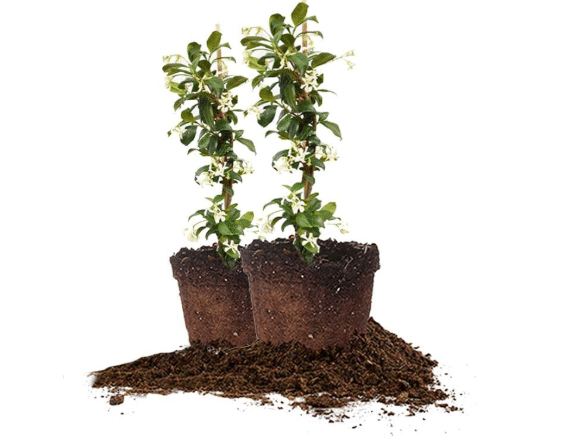
Why it is a good choice for full sun: Confederate jasmine grows well in full sun to part shade and performs especially well against warm, sheltered walls. It can be trained onto a trellis or fence support.rhs.org
Ideal use case: Choose Confederate jasmine if you want low-maintenance evergreen coverage, fragrance, and a tidy appearance on a fence or wall.
Best trellis pairing: Fence trellis, wall-mounted panel, horizontal wires, or freestanding support.
Quick-grow facts:
-
Sunlight: Full sun to part shade
-
Mature size: Often 10–20 feet with support
-
Bloom season: Late spring to early summer
-
Support method: Needs initial training
-
Maintenance: Low to moderate
Pros
-
Evergreen foliage
-
Fragrant white flowers
-
Suitable for fences, walls, and pergolas
-
Lower maintenance once established
Cons
-
Can be slow to establish
-
Needs winter protection in colder regions
-
May require tying during early growth
Amazon buyer note: A current Amazon best-seller listing for vine plants is Perfect Plants Confederate Jasmine Live Plant, 1 Gal (2-Pack), marketed as an evergreen climber for fences and trellises. Check the live listing for the current price, rating, review count, and shipping availability.
9. Climbing Hydrangea — Best for Elegant Foliage and Flowers
Climbing hydrangea is a sophisticated choice for gardeners who want lush foliage, attractive peeling bark, and delicate white flower clusters. It is slower to establish than annual vines but becomes a beautiful, long-lived feature on a wall or large trellis.
While many climbing hydrangeas prefer part shade, certain cultivars can perform well in full sun when the soil remains consistently moist and the roots are protected from excessive heat.
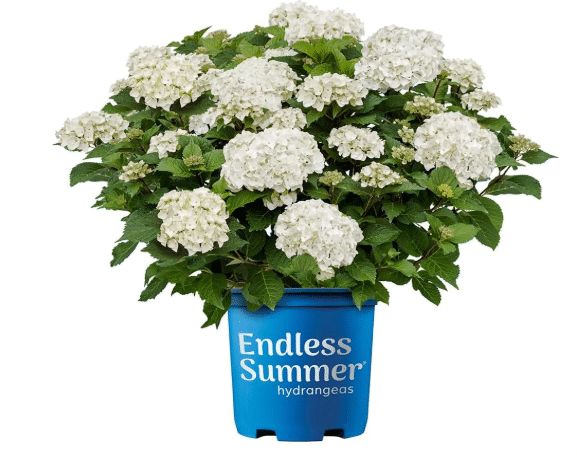
Why it is a good choice for full sun: Climbing hydrangea can tolerate full sun in cooler climates or where soil moisture is reliable. In hotter regions, afternoon shade may produce better results.
Ideal use case: Choose climbing hydrangea if you want a refined, long-term climber for a large wall, fence, or shaded-to-sunny transition area.
Best trellis pairing: Sturdy wall trellis, horizontal wires, or a large fence-mounted support.
Quick-grow facts:
-
Sunlight: Full sun to part shade, depending on climate
-
Mature size: Often 15–30 feet
-
Bloom season: Early to midsummer
-
Support method: Aerial rootlets
-
Maintenance: Moderate
Pros
-
Elegant white flower clusters
-
Attractive foliage and bark
-
Long-lived perennial climber
-
Works well on large walls and fences
Cons
-
Slow to establish
-
Needs consistent moisture in hot sun
-
Requires a large, sturdy support
Amazon buyer note: Live climbing hydrangeas can vary greatly by cultivar. Prioritize listings that specify the botanical name, mature size, hardiness zone, and whether the plant is dormant or actively growing.
10. Golden Hop — Best Fast Foliage Climber
Golden hop (Humulus lupulus ‘Aureus’) is a vigorous, fast-growing climber valued for its bright golden-green foliage rather than flowers. It creates a lush, informal look on fences, pergolas, arches, and large trellises.
This plant is ideal when you want rapid coverage and dramatic foliage. It grows quickly in full sun but needs plenty of space and a strong support system.
Why it is a good choice for full sun: Golden hop is a sun-loving climber that can reach 4–8 meters when given room to grow.
Ideal use case: Choose golden hop if you want fast, bold foliage coverage on a large fence, pergola, or garden structure.
Best trellis pairing: Large fence trellis, pergola, arch, or heavy-duty obelisk.
Quick-grow facts:
-
Sunlight: Full sun
-
Mature size: 13–26 feet
-
Bloom season: Late summer, with inconspicuous flowers
-
Support method: Twining stems
-
Maintenance: Moderate to high
Pros
-
Very fast-growing
-
Bright golden foliage
-
Excellent for quick coverage
-
Adds texture and movement to a garden
Cons
-
Can become very large and vigorous
-
Needs a strong, tall support
-
Dies back in winter in cold climates
Amazon buyer note: Look for live rhizomes or young plants with clear planting instructions. Avoid planting golden hop near small structures or delicate supports because its rapid growth can quickly overwhelm them.
Best Trellis Products for Full-Sun Climbers
1. Best Overall: Expandable Heavy-Duty Metal Garden Trellis
An expandable metal garden trellis is one of the most versatile supports for full-sun climbing plants. Its adjustable design allows you to widen or narrow the frame to fit a fence, wall, raised bed, or container area.
This type of trellis is especially useful for gardeners who want one support that can handle flowering vines, edible climbers, and seasonal annuals. A current Amazon listing for an expandable garden trellis is priced around $23.99–$33.42, has a 4.4/5-star rating, and has approximately 127 ratings.
Why it is a good choice for full sun: Metal construction, especially with a rust-resistant coating, holds up well outdoors and provides dependable support for plants exposed to sun, rain, and wind.
Ideal use case: Best for gardeners who want a flexible, durable support for clematis, jasmine, beans, peas, cucumbers, or flowering annual vines.
Pros
-
Expandable width for flexible placement
-
Suitable for outdoor use
-
Works for ornamental and edible climbers
-
Good value for a multi-purpose trellis
Cons
-
Assembly may be required
-
Long-term rust resistance depends on coating quality
-
May need anchoring in windy locations
2. Best Budget Pick: 4-Pack Small Metal Plant Trellis
A 4-pack of small metal plant trellises is ideal for containers, balcony gardens, houseplants, and young climbing plants. These compact supports are typically around 16 inches tall and come in decorative patterns.
They are not suitable for mature climbing roses, trumpet vine, or large perennial climbers, but they are excellent for black-eyed Susan vine, small morning glories, pothos, ivy, and other lightweight climbers.
Current Amazon listings for 4-pack small trellises show prices around $9.99–$24.22, ratings around 4.6/5 stars, and review counts ranging from roughly 1,106 to 3,685 ratings, depending on the exact product.
Why it is a good choice for full sun: These trellises are lightweight, affordable, and easy to position in pots where full sun can quickly dry out the soil. They give young vines an immediate structure to climb.
Ideal use case: Best for balcony gardeners, renters, houseplant owners, and anyone growing compact annual climbers in containers.
Pros
-
Very affordable
-
Easy to place in pots
-
Attractive decorative design
-
Highly popular with buyers
Cons
-
Too small for large or woody climbers
-
May need replacement after several seasons outdoors
-
Not ideal for heavy flowering plants
3. Best for Large Walls: Expandable Wooden Lattice Panels
Expandable wooden lattice panels provide broad coverage for fences, patios, porches, and garden walls. They are especially attractive with clematis, climbing roses, jasmine, ivy, cucumbers, and beans.
A current Amazon listing for a 2-piece expandable wooden lattice set, sized approximately 38 x 89 inches, shows a 4.4/5-star rating, about 290 ratings, and a Garden Trellises category rank around #35.amazon
Why it is a good choice for full sun: The open lattice design allows sunlight and airflow to reach the foliage while giving climbing plants plenty of surface area to cover.
Ideal use case: Best for gardeners who want a traditional, natural-looking support for a wide fence, patio wall, or outdoor privacy screen.
Pros
-
Covers a large area
-
Natural wood appearance
-
Good airflow and light exposure
-
Suitable for many climbing plants
Cons
-
Mixed buyer feedback on sturdiness
-
Wood may need sealing or weather protection
-
Can be heavier and less portable than metal options
4. Best for Vegetables: A-Frame Cucumber Trellis
An A-frame trellis is one of the most practical supports for vegetable gardeners. It provides two climbing surfaces and works especially well for cucumbers, peas, beans, and other edible climbers in raised beds or garden rows.
A current Amazon listing for a foldable A-frame cucumber trellis is priced around $38.99, has a 4.3/5-star rating, 385 ratings, and more than 100 purchases in the past month.
Why it is a good choice for full sun: Vegetable climbers need strong sunlight, good airflow, and easy access for harvesting. An A-frame design keeps foliage elevated, reduces ground contact, and makes harvesting simpler.
Ideal use case: Best for raised-bed gardeners growing cucumbers, peas, beans, or other edible vines in a sunny vegetable garden.
Pros
-
Practical for edible crops
-
Folds for seasonal storage
-
Provides two climbing surfaces
-
Often includes ties or fasteners
Cons
-
Less decorative than ornamental trellises
-
May be too small for very vigorous perennial vines
-
Requires stable placement on level ground
5. Best Freestanding Option: 6-Foot Garden Obelisk Trellis
A garden obelisk is a tall, freestanding support that adds vertical interest to borders, containers, and patio gardens. It is particularly effective for clematis, jasmine, climbing roses, and other plants that need training.
A current Amazon listing for a 6-foot garden obelisk trellis is priced around $17.99, has a 4.2/5-star rating, 874 ratings, and more than 500 purchases in the past month.
Why it is a good choice for full sun: A freestanding obelisk allows you to position a climbing plant exactly where it receives maximum sun, without relying on a wall or fence.
Ideal use case: Best for gardeners who want a decorative vertical feature in a border, large container, or sunny patio.
Pros
-
No wall mounting required
-
Creates strong vertical impact
-
Suitable for many flowering climbers
-
Affordable and widely available
Cons
-
May need anchoring in wind
-
Not ideal for very heavy mature vines
-
Smaller growing area than a wall-mounted trellis
Side-by-Side Product Comparison
| Plant / trellis | Best for | Key detail |
|---|---|---|
| Clematis | Beautiful flowering display | Needs cool roots and tying in |
| Climbing rose | Classic blooms and fragrance | Needs strong support and pruning |
| Star jasmine | Fragrant evergreen coverage | Great for warm, sunny walls |
| Black-eyed Susan vine | Fast annual color | Ideal for containers and small trellises |
| Morning glory | Budget fence coverage | Fast-growing annual vine |
| Passionflower | Exotic flowers and pollinators | Needs a sturdy, larger support |
| Trumpet vine | Large walls and hummingbirds | Very vigorous; requires management |
| Confederate jasmine | Easy evergreen privacy | Low-maintenance once established |
| Climbing hydrangea | Elegant foliage and flowers | Needs moist soil in full sun |
| Golden hop | Fast foliage coverage | Best for large fences or pergolas |
Buying Guide
What to Check Before Buying
Before purchasing a climbing plant or trellis, match the plant’s eventual size to the support—not its size on the day it arrives.
-
Choose a plant suited to your USDA hardiness zone and local climate.
-
Confirm the plant receives at least six hours of direct sun.
-
Select a trellis strong enough for the plant’s mature weight.
-
Install the support before planting to avoid damaging established roots.
-
Leave space between a hot wall and the plant base so rain can reach the roots.
-
Check whether the plant climbs by twining, tendrils, aerial roots, or needs tying in.
Materials Compared
| Material | Best for | Main consideration |
|---|---|---|
| Powder-coated metal | Perennial climbers and windy sites | Strong and durable, but can heat up |
| Wood lattice | Traditional fences and walls | May need sealing and maintenance |
| Plastic or composite | Containers and small vines | Lightweight, but less suitable for heavy plants |
| Wire-and-post system | Roses, grapes, vigorous vines | Strong and adjustable, but requires installation |
Planting and Care Plan
Before Planting
Install the trellis first. Position it securely and make sure it can support the plant at maturity. Most climbers need a support to cling to or twine around, such as a trellis, wires, or canes.
Planting
Plant in spring or autumn when conditions are cooler and moist. Set the plant close enough to the support for its stems to reach it, then tie the first shoots gently in place.
Watering
Water deeply during the establishment period. Container-grown climbers in full sun may need daily watering during hot weather, while in-ground plants usually need less frequent but deeper watering.
Feeding
Use a balanced fertilizer according to the plant type. Climbing roses benefit from feeding in late winter or early spring and again in early summer.
Training
Guide young stems onto the trellis and tie them loosely with soft garden ties. Do not tie stems too tightly, because they will thicken as they mature.
Pruning
Remove weak, damaged, or overcrowded growth. Prune according to the species and flowering habit; climbing roses, clematis, jasmine, and trumpet vine each have different pruning needs.
Winter Care
Mulch the root zone in colder regions and protect tender climbers from frost. Bring container-grown tender plants indoors or into a sheltered area before freezing temperatures arrive.
Common Mistakes to Avoid
-
Buying a vigorous climber for a small decorative trellis.
-
Installing the support after the plant is already established.
-
Assuming every plant labeled “climbing” can attach itself without help.
-
Placing drought-sensitive plants against a hot, reflective wall without irrigation.
-
Choosing a trellis that is too light for a mature rose, trumpet vine, or grape.
-
Ignoring local invasive-plant guidance.
-
Overcrowding the trellis, which reduces airflow and can encourage disease.
FAQs
What climbing plants grow best on a trellis in full sun?
Clematis, climbing roses, star jasmine, black-eyed Susan vine, morning glory, passionflower, trumpet vine, and golden hop are strong options, depending on your climate and available space.rhs.org+1
Do climbing plants need a trellis?
Most do. Twining and scrambling climbers need a trellis, wires, or similar structure; only some species, such as ivy, can cling directly to vertical surfaces.
What is the fastest-growing climbing plant for full sun?
Morning glory, black-eyed Susan vine, and golden hop are among the fastest options. Annuals provide quick seasonal coverage, while vigorous perennials need pruning and stronger support.
Can I grow climbing plants in pots in full sun?
Yes. Choose a large container, a compact variety, quality potting mix, consistent watering, and a stable trellis.
What size trellis do I need?
Choose based on the plant’s mature height and spread, not its size at purchase. Check the plant label before buying.
Which trellis is best for a sunny balcony?
A compact metal or plastic potted-plant trellis is usually best. Avoid heavy, vigorous climbers that can outgrow the container and support.