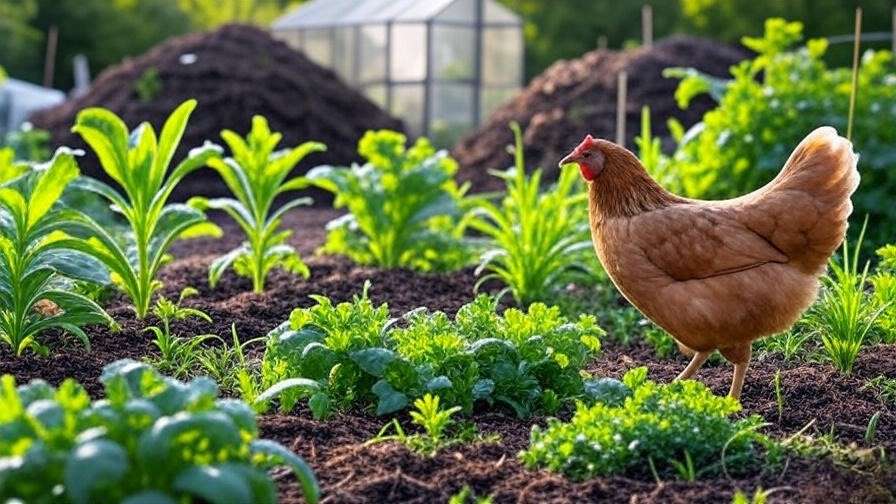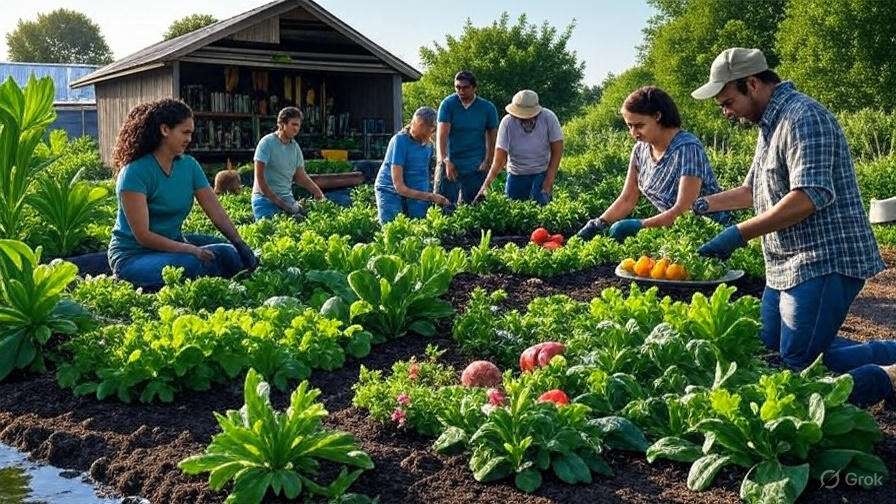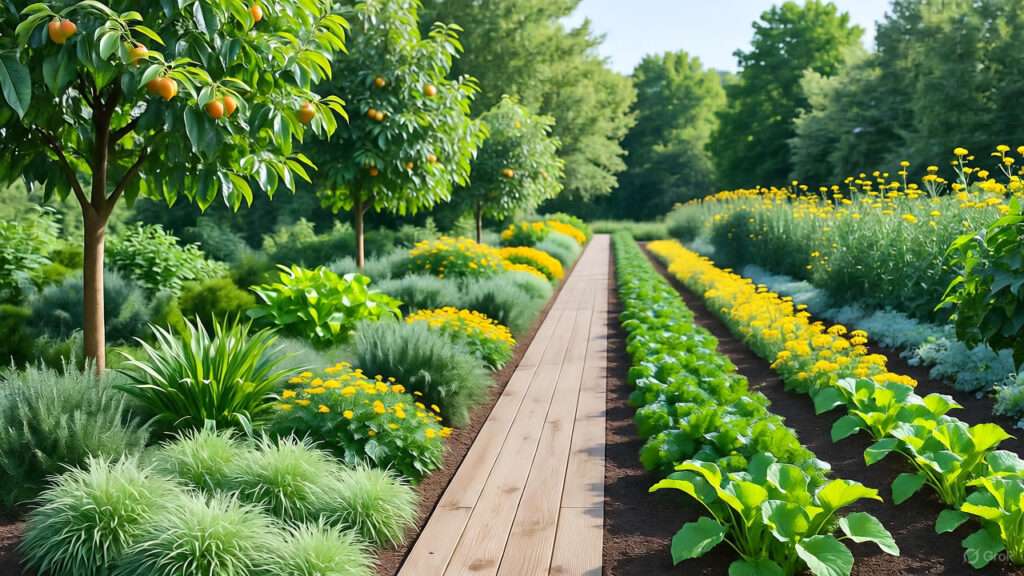
Imagine a farm or garden where destructive insects are managed 24 hours a day, seven days a week, without a single drop of synthetic chemical pesticides. This is not an idealistic pipe dream; it is the tangible reality of a mature, functional ecosystem.
In conventional agriculture and standard landscaping, pest control is treated as a continuous war—an exhausting cycle of intensive labor, chemical spraying, and financial expense that inadvertently kills beneficial predatory insects and degrades soil health. When you disrupt the natural food web, you create an artificial vacuum, making your land entirely dependent on human intervention.
The regenerative solution lies in conscious ecosystem design. By strategically integrating nesting boxes under permaculture principles, you shift your role from an exhausted laborer to an ecosystem conductor. Instead of viewing local birds, bats, and beneficial wildlife as mere passing visitors, you invite them to become permanent, functional partners in your design. This comprehensive, skyscraper guide provides the exact agricultural blueprints, species-matching frameworks, and spatial guidelines needed to establish a self-regulating, highly productive, and naturally pest-free microclimate.
The Core Philosophy: Why Nesting Boxes Belong in Permaculture Design
Permaculture is fundamentally a design science modeled after the patterns and relationships found in nature. It aims to create agriculturally productive ecosystems that mirror the diversity, stability, and resilience of natural environments. Artificial habitats, such as nesting boxes and bat houses, are not superficial additions to this framework; they are vital tools used to accelerate ecological succession and repair broken biological links on managed land.
Principle 1: Integrate Rather Than Segregate
In a healthy, mature forest, older trees naturally develop cavities, hollows, and crevices over decades. These natural cavities provide nesting sites for a wide array of insectivorous birds and small predators. However, on agricultural land, young orchards, or suburban homesteads, these mature trees are often absent.
By installing human-made nesting boxes, you consciously bridge the gap between wild ecological forces and human-managed spaces. Rather than segregating your production areas from nature, you integrate targeted wildlife habitats directly into your cultivation zones, ensuring that nature’s defensive forces are exactly where your crops need them most.
Principle 2: Use and Value Biological Resources
Relying on fossil-fuel-derived chemical inputs or mechanical pest removal is unsustainable and ecologically damaging. Permaculture dictates that we must value and exploit biological resources to do the heavy lifting.
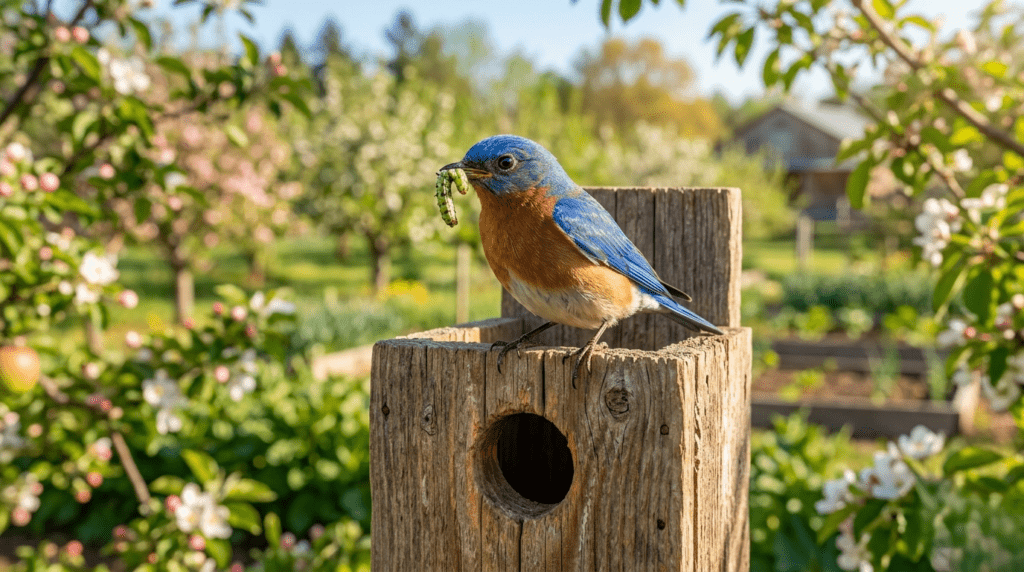
The numbers speak for themselves: a single nesting pair of Eastern Bluebirds (Sialia sialis), along with their fledglings, can consume upwards of 4,000 to 10,000 insects—including destructive beetles, cutworms, caterpillars, and grasshoppers—during a single breeding season. By providing targeted housing, you enlist a highly efficient, self-reproducing, and completely free biological workforce.
Principle 3: Produce No Waste
In a standard agricultural mindset, an outbreak of hornworms or grasshoppers is viewed as a costly waste problem that requires expensive eradication. In a permaculture system, we honor the core adage: “You don’t have an excess of pests; you have a deficit of predators.”
By inviting cavity-nesting insectivores to raise their young on your property, you transform a destructive pest outbreak into a high-density energy source (bird food). Furthermore, as these biological agents hunt through your canopy, their nutrient-dense droppings (guano) fall directly onto your mulched garden beds, cycling essential phosphorus and nitrogen straight back into the soil loop.
Mapping the Zones: Strategic Placement of Nesting Boxes Under Permaculture Principles
One of the foundational methodologies in permaculture is Zone Planning. This practice involves organizing your land into concentric zones (from Zone 0 to Zone 5) based on human energy inputs, accessibility, and the frequency of management. To maximize the efficacy of your avian pest-control network, nesting boxes must be mapped precisely into these zones according to the specific habits and territorial requirements of the target wildlife.
Zone 1 & Zone 2: Intensive Kitchen Gardens and Semi-Intensive Orchards
Zone 1 and Zone 2 experience the highest day-to-day human activity and house your most vulnerable, high-value crops—such as soft berries, leafy greens, brassicas, and young fruit orchards. The primary pest threats here are small, fast-reproducing insects like aphids, codling moths, cabbage loopers, cucumber beetles, and snails.
-
Target Species: Small, agile, cavity-nesting insectivores such as House Wrens (Troglodytes aedon), Black-capped Chickadees (Poecile atricapillus), and Tree Swallows (Tachycineta bicolor).
-
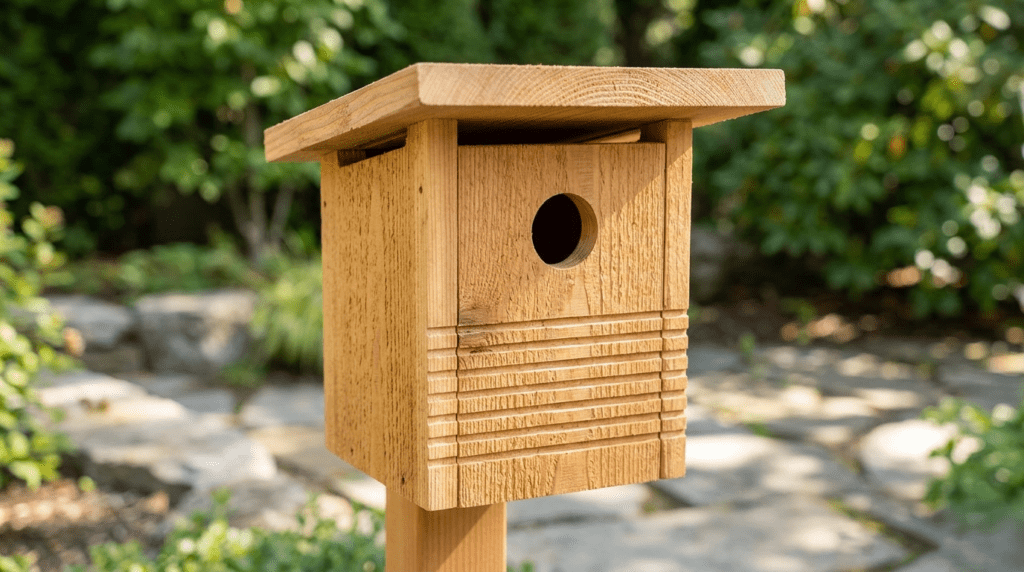
Placement Strategy: Position smaller nesting boxes along the inner edges of orchards, directly on fence posts surrounding raised vegetable beds, or mounted to the sides of garden sheds. Because these birds are highly accustomed to or tolerant of human presence, they will actively hunt within your immediate living spaces, cleaning your most delicate crops daily.
Zone 3 & Zone 4: Main Pastures, Large-Scale Field Crops, and Managed Woodlots
As you move further from the homestead into Zone 3 (commercial row crops, grain fields, and main pastures) and Zone 4 (managed timber, agroforestry blocks, and rotational firewood lots), the scale of pest pressures shifts from micro-insects to macro-pests. Here, voles, gophers, field mice, field crickets, and large grasshoppers pose the greatest economic threat to your agricultural yields.
-
Target Species: Apex avian predators and larger biological control agents, specifically the American Kestrel (Falco sparverius) and the Barn Owl (Tyto alba).
-
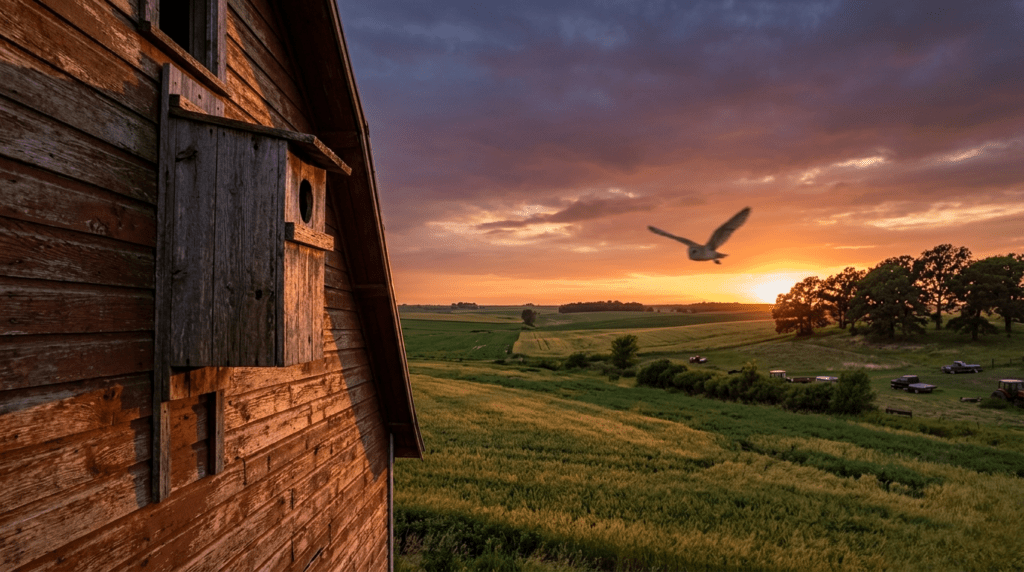
Placement Strategy: Install larger, highly durable nest boxes on isolated poles at heights of 15 to 30 feet, or mount them high up on the exterior walls of barns, outbuildings, or silos. These structures should look out across wide, open fields, providing clear flight paths and an uninhibited vantage point for hunting.
Microclimate Considerations: Aspect, Shade, and Wind Protection
E-E-A-T principles require us to look closely at the fine biological details that dictate whether a nesting box succeeds or fails. You cannot simply hang a box anywhere and expect results; you must design for local microclimates and weather vectors:
-
Compass Orientation (Aspect): Throughout most of the United States and the Northern Hemisphere, nesting boxes should ideally face East, Northeast, or Southeast. This specific orientation shields the vulnerable entrance hole from the harsh, blazing afternoon sun of mid-summer, preventing the interior chamber from turning into a fatal heat trap for young nestlings.
-
Prevailing Winds and Rain: Analyze your local weather sectors. Ensure that the opening of the box faces away from the direction of your region’s typical driving summer rainstorms. Water entering a nest box chills the eggs and young fledglings, often causing complete brood mortality.
-
Thermal Mass and Shade: When integrating boxes into orchards, take advantage of the shade provided by the tree canopy during the hottest peak hours of July and August, while ensuring the flight path directly in front of the box entrance remains clear of dense, tangled branches.
Target Species Matching: Who Are Your Ecological Partners?
To turn your landscape into an optimized biological shield, you must match the architecture and placement of your nesting boxes with the precise life histories of your target regional wildlife. Treating all birds as a single monolithic group is a common mistake; each species occupies a unique ecological niche, has distinct territorial boundaries, and targets specific agricultural pests.
The following comprehensive reference table outlines the precise parameters required for an effective multi-species permaculture deployment:
| Target Predator | Preferred Habitat & Box Placement | Primary Agricultural Pest Eaten | Best Permaculture Zone | Minimum Spacing / Territorial Needs |
| Bluebirds (Eastern, Western, Mountain) | Open agricultural fields, pasture edges, low-intensity orchards. Mount 4–6 feet high on dedicated metal conduit conduit poles. | Grasshoppers, cutworms, crickets, beetles, grubs, and wireworms. | Zone 2 & Zone 3 | Highly territorial. Space boxes at least 100 yards (300 feet) apart from other bluebird pairs. |
| Tree Swallows | Open fields, near farm ponds, swales, or irrigation channels. Mount 5 feet high on poles. | Flying insects, adult mosquitoes, midges, moths, and winged aphids. | Zone 2 & Zone 3 | Can be “paired” within 10–20 feet of a bluebird box to eliminate interspecies competition and protect a single zone. |
| House Wrens & Chickadees | Shrubby edges, thick brush piles, kitchen gardens, food forests. Mount 4–7 feet high on walls, posts, or tree trunks. | Aphids, leafhoppers, caterpillars, moths, scale insects, spider mites, and weevils. | Zone 1 & Zone 2 | Tolerate close proximity to humans. Space individual wren boxes 30–50 feet apart in dense cover. |
| Barn Owls | Large open fields, pasture lands, grain storage areas. Mount 15–25 feet high in quiet barns, silos, or on isolated tall poles. | Voles, pocket gophers, field mice, rats, and small moles. | Zone 3 & Zone 4 | Non-territorial hunters. Multiple pairs can live in close proximity if rodent populations are high. |
| American Kestrels | Wide open grasslands, large pastures, orchards, crop edges. Mount 10–20 feet high on poles with a clear 360-degree view. | Large grasshoppers, cicadas, beetles, meadow voles, and mice. | Zone 3 & Zone 4 | Keep at least a half-mile distance between kestrel boxes to respect their large hunting territories. |
| Insectivorous Bats (Little Brown, Big Brown) | Unobstructed flight paths, close to water elements (ponds, swales). Mount 15–20 feet high on southern faces of buildings or poles. | Nocturnal pests: Codling moths, cucumber beetles, cutworm moths, and mosquitoes. | Zone 2 & Zone 3 | Colonial. A single large multi-chamber bat house can support 50 to 300 bats, covering several acres. |
Material and Design Criteria for Authentic Permaculture Nesting Boxes
When building or sourcing nesting boxes, you must prioritize longevity, safety, and ecological sustainability. Cheaply produced, novelty, or decorative commercial birdhouses are often death traps for wild birds due to poor thermal design, lack of ventilation, or toxic manufacturing treatments.
Sourcing Sustainable, Non-Toxic Materials
True permaculture design values local, untreated, and renewable resources.
-
The Best Wood Choices: Choose naturally rot-resistant, rough-sawn hardwoods or softwoods such as Western Red Cedar, Redwood, Cypress, or White Oak. These woods contain natural oils that resist decay for decades without requiring chemical treatments. Alternatively, upcycle untreated, weathered barn wood or scrap lumber from local sawmills.
-
What to Absolutely Avoid: Never use pressure-treated lumber (which contains chemical copper azole or arsenic formulations that leach harmful vapors in intense summer heat). Avoid exterior-grade plywoods containing urea-formaldehyde binders, and skip plastics or metals for the main body structure, as they offer zero thermal insulation and will cook nestlings during summer heatwaves. Never apply chemical paints, stains, or synthetic varnishes to the interior of the nesting chamber.
The Critical Science of Architectural Anatomy
An expertly constructed permaculture nesting box must feature specific design elements to ensure safety and comfort:
-
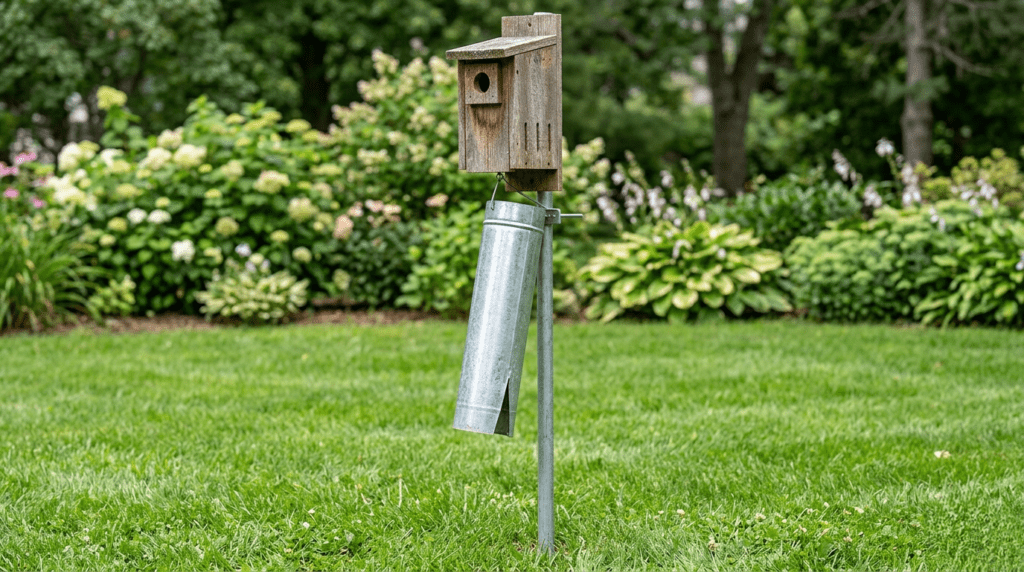
Precise Entrance Hole Dimensions: The diameter of the entrance hole dictates exactly who can enter your box and who is locked out. For example, a precise 1.5-inch (38 mm) entry hole is perfect for Eastern Bluebirds, but just small enough to keep out destructive, invasive European Starlings (Sturnus vulgaris). A 1.125-inch (28 mm) hole allows House Wrens and Chickadees entry while keeping out larger predators and competitive egg-smashers.
-
The “No Perch” Rule: Never buy or build a nesting box that features a little wooden peg or perch underneath the entrance hole. Native cavity-nesting birds have powerful feet perfectly adapted to clinging directly to rough vertical wood surfaces. Perches are completely unnecessary for them—instead, they provide a highly convenient handhold for invasive birds, raccoons, and cats to balance on while they reach inside to steal eggs and kill the brooding mother.
-
Thermal Regulation (Ventilation and Drainage): Ensure there is a gap of at least 0.25 inches between the top of the side walls and the overhanging roof line to allow rising body heat to escape efficiently. Drill at least four 0.25-inch drainage holes in the bottom corners of the floor panel to allow any wind-driven moisture or waste liquids to drain out instantly, keeping the nesting material dry.
-
Interior Fledgling Ladders: The interior front wall of the nesting box, directly beneath the entrance hole, must consist of rough-sawn, unplaned wood. If you are using smooth wood, you must explicitly score shallow horizontal grooves into the wood using a saw or chisel. This creates a functional “ladder” that allows weak young fledglings to grip the wall and climb out of the dark box safely when they are ready to take flight.
Step-by-Step Guide to Installing Your Avian Pest-Control Network
To transform this knowledge into direct action on your land, follow this rigorous installation workflow. This process ensures your boxes are placed safely, function optimally, and interact beneficially with surrounding permaculture infrastructure.
Step 1: Conduct a Site Sector Analysis
Before hammering a single post, walk your land and map its energy vectors and existing biological sectors. Mark down:
-
Wild Vectors: Where are wild predators (like neighborhood outdoor cats, hawks, raccoons, or snakes) likely to travel?
-
Resource Access: Locate your reliable, clean water elements. Birds and bats require water for hydration and bathing. Placing your nesting boxes within a short flight path of a farm pond, a biological swale, a ram-pump-powered birdbath, or an aquaponics system drastically increases the appeal and occupancy rate of the site.
-
Pest Hotspots: Identify zones of recurring pest vulnerability, such as a row of brassicas routinely hit by loopers, or an apple orchard prone to codling moth damage.
Step 2: Establish Height and Stability Parameters
Stability equals safety. A shaking, unstable nesting box will be quickly abandoned by discerning wild birds.
-
Avoid Live Tree Trunks for Small Birds: While it seems natural, mounting small insectivore boxes directly to live tree trunks makes them highly vulnerable to tree-climbing predators like raccoons, opossums, and arboreal snakes.
-
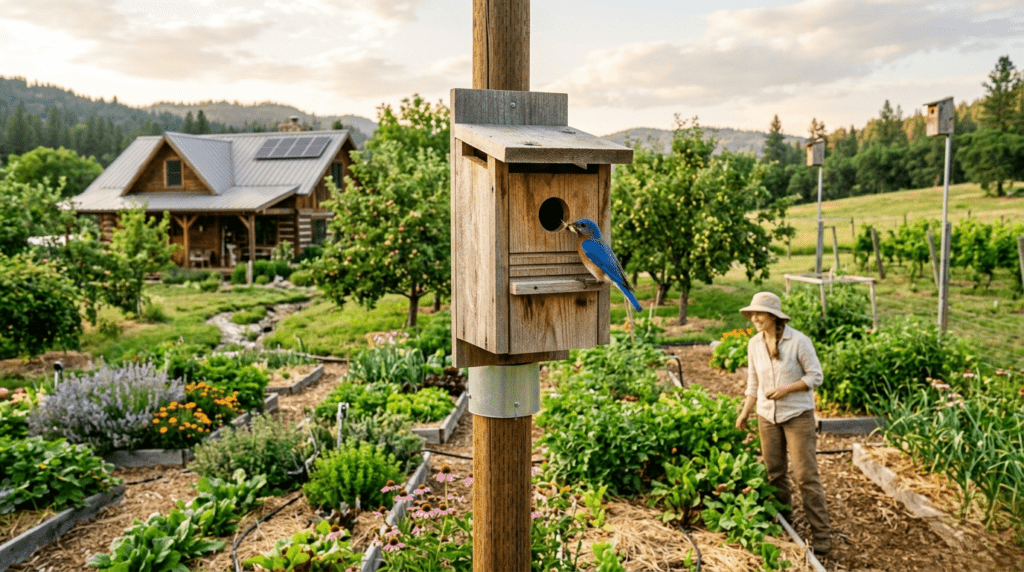
The Conduit Pole Solution: The safest approach is to mount your boxes to lengths of heavy-duty 1-inch metal electrical conduit (EMT) poles or sturdy steel T-posts. Drive the poles deep into the ground using a post driver until they are perfectly rigid. Mount the boxes at a height appropriate for the species (typically 4 to 6 feet for bluebirds and small insectivores to allow easy human monitoring and maintenance).
Step 3: Implement Heavy-Duty Baffles and Predator Guards
In a permaculture system, we want to maximize life, not create a vulnerable trap for native wildlife. To stop climbing predators completely, every single isolated pole mount must feature a dedicated predator guard.
-
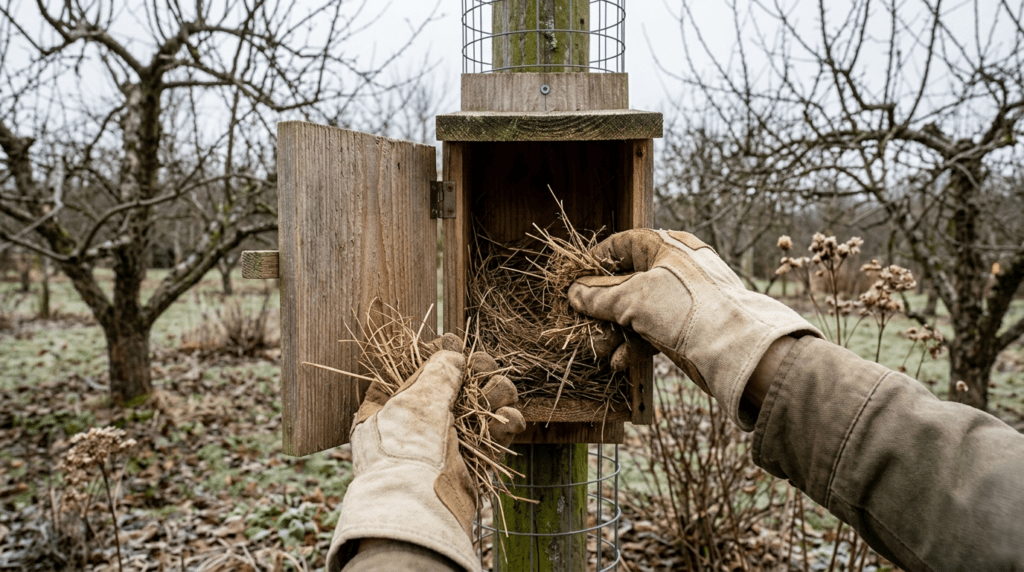
The Stovepipe Baffle: Install a 24-to-36-inch length of 6-inch-diameter galvanized metal stovepipe nesting directly over the conduit pole, positioned right below the base of the box. Cap the top of the stovepipe with a circular metal end-cap containing a center hole sized exactly to your pole. Crucially, support the baffle from the inside using a hose clamp or bracket, allowing the metal pipe to hang loosely and wobble freely. When a raccoon, feral cat, or snake tries to climb the pole, their weight shifts the loose baffle, completely cutting off their footing and stopping them from advancing upward.
Step 4: Pair with Supporting Native Flora
Nesting boxes do not work in isolation; they reach peak efficiency when supported by a diverse polyculture. Plant diverse, multi-tiered native insectary strips, hedgerows, and support plants nearby. By incorporating native berry-producing shrubs—such as Elderberry (Sambucus), Serviceberry (Amelanchier), and Winterberry (Ilex verticillata)—along your boundaries, you provide vital alternative food resources for your avian partners during early spring and late autumn when insect populations are low. This keeps your biological security team firmly stationed on your land year-round.
Troubleshooting, Management, and Regenerative Maintenance Cycles
A true professional understands that an agricultural ecosystem requires ongoing observation and adaptive management. Installing a nesting box is not a “set-it-and-forget-it” project; unmanaged boxes can quickly degenerate into breeding grounds for disease, parasites, and invasive species.
The Annual Cleaning Protocol
To preserve the long-term health of your beneficial avian populations, you must establish a rhythmic maintenance schedule. Wild birds accumulate external parasites, including blowfly larvae (Protocalliphora), mites, ticks, and fleas, within their nesting materials. In an unmanaged natural cavity, these parasites overwinter in the organic debris and emerge in spring to feed on the next generation of vulnerable nestlings, often causing severe anemia or death.
-
Timing the Clean-Out: The optimal window for box maintenance is late winter (January to February across most of the US and global temperate zones), well before migratory birds return to establish spring territories.
-
The Sanitation Process: Wear thick gloves and a dust mask to avoid inhaling airborne pathogens. Open the side or front access panel (a foundational requirement of any good box design) and pull out the old nest completely. Dispose of it far away from the box or compost it deeply.
-
Safe Disinfection: Use a stiff-bristled brush to scrape away dried feces and mud. Scrub the interior walls with a simple solution of water and natural, unscented castile soap, or a 10% solution of white vinegar. Avoid commercial chemical disinfectants or bleach, as their residual fumes can damage the highly sensitive respiratory systems of avian young. Leave the box open to air-dry completely under the sun for 24 hours before closing and locking the access panel.
Managing Invasive and Non-Native Competitors
When deploying nesting boxes globally—especially within the United States—you will inevitably encounter aggressive competition from non-native, invasive bird species. The two primary culprits are the House Sparrow (Passer domesticus) and the European Starling (Sturnus vulgaris). Both species were introduced to North America from Europe and are highly aggressive cavity nesters that will routinely kill native brooding mothers, smash their eggs, and displace your local biological control agents.
-
Exclusion by Design: The most effective defense is architectural prevention. As established, keeping your entry hole diameter strictly at 1.5 inches permanently bars the larger European Starling from entering bluebird boxes.
-
Combating House Sparrows: House Sparrows are smaller and can easily fit into bluebird-sized holes. If a pair begins building a nest (identifiable by a messy, chaotic jumble of straw, grass, and trash extending all the way to the top of the box), you must act decisively. Under US federal law (the Migratory Bird Treaty Act), native birds, their nests, and eggs are strictly protected; however, invasive non-native species are not protected. You can legally and repeatedly remove House Sparrow nesting material every few days. Eventually, the pair will tire of the energy expenditure and abandon the site.
-
The “Pairing” Strategy for Swallows and Bluebirds: Sometimes, native species like Tree Swallows will compete with Eastern Bluebirds for the same box. Because both are incredibly valuable insectivores, you do not want to discourage either. Solve this by installing paired boxes—placing two identical nesting boxes a mere 10 to 15 feet apart. Tree Swallows are highly territorial against their own species, but will happily tolerate a bluebird neighbor. Once a swallow pair claims one box, they will aggressively defend the immediate 15-foot airspace from other swallows, leaving the adjacent box completely open and safe for a bluebird family.
Managing Invertebrate Invaders (Wasps and Paper Wasps)
Paper wasps and mud daubers frequently view the dry, sheltered overhangs of a nesting box roof as prime real estate for building their combs. If a wasp colony establishes itself early in the spring, wild birds will completely abandon the box to avoid being stung.
-
The Permaculture Trick: Do not use chemical wasp sprays or pesticide strips, which leave deadly chemical residues inside the chamber. Instead, during your late winter clean-out, take a simple bar of unscented, raw bar soap or paraffin wax and rub it heavily across the interior ceiling of the nesting box roof. This leaves a slick, invisible, waxen film. When a queen wasp attempts to attach her initial paper or mud foundation to the wood, the adhesive fails to stick to the soapy residue, causing the primitive comb to drop off. The queen will quickly give up and relocate elsewhere, leaving the box safe for avian occupancy.
Case Study & Expert Insight: The Tangible ROI of Avian Biological Control
To truly appreciate the value of placing nesting boxes under permaculture principles, look at the concrete data coming out of advanced agroecological research stations and commercial organic farms worldwide.
The Napa Valley Vineyard Case Study
In the world-class wine-growing regions of California, USA, vineyard managers face massive economic threats from field mice, voles, and pocket gophers, which gnaw on the roots and bark of premium grapevines, killing mature plants and destroying expensive drip-irrigation lines. Traditionally, vineyards used highly toxic chemical rodenticides to manage these populations. However, these poisons cause secondary poisoning, killing the very hawks and owls that hunt the fields.
By transitioning to permaculture principles, a network of forward-thinking vineyards installed a dense grid of Barn Owl nesting boxes at a density of roughly one box per 10 to 20 acres.
-
The Biological Impact: Research tracked by university extension offices revealed that a single family of Barn Owls (two adults and an average of four to five chicks) consumes roughly 1,000 to 3,000 rodents over the course of a single 10-week breeding cycle.
-
The Financial Return: Across a 100-acre vineyard matrix, a functional owl box network successfully eliminated the need for commercial trapping and chemical baits entirely. This saved estate managers upwards of $1,500 to $3,000 annually in direct material and labor inputs, while simultaneously earning their crops premium organic and sustainable certification points.
The Michigan Apple Orchard Assessment
In similar long-term agricultural studies across the American Midwest, researchers monitored the impact of placing American Kestrel boxes along the borders of commercial apple orchards. Kestrels are small, voracious falcons that hunt during the day.
The studies proved that the presence of active kestrel boxes significantly reduced fruit damage caused by both small rodents and fruit-eating pest birds (like European Starlings). The kestrels’ presence created a localized “landscape of fear,” deterring pest flocks from settling in the orchard canopy, resulting in significantly higher pack-out yields of unblemished fruit at harvest time.
Frequently Asked Questions (FAQ)
Q: Can I place multiple nesting boxes close together to maximize my bird population?
A: Generally, no. Most native cavity-nesting birds are fiercely territorial during the breeding season and will fight to the death to protect their hunting domain from members of their own species. For bluebirds, you must maintain a absolute minimum distance of 100 yards (300 feet) between individual boxes. The sole exceptions to this rule are colonial nesters, such as Purple Martins or insectivorous bats, which thrive in high-density, multi-room complexes.
Q: Do nesting boxes attract mites and ticks that will spread to my chickens or livestock?
A: While wild birds do carry species-specific mites, these parasites are highly specialized to their unique hosts and generally cannot survive long or reproduce on mammalian livestock or domesticated poultry. By following the late-winter cleaning protocol and keeping boxes positioned on dedicated poles away from your immediate chicken coops, the risk of cross-contamination is virtually zero. The net benefit of the birds consuming thousands of ticks, flies, and livestock pests far outweighs any minimal parasite risk.
Q: How long does it take for a newly installed nesting box to be occupied?
A: If a box is installed in late autumn or mid-winter, it has the highest chance of immediate occupancy during the following spring, as local birds spot the structures while searching for overwinter shelter or early breeding territories. If you install a box in late spring, it may remain empty for the remainder of that season. However, do not be discouraged; wild birds observe their environment continuously, and an empty box this year is highly likely to be claimed the following spring once it has weathered naturally into the landscape.
Q: Should I put birdseed or food inside or near the nesting boxes?
A: Absolutely not. This is a common and dangerous beginner mistake. Placing artificial food sources (like seed mixes or suet) directly near a nesting box attracts non-target foraging animals, including raccoons, mice, rats, starlings, and house sparrows. This concentrates predatory pressure and competitive conflict right at the doorstep of your brooding native birds. Let the nesting box remain a quiet, hidden sanctuary; your birds will easily find their own food by hunting the abundant insect populations living naturally throughout your permaculture zones.
Conclusion: Designing for the Long Game
Integrating nesting boxes under permaculture principles is much more than a weekend crafting project; it is a profound declaration of partnership with the natural world. It requires you to shift your perspective from short-term, reactionary intervention to long-term, proactive ecosystem design.
By treating your farm, homestead, or garden as an interconnected web of living energy, you transform potential agricultural vulnerabilities into self-stabilizing strengths. A well-placed kestrel box on a pasture edge, a carefully oriented bluebird box in an orchard canopy, and a soap-treated wren house in a kitchen garden altogether form an invisible, highly efficient ecological shield.