Fish farming can be a powerful opportunity—or a costly mistake—depending on why you start.
Every year, thousands of farmers, homesteaders, and backyard growers rush into aquaculture without clearly defining their goal. Some expect fast income and end up overwhelmed by costs. Others simply want healthy food for their family but unknowingly adopt commercial systems that demand more time, money, and stress than necessary.
This is where the critical distinction lies: Raising Fish for Profit vs Personal Use is not just a difference in scale—it’s a difference in mindset, management, investment, and long-term outcomes.
If you are considering fish farming to make money, improve household food security, or decide which path suits your land, budget, and lifestyle, this guide is designed for you. Drawing from real-world aquaculture practices, agricultural extension principles, and proven fish production models, this article will help you make an informed, practical, and sustainable decision—before you invest a single dollar.
Understanding the Core Differences Between Raising Fish for Profit and Personal Use
Before choosing a system, species, or stocking density, you must understand what truly separates profit-driven fish farming from personal-use aquaculture.
What Does Raising Fish for Profit Really Mean?
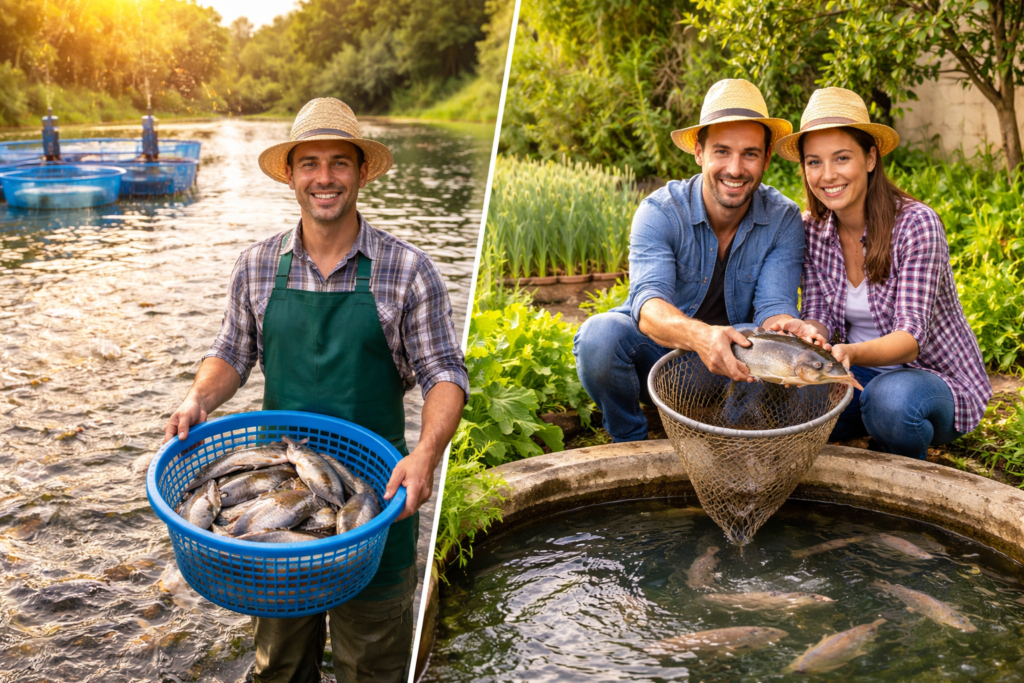
Raising fish for profit is a commercial activity. The primary goal is to produce fish efficiently, consistently, and at a volume that generates income after expenses.
Key characteristics include:
-
Production focused on market demand, not personal preference
-
Emphasis on fast growth rates, feed efficiency, and survival
-
Structured operations with predictable harvest cycles
-
Financial planning, record-keeping, and cost control
-
Compliance with regulations, permits, and biosecurity rules
Commercial fish farming treats fish as a business asset, not just food.
What Is Fish Farming for Personal Use?
Fish farming for personal use—often called subsistence or household aquaculture—is centered on self-sufficiency, not revenue.
Its defining features include:
-
Smaller production volumes
-
Flexible timelines (no pressure to harvest fast)
-
Focus on food quality, taste, and safety
-
Lower stocking density and reduced risk
-
Minimal regulatory burden in most regions
Here, fish are a nutritional resource rather than a commercial product.
Who Is This Guide For? (Search Intent Breakdown)
This article is designed to answer one core question:
“Should I raise fish for profit or personal use—and which option is right for me?”
It is especially helpful for:
-
Small-scale farmers exploring fish farming as a side income
-
Backyard growers seeking affordable protein sources
-
Beginners confused by conflicting aquaculture advice
-
Rural households with access to land and water
-
Urban or peri-urban growers considering tanks or aquaponics
If you want clarity before committing time and capital, you’re in the right place.
Key Decision Factors: Profit vs Personal Use Fish Farming
Initial Investment and Startup Costs
One of the biggest differences between raising fish for profit vs personal use is startup cost.
Commercial Fish Farming Costs
Profit-oriented fish farming often requires:
-
Larger ponds or multiple tanks
-
High-quality fingerlings in bulk
-
Aeration systems and water pumps
-
Harvesting and storage equipment
Startup costs can range from moderate to very high, depending on scale.
Personal Fish Farming Costs
Personal-use systems are typically:
-
Smaller ponds, tanks, or barrels
-
Lower stocking density
-
Simpler feeding and aeration needs
Many families start with minimal investment, especially when using existing water sources or repurposed containers.
Expert insight:
Most financial losses in fish farming occur when beginners invest in commercial-scale systems without commercial-level planning.
Operational Complexity and Daily Management
Managing Fish for Profit
Commercial fish farming demands:
-
Strict feeding schedules
-
Frequent water quality testing
-
Disease monitoring and treatment
-
Growth tracking and grading
Missed feedings or poor water quality can quickly translate into financial loss.
Managing Fish for Personal Use
Personal systems are more forgiving:
-
Lower feeding pressure
-
More stable water conditions
-
Less disease risk due to low density
This makes personal fish farming ideal for beginners or part-time farmers.
Time Commitment and Lifestyle Impact
If time is limited, this factor alone may decide your path.
-
Profit farming often feels like a job or business
-
Personal farming feels like a lifestyle addition
Commercial systems require daily attention, while personal systems can often be managed alongside other activities.
Profit Potential: Is Commercial Fish Farming Worth It?
Revenue Streams in Profit-Oriented Fish Farming
Commercial fish farmers generate income through:
-
Sale of live fish
-
Sale of processed fish (smoked, filleted, frozen)
-
Fingerling production for other farmers
Profitability depends heavily on market access, not just production volume.
Cost vs Return Analysis
Major cost drivers include:
-
Feed (often 50–70% of operating costs)
-
Fingerlings
-
Labor
-
Water and energy
Without careful planning, profit margins can be thin.
Real-world reality:
Fish farming is profitable only when production efficiency and market timing align.
Common Financial Mistakes Beginners Make
-
Overstocking ponds
-
Buying cheap, poor-quality fingerlings
-
Ignoring local market prices
-
Underestimating feed costs
These mistakes are far more damaging in profit-focused systems.
Personal Fish Farming Benefits Beyond Money
Food Security and Nutritional Advantages
One of the strongest arguments for personal-use fish farming is reliable access to fresh protein.
Benefits include:
-
Control over feed and medication
-
Higher nutritional quality
-
Reduced dependency on market prices
For many households, this alone justifies the effort.
Sustainability and Environmental Benefits
Personal systems often:
-
Use less water
-
Produce less waste
-
Integrate well with crop farming
Aquaponics systems are especially popular for this reason.
Stress Reduction and Family Involvement
Unlike commercial farming, personal fish farming:
-
Has no sales pressure
-
Encourages learning and experimentation
-
Involves family members in food production
This makes it emotionally rewarding as well as practical.
Species Selection: Choosing the Right Fish for Your Goal
Best Fish Species for Profit-Oriented Farming
Commercial farmers prioritize species that:
-
Grow fast
-
Convert feed efficiently
-
Have strong market demand
Common examples:
-
Tilapia
-
Catfish
-
Carp
Species choice should always match local climate and market preference.
Best Fish Species for Personal Consumption
For personal use, priorities shift to:
-
Hardiness
-
Taste
Tilapia and catfish are also popular here, but at much lower densities.
System Types: Matching Infrastructure to Your Purpose
Pond Fish Farming
-
Ideal for rural areas
-
Lower energy costs
-
Suitable for both profit and personal use
However, commercial ponds require precise management.
Tank and Recirculating Systems (RAS)
-
Best for limited space
-
High control, higher cost
-
Often better suited for personal use or niche markets
Cage and Integrated Systems
-
Useful near natural water bodies
-
Often regulated
-
Riskier for beginners
Legal, Regulatory, and Biosecurity Considerations
Commercial fish farming may require:
-
Licenses or permits
-
Environmental compliance
-
Disease reporting
Personal fish farming usually faces fewer legal barriers but still requires responsible practices.
Risk Assessment: What Can Go Wrong?
Environmental Risks
-
Water shortages
-
Flooding
-
Pollution
Market Risks (Profit Farming)
-
Price drops
-
Oversupply
Risk Mitigation
-
Start small
-
Diversify production
-
Learn locally
Profit vs Personal Use: Side-by-Side Comparison
| Factor | Profit Farming | Personal Use |
|---|---|---|
| Startup Cost | High | Low |
| Time Demand | High | Low–Moderate |
| Risk Level | High | Low |
| Stress | High | Low |
| Goal | Income | Food Security |
How to Decide: A Practical Decision Framework
Ask yourself:
-
Do I want income or food?
-
Can I commit daily time?
-
Do I have market access?
Your honest answers will guide you.
Expert Tips for Success in Either Path
-
Start small
-
Keep records
-
Learn from local farmers
-
Invest in quality inputs
Common Myths About Raising Fish for Profit vs Personal Use
-
“Fish farming is easy money”
-
“Personal systems don’t require skill”
-
“Bigger ponds guarantee profit”
All are false.
Frequently Asked Questions (FAQ)
Can I switch from personal to commercial later?
Yes—many successful farmers do.
Is fish farming profitable for beginners?
Only with proper planning and realistic expectations.
How long does it take to harvest fish?
Typically 4–8 months, depending on species and system.
Conclusion: Choosing the Right Path for Long-Term Success
The debate between raising fish for profit vs personal use is not about which is better—it’s about which is right for you.
Profit farming rewards planning and discipline.
Personal fish farming rewards patience and sustainability.
When your goals align with your system, fish farming becomes not just productive—but fulfilling.