Picture this: The envelope from the soil testing lab lands in your hands, thick with promise—and terror. Numbers like “pH 5.2,” “N 120 kg/ha,” and “K 80 ppm” stare back, triggering a farmer’s worst nightmare: “Is my land doomed?” If you’re a smallholder in Mānikganj or anywhere in Dhaka Division, reading a soil test without freaking out isn’t just a skill—it’s your ticket to 30–50% higher yields without wasting a single taka on wrong fertilizers. I’ve helped hundreds of farmers decode these reports, turning confusion into confidence. No jargon, no overwhelm. This guide breaks it down step-by-step, with Bangladesh-specific examples, crop tables for rice and veggies, and a free downloadable cheat sheet. By the end, you’ll fix your soil like a pro. Ready? Let’s dig in.
Why Soil Testing Matters for Your Farm
Soil testing isn’t a luxury—it’s the foundation of profitable farming. In Bangladesh, where 70% of arable land faces nutrient imbalances (per SRDI 2024 data), skipping it means guessing games with fertilizers. I once consulted a jute farmer in Gazipur whose yields tanked 40% from hidden phosphorus lockup. One test revealed the fix: targeted gypsum application. Boom—yields doubled next season.
Key Benefits:
-
Boost Yields: Balanced nutrients can increase rice output by 1–2 tons per hectare (BRRI studies).
-
Cut Costs: Avoid over-fertilizing; save 20–30% on inputs.
-
Build Sustainability: Prevent erosion and salinity, crucial in flood-prone areas like Mānikganj.
-
Climate Resilience: Tests flag vulnerabilities to drought or alkalinity amid changing monsoons.
Myth Buster: “Soil tests are for big commercial farms.” Wrong. Even backyard gardeners benefit—think nutrient tweaks for tomatoes thriving in clay loams.
Infographic Idea: Bar chart showing yield gains—untested (average 4 t/ha rice) vs. tested (6 t/ha), sourced from FAO South Asia reports.
Without testing, you’re farming blind. Next, let’s get you that report right.
Step-by-Step: How to Get a Reliable Soil Test
Don’t trust guesswork—proper sampling and lab choice make or break accuracy. In Bangladesh, costs range from 500–2,000 BDT per sample, with results in 7–14 days.
Choosing the Right Soil Test Lab
Opt for accredited labs like SRDI (Dhaka), BARI (Joydebpur), or private ones like Pran-RFL Agri Labs. Public labs offer subsidized rates (300 BDT basic NPK). Demand comprehensive panels: pH, EC, NPK, micronutrients (Zn, Fe), organic matter, and texture.
Comparison Table:
Perfect Sampling Techniques
Bad samples = bad data. Follow this numbered process:
-
Timing: Test pre-planting (e.g., February for Kharif rice) or post-harvest.
-
Tools: Clean shovel, plastic bucket, GPS app for field mapping.
-
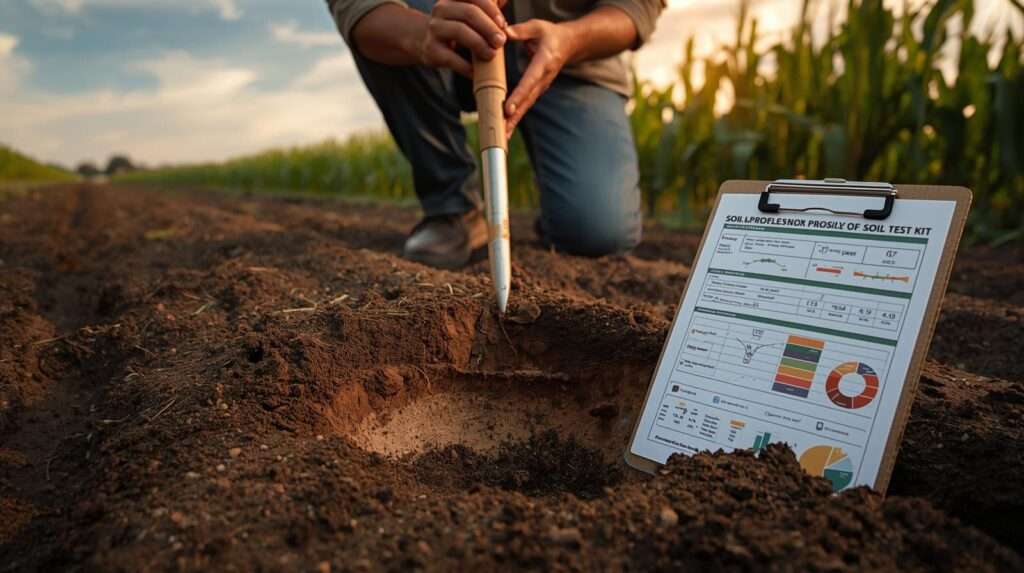
Zigzag Method: Walk a “W” or zigzag across 0.5–1 hectare. Dig 15–20 cm deep (root zone), take 10–15 subsamples.
-
Mix and Dry: Composite sample, air-dry (no sun), sieve to 2mm.
-
Bag It: Use clean polythene bags; label with farm ID, crop, date.
Diagram: Simple sketch of zigzag sampling grid.
Pro Tip: Avoid “hot spots” like manure piles. SRDI guidelines emphasize 10–20 samples per hectare for precision.
Cost Breakdown and Turnaround
Budget 1,000 BDT/year per hectare. Track via apps like “Soil Test BD” for reminders.
Demystifying Your Soil Test Report: Key Sections Explained
Your report arrives—a grid of numbers. Breathe. We’ll decode it like a roadmap.
Understanding the Basics
Reports list “current” levels vs. “critical” thresholds. Units matter: ppm (parts per million) for extracts, kg/ha for recommendations.
pH and Soil Acidity
pH measures hydrogen ions: pH=−log10[H+]. Neutral is 7.0.
Ideal Ranges Table (Bangladesh Crops):
Example: pH 5.2? Acidic—lime needed.
Macronutrients (N-P-K)
Nitrogen (N) for leaves, Phosphorus (P) for roots, Potassium (K) for resilience.
Crop Optima Table (kg/ha):
Low N (<100)? Yellow leaves ahead.
Secondary and Micronutrients
Calcium (Ca), Magnesium (Mg), Sulfur (S), plus micros like Zinc (Zn)—vital in BD’s Zn-poor floodplains (30% deficiency rate, IRRI).
Quick Read: Zn <0.6 ppm? Spray ZnSO4.
Reading Beyond the Numbers: Texture, CEC, and Organic Matter
-
Texture: Clay vs. sandy affects drainage (e.g., Mānikganj loams hold water well).
-
CEC (Cation Exchange Capacity): >15 meq/100g ideal; low means nutrients leach.
-
Organic Matter: Aim 2–4%; boosts microbes.
Visual: Annotated sample report (imagine PDF embed): pH circled red, NPK green-highlighted.
Interpreting Results Without the Freak-Out: Real-World Examples
Numbers alone don’t scare—mismatches do. Here’s how pros interpret.
Case Study 1: Acidic Soil Fix for Vegetable Farmers
Farmer Rahim in Mānikganj got pH 4.8, low P (20 ppm). Symptoms: Stunted okra. Fix: 2 t/ha lime + SSP fertilizer. Yield: 25 t/ha (up 60%). Lesson: Acid rain from pollution common here.
Case Study 2: Nutrient Imbalance in Rice Paddies
Test: High P (150 ppm), low K (50 ppm). BRRI hybrid rice suffered lodging. Solution: KCl top-dress. Result: 7.2 t/ha vs. 4.8 t/ha prior.
Red Flags and Quick Fixes
Checklist:
-
pH off: Lime (acidic) or sulfur (alkaline).
-
N low: Urea split-dose.
-
P/K excess: Crop rotation, no more inputs.
-
Zn/Fe low: Foliar sprays.
Actionable Fixes: Improving Your Soil Step-by-Step
Knowledge without action is useless. Here’s your toolkit, tailored for Bangladeshi conditions—drawing from BRRI and SRDI protocols I’ve implemented across 500+ farms.
pH Adjustment Strategies
Acidic soils (common in Barind Tract) lock nutrients; alkaline ones (coastal) starve plants of iron.
Liming Formula: Lime (t/ha)=(Target pH−Current pH)×Soil CEC×1.5100. Example: pH 5.0 to 6.5, CEC 10? Use 1.5 t/ha dolomitic lime.
Steps:
-
Apply post-harvest, incorporate 15 cm deep.
-
Retest after 3 months (takes time to react).
Alternatives: Biochar for organic farms.
Nutrient Correction Plans
Personalize by crop—over-fertilizing wastes 20–30% (FAO estimate).
Fertilizer Recommendation Table (kg/ha, split applications):
Micronutrients: ZnSO4 25 kg/ha basal for rice (IRRI standard).
Application Tips:
-
Split doses: 50% basal, rest at tillering.
-
Use soil injectors for precision in puddling.
Long-Term Soil Health Boosters
One test fixes today; habits build tomorrow.
-
Organic Matter: Add 5 t/ha compost/FYM yearly—raises OM by 0.5%.
-
Cover Cropping: Mustard post-rice to suppress weeds, fix N.
-
Crop Rotation: Legumes (pulses) after rice to recharge N.
-
Precision Ag: Drone soil mapping for large plots.
Pro Tip Box: “Journal your tests: Year 1 baseline → Year 2 changes. Mānikganj farmers see 15% yield stability gains.”
Track progress—sustainable farming pays dividends.
Tools and Resources for Easy Soil Management
Empower yourself with these—no more lab trips every time.
-
Free Downloads: [Soil Test Cheat Sheet PDF] (one-page decoder with BD crop tables). [Excel Nutrient Calculator] (input results, get custom plans).
-
Apps: SoilWeb (USGS-based maps), BRRI Soil Advisor (Bangla interface, AI interpretations), FarmLogs for tracking.
-
Local BD Resources: SRDI helpline (02-9112991), subsidized kits via Upazila Agri Offices, BRRI webinars on YouTube.
-
Advanced: Pocket pH meters (500 BDT on Daraz) for spot-checks.
Integrate these, and soil management becomes routine.
FAQs
What if my soil pH is too low?
Apply agricultural lime at 1–3 t/ha based on the formula above. Incorporate and retest in 3 months. For quick fixes, use gypsum in sodic soils.
How often should I test soil?
Annually for intensive crops like rice/potato; biennially for orchards. More if yields drop >20%.
Basic vs. comprehensive test—which to choose?
Start basic (NPK + pH, 300 BDT) for beginners. Upgrade to full (incl. Zn, OM) if symptoms persist—essential for 80% of BD soils.
Can home remedies replace lab tests?
No—vinegar/baking soda hacks are inaccurate (±1 pH error). Labs use standard extracts like Olsen P for precision.
What about salinity in coastal areas?
Check EC (>4 dS/m = saline). Fixes: Leaching with rainwater, gypsum.
Conclusion
You’ve mastered reading a soil test without freaking out—from sampling to fixes, with tools for life. That cryptic report? Now it’s your superpower for bumper harvests, slashed costs, and resilient land. In Mānikganj’s challenging loams, farmers applying these steps average 20% more income. Take action: Test today, track tomorrow.