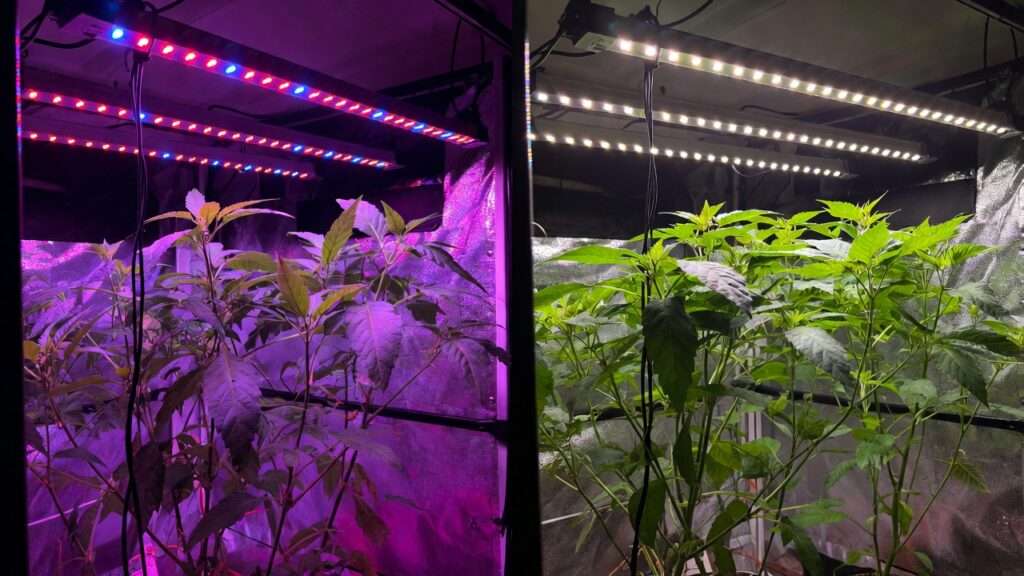
Indoor growers and commercial farmers frequently grapple with high energy costs, inconsistent plant health, and yields that fall short of expectations. The choice of LED grow light spectrum can make or break your results. Red/blue vs full-spectrum grow lights remains one of the most debated topics in modern horticulture, as growers seek the optimal balance between energy efficiency, photosynthetic performance, and overall crop quality.
Recent advancements in LED technology have shifted the landscape dramatically. While traditional red/blue (often appearing as purple or pink) lights dominated early indoor farming for their targeted efficiency, modern full-spectrum LEDs—designed to closely mimic natural sunlight—frequently deliver superior real-world outcomes in plant morphology, secondary metabolite production, flavor profiles, and marketable yields. This comprehensive guide draws from plant physiology principles, peer-reviewed studies, and practical grower experiences to provide an unbiased comparison. Whether you’re cultivating leafy greens, vegetables, herbs, cannabis, or ornamental crops in controlled environments, you’ll find clear, evidence-based insights to solve the spectrum dilemma and maximize your results.
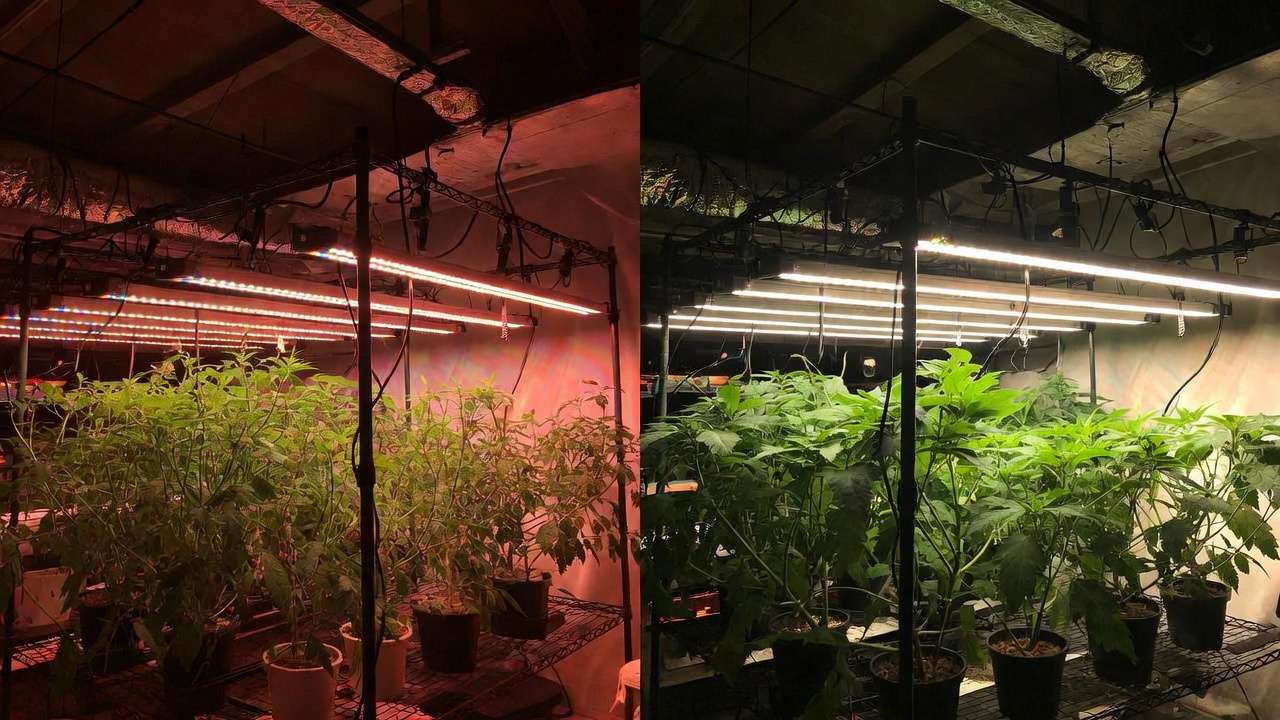
Understanding Grow Light Spectrums: The Basics
To decide between red/blue and full-spectrum grow lights, start with the fundamentals of how plants use light.
Photosynthetically Active Radiation (PAR) spans 400–700 nm, the range plants primarily use for photosynthesis. Within PAR, chlorophyll a and b absorb most strongly in the blue (around 430–450 nm) and red (around 660 nm deep red) regions. This is why early LED grow lights focused heavily on these peaks—they deliver high photosynthetic photon flux (PPF) per watt, maximizing energy-to-biomass conversion.
Blue light drives vegetative growth: it promotes compact structure, strong stems, thicker leaves, and stomatal opening for better CO₂ uptake. Excessive blue can stunt elongation, while too little leads to leggy, stretched plants.
Red light excels at driving photosynthesis and biomass accumulation, triggering flowering, fruit set, and elongation in many species. Deep red (660 nm) is particularly efficient, while far-red (700–750 nm) influences shade avoidance and flowering timing via phytochrome.
Full-spectrum grow lights incorporate a broader mix: blue and red peaks plus significant green (500–600 nm), warm white tones, and often enhanced far-red, UV-A (for stress resistance and terpenes), and sometimes UV-B. Green light penetrates deeper into dense canopies, improving lower-leaf photosynthesis, while the “white” appearance aids visual inspection for pests or deficiencies.
The key distinction: red/blue lights optimize for peak chlorophyll absorption (highest efficiency), while full-spectrum aims for holistic plant response mimicking sunlight, supporting morphology, defense compounds, and quality traits beyond raw biomass.
Red/Blue Grow Lights: Pros, Cons, and Ideal Use Cases
Red/blue LED grow lights primarily combine 450 nm blue diodes with 660 nm deep red (sometimes 630 nm broad red), resulting in the signature purple/pink glow.
How They Work These fixtures target McCree’s photosynthetic action spectrum peaks, converting electricity to usable photons with top-tier efficacy (often 2.5–3.0+ µmol/J in modern models).
Pros
- Superior energy efficiency: More PAR output per watt compared to broader-spectrum lights, lowering electricity bills—critical for large-scale or budget operations.
- Proven for targeted stages: Blue-heavy ratios excel in vegetative growth for compact, sturdy plants; red-heavy for flowering and fruiting biomass.
- Lower heat output in focused designs, easier cooling in tight spaces.
- Cost-effective for supplemental greenhouse lighting where natural sunlight fills spectral gaps.
Cons
- Limited secondary benefits: Plants may lack robust secondary metabolites (e.g., antioxidants, terpenes, flavonoids), leading to reduced flavor, aroma, nutritional density, or pest resistance.
- Poor color rendering: The purple light makes it hard to assess plant health, nutrient issues, or early pests/diseases.
- Morphology risks: Imbalanced ratios can cause stretching (low blue) or stunting (high blue).
- Less versatile across full cycles: Often requires switching fixtures or ratios between veg and flower.
Best For Budget-conscious home growers, cannabis flowering stages (high red for bud density), leafy greens in greenhouses with sunlight supplementation, and energy-focused commercial vegetable production where cost per gram matters most.
Full-Spectrum Grow Lights: Pros, Cons, and Ideal Use Cases
Full-spectrum LEDs blend white phosphor-converted diodes (often 3000K–6500K) with boosted red (660 nm), blue, and sometimes green/far-red/UV, producing a natural white or warm white light.
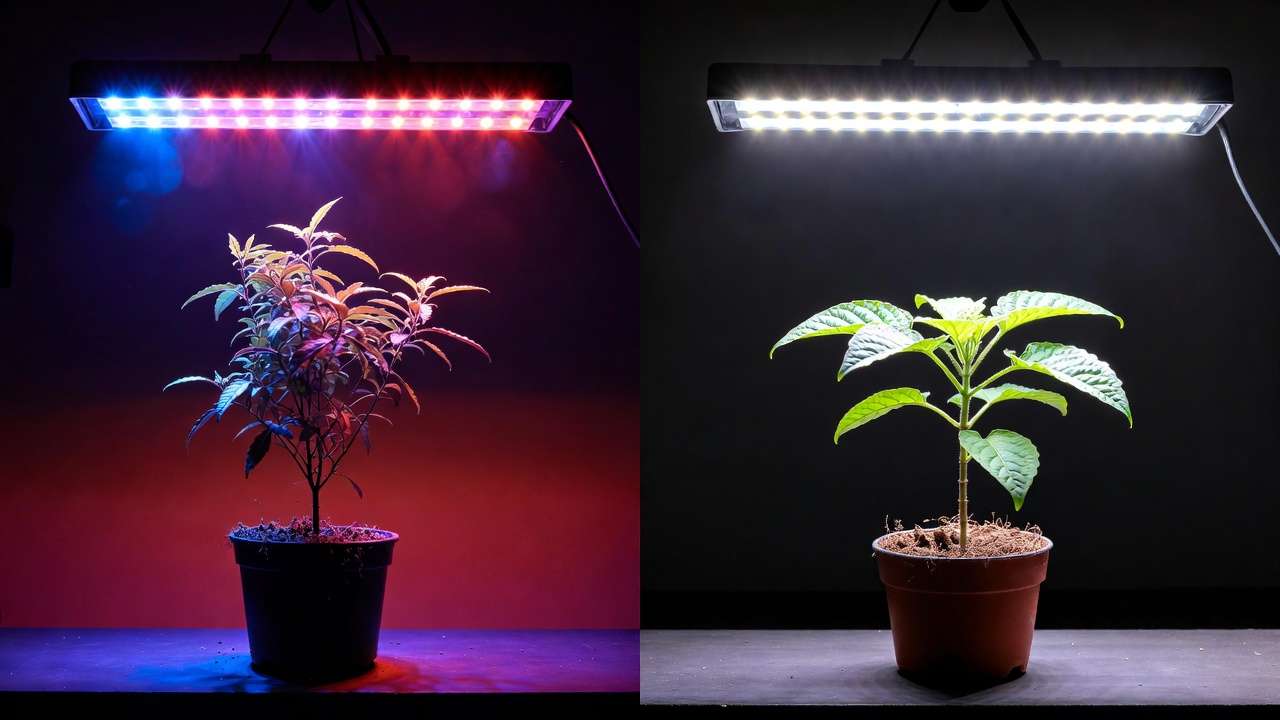
How They Work They deliver a continuous spectrum closer to sunlight, with high CRI (color rendering index) and balanced peaks. Modern diodes (e.g., Samsung LM301H or similar) achieve excellent efficacy while including “non-peak” wavelengths for deeper benefits.
Pros
- Balanced development across all stages: No need to swap lights—supports seedling to harvest seamlessly.
- Superior plant health and quality: Enhanced secondary metabolites, better color, flavor, nutrient density, and resilience (e.g., higher antioxidants in greens, improved terpene profiles in herbs/cannabis).
- Better canopy penetration: Green light reaches lower leaves, increasing overall photosynthesis in dense crops.
- Easier monitoring: Natural appearance reveals true plant color, deficiencies, or issues instantly.
- Often higher real-world yields: Studies and grower reports show 15–30%+ gains in biomass and quality over red/blue in sole-source setups.
Cons
- Slightly lower peak efficacy: Energy spent on green/other wavelengths reduces photons per watt compared to pure red/blue (though modern full-spectrum closes the gap to <10–15%).
- Higher upfront cost for premium models.
- Potential overkill for single-stage or greenhouse supplemental use.
Best For Indoor sole-source growing, vegetables/fruits/herbs needing high market quality, houseplants, cannabis for potency/flavor, and commercial ops prioritizing yield quality, uniformity, and ROI over marginal energy savings.
Head-to-Head Comparison: Key Factors
Efficiency & Energy Costs Red/blue traditionally wins on efficacy (e.g., 3.0+ µmol/J vs. 2.7–3.1 for full-spectrum), but 2025+ full-spectrum lights match or exceed in practice due to advanced diodes. For a 1000W equivalent setup, red/blue might save 10–20% on bills, but full-spectrum’s higher yields often offset this long-term.
Plant Growth & Morphology Red/blue promotes targeted biomass but risks legginess or brittleness. Full-spectrum yields compact, robust plants with stronger stems and denser foliage—ideal for vertical farming or high-density setups.
Yield & Quality Real-world data favors full-spectrum: 15–35% higher yields in crops like tomatoes, lettuce, and cannabis, plus better quality (e.g., nutrient density, aroma). Red/blue excels in raw dry weight for specific stages but lags in marketable traits.
Heat Output & Lifespan Both run cool with LEDs (50,000+ hours), but balanced full-spectrum designs often distribute heat better.
Cost Analysis (Upfront vs. Long-Term) Red/blue: Lower initial cost, faster ROI in energy-heavy scenarios. Full-spectrum: Higher upfront but superior 3–5 year ROI via yields/quality.
Crop-Specific Performance
- Leafy greens (lettuce, spinach): Full-spectrum for nutrient-rich, vibrant leaves; red/blue efficient but less flavorful.
- Tomatoes/peppers: Full-spectrum for uniform ripening, higher fruit weight.
- Cannabis: Full-spectrum for terpenes/resin; red/blue strong for flowering biomass.
- Herbs: Full-spectrum enhances essential oils
Scientific Insights & Recent Studies
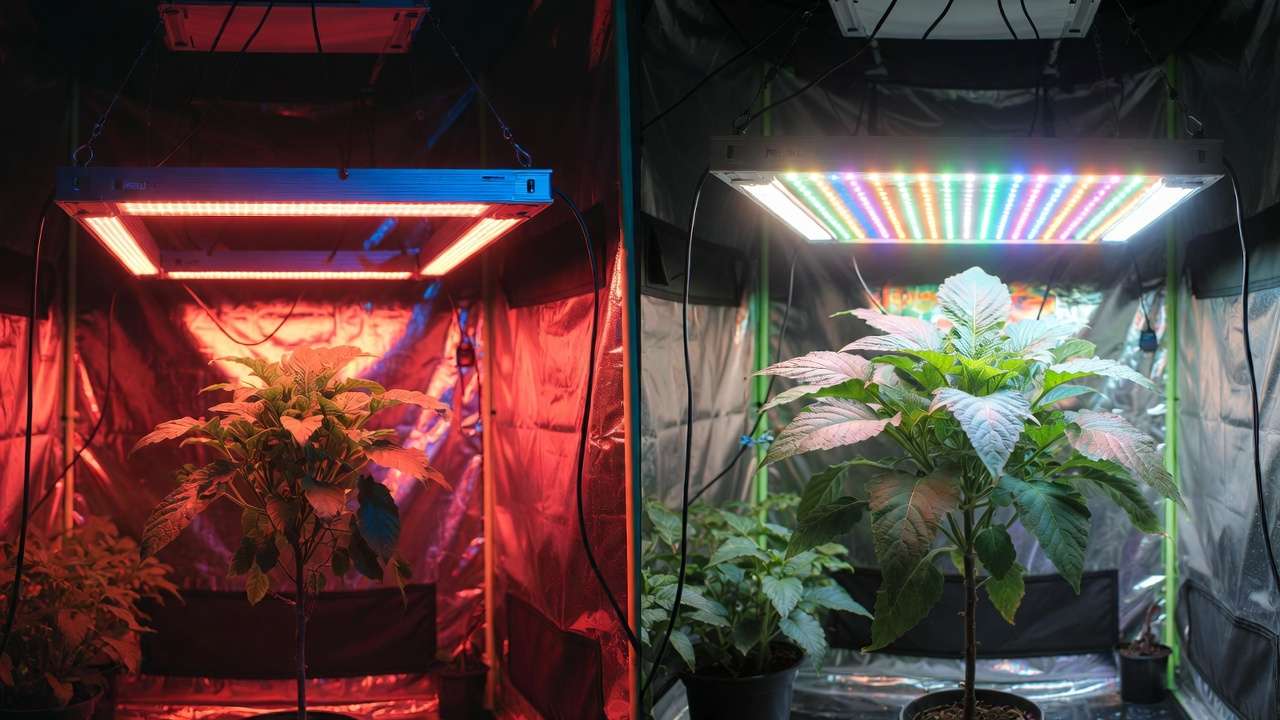
The debate between red/blue and full-spectrum grow lights is grounded in decades of plant photobiology research. Understanding the science helps explain why efficiency on paper doesn’t always translate to the best real-world performance.
The McCree curve (1972) remains the gold standard for photosynthetic efficiency, showing that plants use 400–700 nm light, with peak quantum yield in the red region (~620–680 nm) followed by blue (~400–500 nm). Green light (500–600 nm) has lower absorption by chlorophyll but still contributes significantly—especially in dense canopies—because it penetrates deeper and drives photosynthesis in lower and inner leaves.
Modern studies have expanded beyond raw photosynthesis:
- A 2021–2024 series of trials using sole-source LED lighting (published in Frontiers in Plant Science and HortScience) compared narrow-band red/blue LEDs (typically 4:1 or 5:1 red:blue ratio) against broad “sunlike” full-spectrum LEDs. Results consistently showed full-spectrum lights producing 10–35% higher fresh and dry biomass in crops such as lettuce, basil, tomato seedlings, and microgreens, even when both lights delivered identical PPFD (photosynthetic photon flux density).
- Secondary metabolite production is markedly better under full-spectrum. For example, anthocyanin (red/purple pigments in red lettuce), flavonoids, and essential oils in herbs increased 20–60% under white/full-spectrum LEDs compared to red/blue alone. This translates directly to higher nutritional value and market appeal.
- Far-red supplementation (730–740 nm), often included in modern full-spectrum designs, triggers the shade-avoidance response and can accelerate flowering in long-day plants or improve internode length in controlled environments—effects largely absent in pure red/blue setups.
- UV-A (315–400 nm), increasingly added to premium full-spectrum fixtures, enhances pest and pathogen resistance and boosts terpene/cannabinoid content in cannabis and aromatic crops.
A landmark 2023 meta-analysis of controlled-environment agriculture studies concluded that while red/blue LEDs maintain a slight edge in electrical efficiency (typically 5–15% higher PPF per watt), full-spectrum LEDs deliver superior economic yield when quality, uniformity, and secondary traits are valued—especially in sole-source indoor farming where sunlight provides no compensation.
In short: red/blue maximizes photons per dollar spent on electricity, but full-spectrum maximizes desirable plant responses per photon delivered.
Practical Recommendations: Which Should You Choose?
Choosing between red/blue and full-spectrum grow lights depends on your specific goals, crop, setup, and budget. Here’s a clear decision framework:
- Choose red/blue LEDs if:
- Your top priority is minimizing electricity costs (especially large-scale or 24/7 operation).
- You grow in a greenhouse with natural sunlight supplementation.
- You cultivate a single-stage crop (e.g., vegetative leafy greens only, or flowering cannabis only).
- Budget is tight and you accept slightly lower quality in exchange for lower operating costs.
- You already have experience adjusting light ratios and don’t mind the purple appearance.
- Choose full-spectrum LEDs if:
- You want the highest possible marketable yield, flavor, color, nutritional density, and plant uniformity.
- You run a sole-source indoor grow room, vertical farm, or home grow tent with no natural light.
- You grow multiple crops or full lifecycle plants (seedling → harvest under one fixture).
- Visual plant monitoring is important (pest scouting, deficiency diagnosis).
- Long-term ROI matters more than short-term energy savings.
Hybrid Strategy (Best of Both Worlds) Many advanced growers now use tunable or multi-channel fixtures that allow blending: full-spectrum white base + switchable/extra deep red channels. This gives flexibility—full-spectrum for vegetative and early flowering, then boost red for maximum bud/fruit swell in later stages.
2026 Buying Tips
- Look for diodes rated ≥2.7 µmol/J (Samsung LM301H EVO, Osram Oslon SSL, or equivalent).
- Prefer brands offering spectrum graphs and actual PPF measurements (avoid vague “full-spectrum” marketing claims).
- For full-spectrum, target 3000K–5000K white with enhanced 660 nm red and some far-red.
- For red/blue, seek adjustable ratios or separate veg/flower models.
How to Maximize Results Regardless of Choice
Spectrum is only one piece of the puzzle. Use these best practices to get the most from either type:
- Target correct PPFD and DLI Seedling/young veg: 100–250 µmol/m²/s Mature veg: 300–600 µmol/m²/s Flowering/fruiting: 600–1000+ µmol/m²/s Calculate Daily Light Integral (DLI = PPFD × hours × 3600 / 1,000,000) and aim for crop-specific targets (e.g., lettuce 12–17 mol/m²/day, tomatoes 20–30 mol/m²/day).
- Correct hanging distance Too close → leaf burn; too far → stretching. Follow manufacturer PAR maps and adjust weekly as plants grow.
- Photoperiod management Vegetative: 16–18 hours; Flowering (short-day crops): 12 hours. Use timers religiously.
- Avoid common spectrum mistakes
- Over-relying on blue → overly compact, stunted plants.
- Too much red without blue → excessive stretching.
- Ignoring green/far-red in dense canopies → lower overall yield.
- Monitor and log Track growth rate, internode length, leaf color, and final yield/quality. Adjust based on data, not assumptions.
FAQs
Is red/blue better than full-spectrum for beginners? No—full-spectrum is generally more forgiving and produces better-looking, healthier plants right away, making it easier for newcomers to spot and correct issues.
Do full-spectrum lights waste energy on unused wavelengths? They direct slightly less energy to peak chlorophyll absorption, but modern designs minimize this gap. The “waste” often pays off through better plant quality and higher marketable yield.
Can red/blue lights cause plant stress or color fading? Yes—prolonged imbalanced ratios can lead to phototoxicity (high blue), excessive elongation (low blue), or faded appearance in anthocyanin-rich crops.
What’s the role of green light in grow lights? Green penetrates deeper into the canopy, drives photosynthesis in shaded leaves, and improves overall light-use efficiency in dense or tall crops.
How do I measure if my light is truly full-spectrum? Request a spectral distribution graph (SPD) from the manufacturer. Look for significant output across 400–700 nm with no large gaps, plus reasonable peaks in blue and red.
Are full-spectrum lights worth the extra cost in 2026? For most indoor and quality-focused growers—yes. The yield and quality improvements typically deliver a faster ROI than the marginal energy savings of red/blue alone.
Conclusion
Red/blue vs full-spectrum grow lights boils down to a classic trade-off: raw efficiency versus comprehensive plant performance.
Red/blue LEDs remain unbeatable for minimizing energy consumption and delivering targeted biomass in specific scenarios—particularly budget-conscious or greenhouse-supplemented grows.
However, modern full-spectrum LEDs have pulled ahead in most practical applications. They produce healthier plants, superior secondary metabolites, better morphology, higher marketable yields, and easier management—often outweighing their slightly lower peak efficiency.
For the majority of serious indoor growers, commercial vegetable producers, and quality-driven cultivators in 2026, full-spectrum grow lights deliver better overall plant growth and higher yields.
The best approach? Start with a high-quality full-spectrum fixture, measure your results meticulously, and experiment if needed. Your plants—and your bottom line—will thank you.