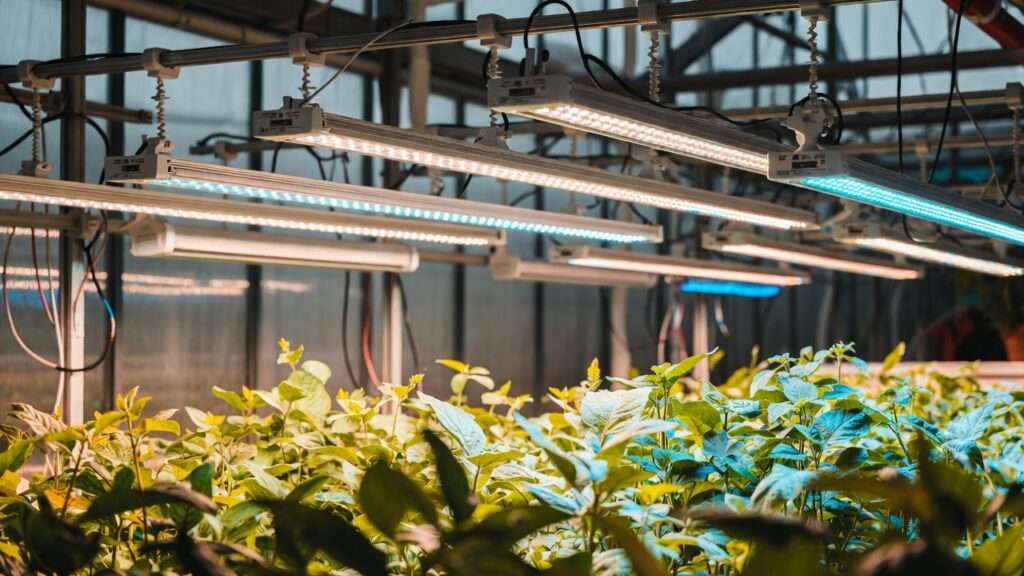
Imagine opening your electricity bill and seeing a $420 monthly charge—almost double what you paid just six months earlier—simply because you added two more grow lights to increase production. This exact scenario plays out every month for countless indoor growers raising cannabis, tomatoes, peppers, leafy greens, microgreens, and herbs. Grow lights are essential for year-round, high-quality yields, but they remain one of the largest—and fastest-growing—line items on indoor agriculture budgets. Running Grow Lights Without Exploding Your Power Bill
The good news? In 2025 and 2026, running grow lights without exploding your power bill is more achievable than ever. Electricity rates continue to climb (U.S. residential averages now hover around 17.8–18.7 cents per kWh depending on the month and region), yet rapid advances in LED technology, smarter controls, optimized scheduling, and available utility incentives have created the biggest opportunity in years to dramatically cut lighting-related costs.
Most growers who implement even 4–5 of the strategies in this guide achieve 35–65% reductions in lighting electricity use without meaningful yield penalties—and in many cases with better plant health and quality.
This comprehensive guide walks you through nine proven, field-tested methods ranked roughly by impact-to-effort ratio for 2025–2026 conditions. Whether you’re a home grower with a 4×4 tent, a small commercial vegetable operation, or a mid-scale cannabis cultivator, these tactics deliver real dollars back to your pocket.
Let’s start with the single biggest lever available today.
1. Choose Modern, High-Efficiency LED Grow Lights (The Single Biggest Lever)
If your lights still use HPS (high-pressure sodium), MH (metal halide), or even early-generation “blurple” LEDs, you’re almost certainly burning far more electricity than necessary.
Modern horticultural LEDs have made enormous strides. The key metric in 2025–2026 is photosynthetic photon efficacy (PPE), measured in μmol/J (micromoles of photosynthetically active photons per joule of electricity consumed). Higher μmol/J = more light for your plants per dollar spent on power.
Realistic efficiency tiers in today’s market:
- Entry-level full-spectrum LEDs → 2.3–2.6 μmol/J
- Mid-tier reputable horticultural brands → 2.7–3.1 μmol/J
- Top-tier bar-style / research-grade fixtures (using latest Samsung LM301H EVO, Osram, or equivalent diodes) → 3.2–3.6+ μmol/J
A practical example comparison for a typical 4×4 flowering area:
- Old 600 W HPS (≈1.7–1.9 μmol/J effective after losses) → draws ~620 W actual, delivers roughly 1,050–1,150 μmol/s PPF
- Modern 400–450 W LED at 3.1–3.3 μmol/J → draws ~430 W, delivers 1,300–1,450 μmol/s PPF
Result: 30–40% less electricity for similar or better light delivery, plus significantly less heat (reducing air conditioning load).
Quick cost math (at 18¢/kWh, 12 hours/day, 30 days):
- 600 W HPS → ≈ $38–40/month per light
- 430 W high-efficiency LED → ≈ $23–25/month per light → Savings of $180–200 per light per year, often paying back the fixture upgrade in 12–24 months.
What to look for in 2025–2026:
- PPE ≥ 2.8 μmol/J (ideally ≥ 3.0) on spec sheets or third-party tests
- Full-spectrum white + targeted red enhancement (avoid pure blurple unless extremely budget-constrained)
- Reliable brands offering 5-year warranties and actual performance data
Warning: Many ultra-cheap “1000W” Amazon/eBay lights actually draw 280–350 W and deliver poor uniformity and spectrum. Always verify actual wattage draw and PPE.
2. Right-size Your Lighting – Stop Over-Lighting Everything
Over-lighting is surprisingly common and extremely expensive.
Many growers target Daily Light Integral (DLI) levels far above what their crops actually need or can efficiently use. DLI measures total photosynthetically active radiation received per square meter per day (mol/m²/d).
2025 realistic target DLI ranges for popular indoor crops:
- Leafy greens, herbs, microgreens (vegetative) → 12–20 mol/m²/d
- Basil, lettuce, kale → 14–22 mol/m²/d
- Peppers, cucumbers (vegetative → early fruit) → 18–28 mol/m²/d
- Tomatoes (mature fruiting) → 22–35 mol/m²/d
- Cannabis (vegetative) → 20–35 mol/m²/d
- Cannabis (flowering) → 30–45 mol/m²/d (many modern strains peak economically around 35–40)
Pushing beyond a crop’s efficient DLI range often yields diminishing photosynthetic returns while electricity consumption rises linearly.
How to calculate actual delivered DLI:
- Use a decent PAR meter or quality smartphone app (Photone, PPFD apps calibrated against known sources)
- Measure average PPFD at canopy level
- Multiply average PPFD (μmol/m²/s) × hours of light × 0.0036 = DLI in mol/m²/d
Powerful insight: Dimming lights to 70–85% intensity frequently produces better economics than running at 100%. You deliver nearly the same DLI with noticeably lower wattage and heat.
Case example: A day-neutral strawberry or tomato grower reduced from 42–45 DLI to 30–34 DLI → maintained 92–97% of yield while cutting lighting electricity by ~28%.
3. Implement Lighting Schedules That Actually Match Plant Physiology
The old default of 18/6 veg and 12/12 flower wastes electricity for many crops.
Proven schedule optimizations that maintain quality:
- Vegetative stage: 15–16 hours instead of 18 → 15–17% savings, minimal growth impact for most species
- Auto-flowering cannabis: 18/6 → 20/4 or even 22/2 in some genetics (test small)
- Many herbs & leafy greens: 14–16 hours total light
- Short-day flowering herbs or certain ornamentals: 11–13 hours flower period
- Night interruption technique: 12 hours main light + 1–2 hours low-intensity night break to keep long-day plants vegetative
Biggest savings opportunity in regions with time-of-use (TOU) rates: Shift the bulk of your light hours into off-peak periods (often nights or very early mornings). Savings of 20–40% per kWh are common in many utility territories.
4. Use Lighting Controllers, Timers & Energy Management Systems
Basic timers are no longer enough in 2025.
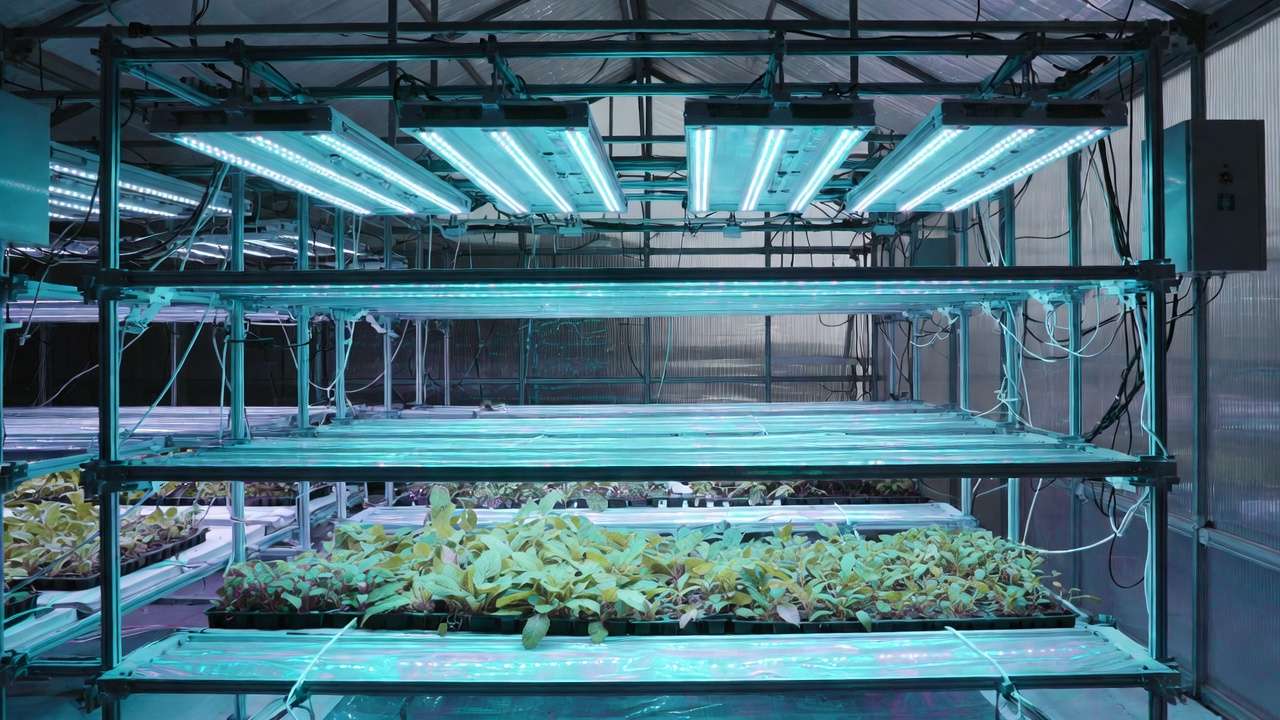
Modern controllers deliver measurable savings through:
- Sunrise/sunset ramping (10–30 minute fade-in/out) → reduces light shock and allows slightly shorter effective photoperiods
- Temperature-based dimming or shutoff → prevents lights from running full power during hot periods when plants close stomata
- Precise minute-level scheduling & grouping of zones
- Built-in power monitoring & alerts for unusual consumption spikes
Even basic digital controllers with ramping and temperature linkage typically save 5–12% compared to hard on/off timers.
Smart systems that integrate DLI accumulation, real-time PPFD feedback, and TOU rate optimization push savings higher—especially in larger or multi-room setups.
5. Optimize Light Distance, Hanging Height & Light Distribution
Poor light placement and uneven coverage can waste 20–40% of the energy you’re paying for. Even the most efficient LED fixture becomes uneconomical if half the canopy receives significantly less light than the other half.
Key physics reminder: Light intensity follows the inverse square law. Doubling the distance from the light source reduces intensity to roughly one-quarter.
Recommended hanging heights in 2025 (general guidelines – always fine-tune with a PAR meter):
- Seedling / early vegetative stage → 24–36 inches (61–91 cm)
- Mid-to-late vegetative → 18–28 inches (46–71 cm)
- Early flowering → 15–24 inches (38–61 cm)
- Peak flowering (dense canopy) → 12–20 inches (30–51 cm) for most 3.0+ μmol/J bar-style LEDs
Common mistakes that inflate power bills:
- Hanging lights too high in flowering → massive drop in PPFD and wasted electricity
- Hanging too low without dimming → leaf burn + unnecessary high wattage
- Using a single point-source light in a rectangular space → severe edge/corner drop-off
- Never adjusting height as plants grow taller
Practical fixes that improve uniformity without buying more lights:
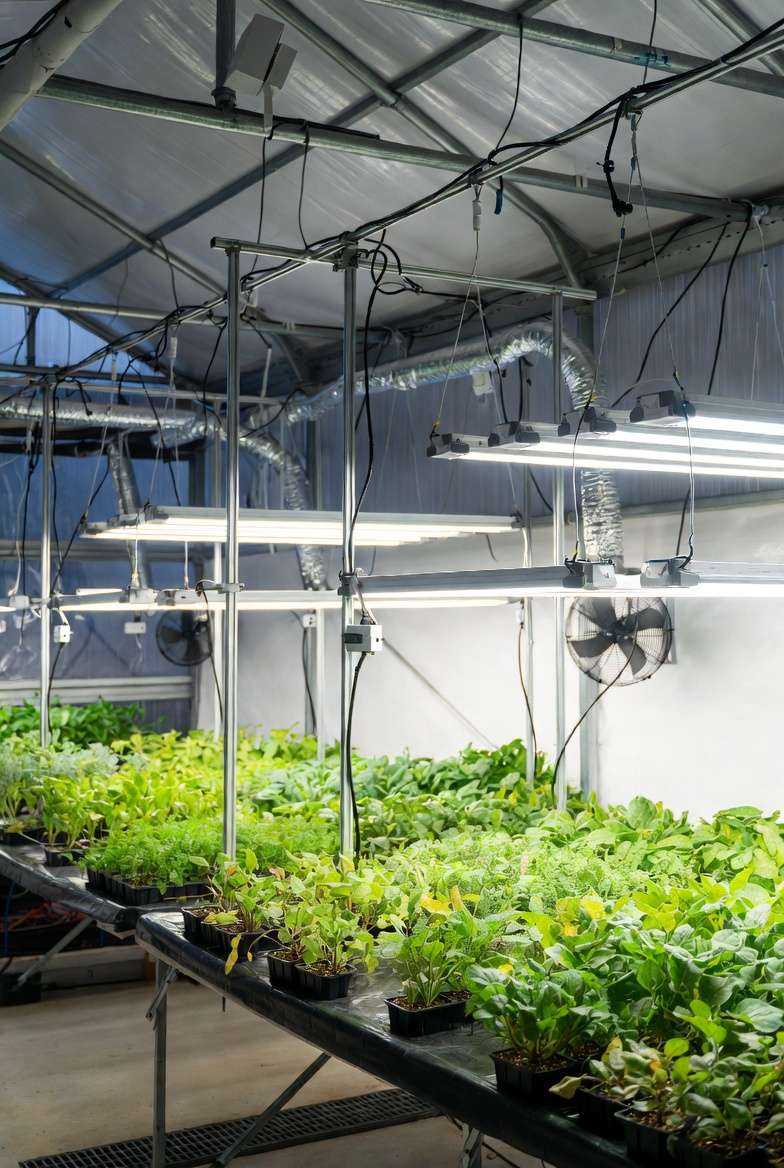
- Use bar-style or multi-bar LED layouts (far superior uniformity compared to single massive fixtures)
- Add inexpensive light movers (linear or circular) in larger rooms – still deliver 15–25% better average PPFD in many setups
- Install reflective wall materials (Mylar, white panda film, flat white paint) – can boost edge PPFD by 10–30%
- Implement side lighting or intra-canopy LEDs in dense vertical or SCROG grows (very high ROI for high-value crops)
- Map your canopy with a PAR meter grid every 2–3 weeks and adjust hanging height + dimming percentage accordingly
A grower who improved uniformity from 55% to 88% across a 5×5 flowering canopy typically sees the same yield with 18–30% less power draw.
6. Lower Temperature = Lower Electricity (Cooling is the Hidden Second Bill)
Many growers focus only on the grow light wattage and completely overlook that cooling costs often equal or exceed lighting costs in sealed or hot-climate indoor environments.
LEDs produce far less infrared heat than HPS, but the waste heat still raises room temperature—and every degree you must remove with air conditioning, exhaust fans, or chillers costs money.
Important 2025 rules of thumb:
- Every 1 °C (1.8 °F) you can raise the acceptable daytime temperature setpoint = roughly 3–7% savings on cooling electricity
- Modern full-spectrum LEDs radiate most waste heat upward through the fixture → use ducting or heat sinks to vent heat out of the room instead of letting it load the A/C
- Many cannabis and fruiting crops perform excellently at 27–29 °C (80–84 °F) lights-on with elevated CO₂ (1200–1500 ppm) → no need to fight for 24–26 °C
High-impact cooling cost reduction tactics running grow lights without exploding your power bill :
- Improve room insulation and air sealing (especially around doors, windows, duct penetrations)
- Use variable-speed EC fans instead of fixed-speed models
- Implement staged exhaust/intake instead of always-on fans
- Run main lighting hours during cooler nighttime periods when outdoor air is free cooling
- In commercial setups: consider water-cooled or air-cooled LED bars that remove heat directly at the fixture
Real-world example: A small commercial cannabis grower moved from 25 °C lights-on target to 28.5 °C + better heat extraction → reduced total HVAC electricity by 41% while maintaining yield and terpene profiles.
7. Take Advantage of Utility Rebates, Tax Credits & Net Metering (2025 Update)
In 2025–2026, many utilities and governments still offer meaningful financial incentives to switch to high-efficiency horticultural lighting.
Common active programs (check your local utility / region):
- United States — ENERGY STAR® Commercial LED incentives, DSIRE database listings, Inflation Reduction Act agricultural energy efficiency grants (still active in many states), state-specific rebates ($0.10–$0.60 per watt saved is common)
- Canada — Save on Energy (Ontario), FortisBC, BC Hydro, Hydro-Québec agricultural LED programs
- EU — Various national and regional energy efficiency subsidies under the Green Deal framework
- Australia — Small-scale Technology Certificates (STCs) for eligible upgrades, state-based programs
- Many regions — Time-of-Use (TOU) rate plans with 30–50% cheaper off-peak kWh
Quick action checklist:
- Visit your utility website → search “horticultural” / “indoor agriculture” / “LED grow light” rebate
- Check DSIRE (dsireusa.org) or equivalent national energy incentive databases
- Ask your electrician or lighting supplier for rebate paperwork support
- Document before-and-after wattage draw (photos of nameplates + kill-a-watt meter readings)
Some growers receive $800–$4,000 rebates on a 10–20 fixture upgrade, cutting payback time to 6–18 months.
8. Monitor, Measure & Benchmark Your Actual kWh per Gram or per Pound Running grow lights without exploding your power bill
You cannot improve what you do not measure.
Stop using “watts per square foot” — it’s outdated and misleading. Focus on energy per unit of yield instead.
2025 realistic efficiency benchmarks for well-run indoor operations:
- Cannabis (dried flower) → 0.8–1.4 kWh per gram (very efficient ops now hitting <1.0 kWh/g)
- Leafy greens / microgreens → 4–9 kWh per kg
- Tomatoes / peppers (fresh weight) → 6–12 kWh per kg
- Basil / herbs → 5–10 kWh per kg
Easy ways to start tracking today:
- Plug-in energy monitors (Kill-A-Watt, Emporia Vue, Sense, etc.) on each light circuit
- Whole-panel smart meters for larger grows
- Simple spreadsheet: record monthly kWh used for lighting → divide by harvested yield
Once you have baseline kWh/yield data, every efficiency improvement becomes clearly visible in dollars saved.
9. Maintenance & Upgrades That Keep Efficiency High Over Time
Even the best LED grow light loses efficiency if neglected. Real-world degradation happens faster than most growers realize.
Typical efficiency losses over time (2025 data from long-term grow journals and university trials):
- Dust buildup on diodes, lenses, and reflectors → 8–22% light output loss within 12–18 months
- Thermal paste / heatsink contamination → 5–12% extra power draw for the same light output
- Diode degradation (L90 – time to 90% of original output) → most quality fixtures reach L90 at 45,000–60,000 hours
- Wiring resistance and connector oxidation → 2–7% additional system losses in older setups
High-ROI maintenance actions (ranked by ease vs. savings):
- Clean fixtures every 3–4 months Use compressed air + isopropyl alcohol wipes on lenses and heat sinks. Expect 10–18% immediate PPFD recovery in dusty environments.
- Check and tighten all electrical connections once a year Loose MC4 connectors or terminal blocks create measurable resistance heat and power loss.
- Replace aging cooling fans proactively Most LED bar fans are rated 30,000–50,000 hours. Listen for bearing noise or reduced airflow.
- Re-lens or add secondary optics when yellowing occurs Many mid-tier fixtures allow lens replacement – restores uniformity and output.
- Upgrade reflectors / light blockers / hanging hardware Switching from old mylar to high-gain white matte surfaces or better parabolic reflectors can return 8–15% more usable light to the canopy.
A small commercial grower who implemented quarterly cleaning + annual fan replacement maintained 94–97% of original system efficacy after 26 months, compared to neighbors who saw 20–28% drop.
Comparison Table: Before vs. After Implementing the 9 Strategies Running grow lights without exploding your power bill
Example scenario: 5 ft × 5 ft flowering space, cannabis production, average U.S. residential rate ~18.5¢/kWh in 2026, 12-hour flowering cycle.
| Metric | Before (Typical 2023–2024 Setup) | After (Optimized 2026 Setup) | Improvement |
|---|---|---|---|
| Light type | 2 × 600 W HPS + older blurple LEDs | 2 × 450 W 3.2–3.4 μmol/J bar LEDs | — |
| Actual power draw (lights only) | ~1,380 W | ~920 W | –33% |
| Monthly electricity cost (lights) | $92–$98 | $61–$65 | –34% |
| Cooling / exhaust load increase | High (HPS heat) | Moderate (LED + better management) | –40–55% |
| Total monthly lighting + cooling | $165–$195 | $88–$112 | –43–48% |
| Average canopy DLI | 38–44 mol/m²/d | 34–38 mol/m²/d (optimized) | Slightly lower but more uniform |
| Yield (dry bud, grams) | 480–540 g | 465–535 g | –1–4% |
| kWh per gram | ~1.9–2.3 kWh/g | ~1.1–1.4 kWh/g | –38–42% |
| Estimated annual savings | — | $920–$1,380 | — |
Quick-Reference Cheat Sheet: Your 2026 Grow Light Cost Reduction Checklist
Print or bookmark this list – start with the top items for fastest payback.
- Upgrade to ≥3.0 μmol/J full-spectrum LEDs (biggest single saving)
- Measure current DLI → reduce to economically optimal range for your crop
- Switch to 15–16 h veg / time-shifted schedules if TOU rates apply
- Install controller with ramping + temperature dimming
- Map canopy PPFD → adjust heights and add reflectors/movers
- Raise acceptable temperature setpoint by 2–3 °C with CO₂ enrichment
- Check for utility rebates / tax credits before purchasing
- Install plug-in or circuit-level energy monitoring
- Set calendar reminders for fixture cleaning every 3 months
Frequently Asked Questions
Do I really need 3.3+ μmol/J LEDs or is 2.7–2.8 enough? If you’re already on modern LEDs, 2.7–2.9 μmol/J is still very good. The jump to 3.2–3.5 μmol/J gives the best ROI when replacing HPS or very old LEDs. For new purchases, aim for ≥3.0 whenever budget allows.
How much can I save if I’m already using decent LEDs? Growers with 2.6–2.9 μmol/J fixtures who optimize DLI, schedules, cooling, and uniformity typically save another 20–40% beyond the initial LED upgrade.
Are cheap blurple LEDs still worth using in any situation? Almost never in 2026 unless you’re on an extremely tight budget and only need supplemental light for 4–8 weeks. Their poor spectrum and efficacy make them more expensive per gram or per kg produced.
Will turning lights off earlier reduce quality / potency? For most modern cannabis strains, dropping from 18 h to 15–16 h veg or from 12 h to 11–11.5 h flower causes negligible (if any) potency loss if DLI is maintained. Always test on a small scale first.
What’s the best way to combine dimming + schedule changes? Dim first to reach target DLI, then shorten photoperiod if quality remains acceptable. Dimming usually preserves cannabinoid/terpene profiles better than大幅 shortening hours.
Are there financing options for upgrading to efficient lights? Yes – many horticultural lighting companies offer 0% interest 12–24 month financing. Some utilities and agricultural lenders also provide low-interest energy efficiency loans.
Next Steps
Running grow lights without exploding your power bill is no longer just a dream—it’s a realistic 2026 reality for almost every indoor grower willing to make strategic changes.
The biggest levers remain:
- Modern high-efficacy LEDs (3.0+ μmol/J)
- Right-sized DLI (stop over-lighting)
- Intelligent schedules + TOU shifting
- Better uniformity and cooling management
Most growers who implement 5–7 of these nine strategies see 35–65% reductions in lighting-related electricity costs, often with equal or better quality and yield. The days of accepting electricity as an uncontrollable fixed expense are over.
Your next steps:
- Measure your current baseline (monthly kWh for lights + yield per cycle)
- Pick the 2–3 highest-ROI actions from the cheat sheet that fit your budget and setup
- Track results after 60–90 days – the numbers will motivate you to keep going
Electricity efficiency is now one of the most powerful ways to improve profitability in indoor agriculture. Start today—the savings compound every single cycle.